
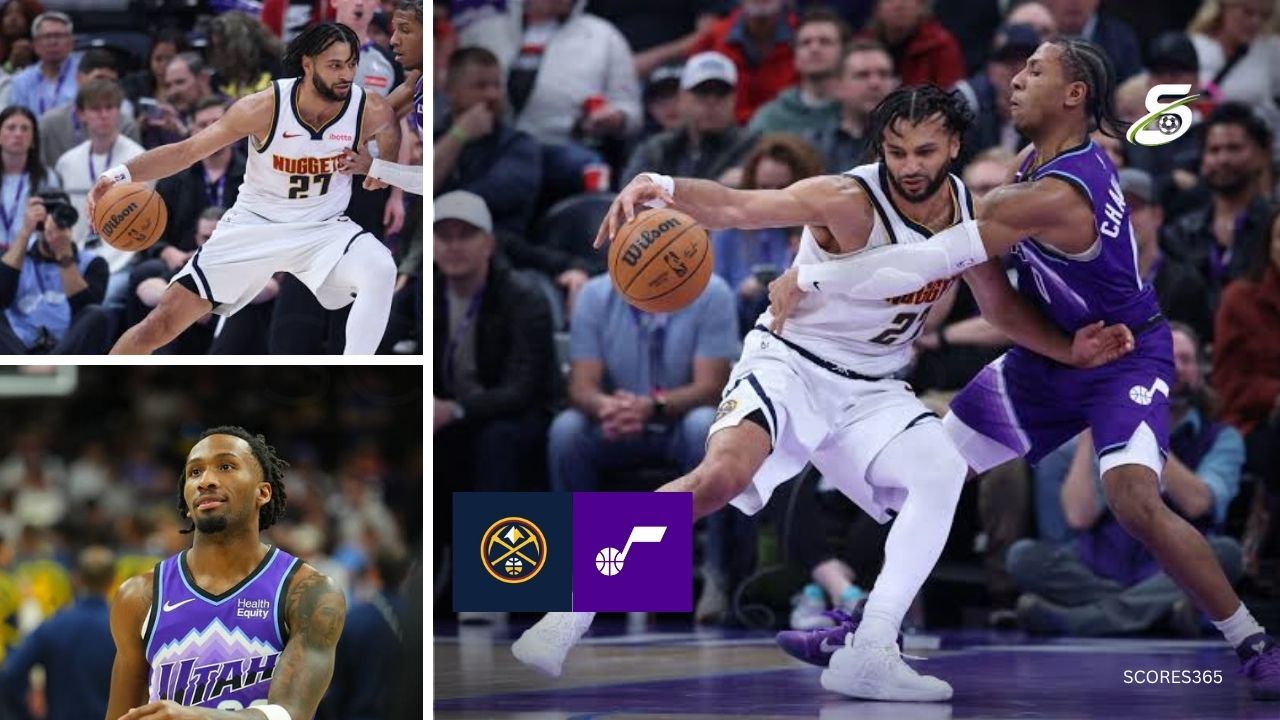
The Denver Nuggets vs Utah Jazz Match Player Stats from the NBA preseason matchup showed Denver recovering from a slow opening quarter to secure a 117-106 victory at the Delta Center in Salt Lake City. Utah started strongly and held a 31-24 lead after the first quarter, but Denver responded with a 41-point second period. The Nuggets carried that momentum through the second half and eventually created an 11-point winning margin. The official NBA record identifies the contest as a preseason game played Tuesday, October 6, 2026, with the game information also carrying an October 7 listing because of the late Eastern Time start.
Denver’s victory was built on efficient shooting, a strong second quarter and contributions from multiple players. Aaron Gordon led the Nuggets with 18 points and five rebounds, while Julian Strawther added 15 points, four rebounds and three assists. Cameron Whitmore scored 14 points, and Tyus Jones contributed 12 points and six assists. Utah received a 23-point performance from Darryn Peterson, who also recorded three rebounds and three assists. Mo Bamba added eight points and 10 rebounds, while Ace Bailey finished with 10 points and seven rebounds. The Nuggets ultimately combined better shooting with stronger scoring balance to overcome Utah’s early advantage.
Final Score and Match Details
The final score was Denver Nuggets 117, Utah Jazz 106. Utah controlled the opening period by seven points, but Denver produced its biggest offensive quarter of the night in the second, scoring 41 points compared with Utah’s 28. That 13-point swing changed the game before halftime and gave Denver a 65-59 advantage. The Nuggets then added 30 points in the third quarter while holding Utah to 22, extending the lead to 95-81. Utah improved offensively in the final period, but Denver maintained enough separation to close out the 11-point victory.
| Match Detail | Information |
|---|---|
| Teams | Denver Nuggets vs Utah Jazz |
| Competition | NBA Preseason |
| Date | October 6, 2026 |
| Game listing | October 7, 2026, 1:00 a.m. ET |
| Venue | Delta Center, Salt Lake City, Utah |
| Final Score | Denver 117, Utah 106 |
| Result | Denver Nuggets won |
The game was played at the Delta Center in Salt Lake City, and the official NBA schedule identifies it as a preseason meeting. Denver improved to 1-1 in the preseason, while Utah also moved to 1-1 following the result. Because the contest was part of the preseason schedule, the outcome did not affect regular-season standings. Instead, it provided another opportunity for both teams to evaluate rotations and individual performances. Denver’s ability to recover from the opening quarter was particularly notable because Utah had established an early offensive rhythm before the Nuggets adjusted their approach.
Quarter-by-Quarter Breakdown
Utah opened the game with a 31-24 advantage, producing the stronger offensive start. Darryn Peterson helped establish the Jazz scoring rhythm, while the home team also received contributions from Ace Bailey and Jaren Jackson Jr. Denver, meanwhile, shot efficiently enough to stay within reach but did not match Utah’s first-quarter scoring. The second quarter completely changed the contest. Denver scored 41 points, its highest-scoring period of the game, while Utah managed 28. That 41-28 quarter gave the Nuggets a six-point halftime lead after they had trailed by seven at the end of the first period.
Denver continued to control the game after halftime, winning the third quarter 30-22. That pushed the Nuggets’ lead to 14 points entering the fourth. Utah responded with 25 points in the final period and reduced the margin slightly, but Denver still scored 22 points and avoided a major late-game swing. The quarter-by-quarter progression shows that Denver’s victory was largely determined by its second- and third-quarter response. The Nuggets outscored Utah 71-50 across those two middle quarters, turning an early seven-point deficit into a comfortable advantage before the final period began.
| Quarter | Denver Nuggets | Utah Jazz |
|---|---|---|
| 1st | 24 | 31 |
| 2nd | 41 | 28 |
| 3rd | 30 | 22 |
| 4th | 22 | 25 |
| Final | 117 | 106 |
Denver Nuggets Player Stats
Aaron Gordon led Denver’s scoring with 18 points, shooting 5-of-7 from the field and 6-of-7 at the free-throw line. Julian Strawther delivered 15 points on 4-of-7 shooting and connected on three of his four three-point attempts. Cam Whitmore also reached double figures with 14 points, while Tyus Jones posted 12 points and six assists. Marvin Bagley III added 10 points and five rebounds while shooting 4-of-5 from the floor. Cameron Johnson finished with 10 points, and Alpha Diallo scored eight points while making all three of his field-goal attempts.
| Denver Player | Points | Rebounds | Assists |
|---|---|---|---|
| Aaron Gordon | 18 | 5 | 0 |
| Julian Strawther | 15 | 4 | 3 |
| Cam Whitmore | 14 | 1 | 0 |
| Tyus Jones | 12 | 2 | 6 |
| Cameron Johnson | 10 | 1 | 1 |
| Marvin Bagley III | 10 | 5 | 0 |
Nikola Jokic played 16:20 and finished with six points, four rebounds, five assists and one steal. Jamal Murray recorded four points, two rebounds and three assists, while DeMar DeRozan scored seven points in 11:27 of action. The distribution of minutes and scoring was consistent with a preseason game, with Denver using a broad rotation. The Nuggets finished with 26 assists and 52 rebounds while making 38 of 72 field-goal attempts. Their 52.8% field-goal percentage was a major statistical advantage over Utah’s 44.1% mark.
Utah Jazz Player Stats
Darryn Peterson was Utah’s leading scorer, finishing with 23 points, three rebounds and three assists in 29:37. He shot 10-of-18 from the field, giving him a 55.6% field-goal percentage despite making only one of his six three-point attempts. Ace Bailey contributed 10 points and seven rebounds while also recording three assists, one steal and one block. Jaren Jackson Jr. scored seven points in 15:41 and made two of his three field-goal attempts. Jaxson Hayes added seven points and four rebounds, while Josh Okogie contributed eight points, three rebounds and three assists.
| Utah Player | Points | Rebounds | Assists |
|---|---|---|---|
| Darryn Peterson | 23 | 3 | 3 |
| Ace Bailey | 10 | 7 | 3 |
| Svi Mykhailiuk | 9 | 3 | 0 |
| Harrison Ingram | 9 | 5 | 2 |
| Mo Bamba | 8 | 10 | 0 |
| Josh Okogie | 8 | 3 | 3 |
Mo Bamba recorded Utah’s highest rebound total with 10 and shot 4-of-6 from the field. Svi Mykhailiuk added nine points and three rebounds, while Harrison Ingram scored nine points with five rebounds and two assists. Keyonte George and Isaiah Collier each scored six points, with George also producing four assists. Utah’s 56 total rebounds were four more than Denver’s 52, but the Jazz struggled to convert those possessions at the same rate. Their 41-of-93 shooting translated to 44.1%, while their 12-of-37 three-point shooting produced a 32.4% mark.
Read New Orleans Pelicans vs Oklahoma City Thunder Match Player Stats and Final Score
Team Statistics and Shooting Comparison
The team statistics explain why Denver won despite Utah’s stronger start and higher total rebound count. The Nuggets made 38 of 72 field-goal attempts for 52.8%, while the Jazz made 41 of 93 for 44.1%. Denver also connected on 11 of 28 three-point attempts, compared with Utah’s 12 of 37. The Nuggets were more effective at the free-throw line as well, converting 30 of 42 attempts. Utah made only 12 of 22 free throws. That 18-point advantage in made free throws helped Denver maintain its scoring edge despite Utah attempting 21 more field goals.
| Team Statistic | Denver | Utah |
|---|---|---|
| Field Goals | 38-72 | 41-93 |
| Field-Goal % | 52.8% | 44.1% |
| Three-Pointers | 11-28 | 12-37 |
| Three-Point % | 39.3% | 32.4% |
| Free Throws | 30-42 | 12-22 |
| Rebounds | 52 | 56 |
| Assists | 26 | 22 |
| Steals | 8 | 6 |
| Blocks | 6 | 5 |
| Turnovers | 15 | 14 |
Denver also held a four-assist advantage, recording 26 compared with Utah’s 22. The Nuggets produced eight steals and six blocks, while the Jazz had six steals and five blocks. Turnovers were relatively close, with Denver committing 15 and Utah 14. The major statistical difference was therefore shooting efficiency and free-throw production. Denver’s 52.8% shooting allowed it to score 117 points despite taking fewer field-goal attempts. Utah’s 56 rebounds and 15 offensive rebounds created extra opportunities, but the Jazz could not convert enough of those possessions to overcome Denver’s efficiency.
Second-Quarter Turning Point
The most important stretch of the game came in the second quarter. Utah had finished the opening period with a 31-24 advantage, but Denver responded with 41 points in the next 12 minutes. The Nuggets shot at a high level during that stretch and received contributions from several players instead of relying on one scorer. Aaron Gordon, Julian Strawther and other Denver rotation players helped turn the seven-point deficit into a six-point halftime lead. The 17-point improvement from Denver’s first-quarter scoring total to its second-quarter output represented the clearest momentum shift in the contest.
The second-quarter response also changed the statistical balance of the game. Denver entered halftime with a 65-59 lead after scoring 41 points against Utah’s 28. The Nuggets then added another 30 points in the third quarter, giving them 71 points across the second and third periods. Utah scored 50 during the same stretch. That middle-game scoring difference effectively created the winning margin. Although Utah recovered slightly in the fourth quarter, the Jazz could not erase the advantage created by Denver’s sustained offensive production during the two middle periods.
Key Player Performances
Aaron Gordon’s 18 points came on efficient shooting, as he made five of seven field-goal attempts and six of seven free throws. Julian Strawther was another important offensive contributor, scoring 15 points while shooting 57.1% from the field and 75% from three-point range. Tyus Jones added six assists to his 12 points, giving Denver a useful playmaking contribution. Marvin Bagley III scored 10 points on 4-of-5 shooting and grabbed five rebounds. The Nuggets also received 14 points from Cam Whitmore, meaning several players reached double figures rather than one player carrying the offensive workload.
For Utah, Darryn Peterson led all players with 23 points. He made 10 of 18 shots and added three rebounds and three assists, providing the Jazz with their most consistent scoring production. Mo Bamba’s 10 rebounds gave Utah a strong interior presence, while Ace Bailey combined seven rebounds with 10 points. Harrison Ingram produced nine points, five rebounds and two assists. Jaren Jackson Jr. made two of three field goals and added a block. Despite these individual contributions, Utah’s lower overall shooting percentage and limited free-throw production left the Jazz trailing after Denver’s second-quarter surge.
Game Flow and Defensive Impact
Denver’s game flow showed a clear progression from an uneven opening to a controlled finish. Utah scored 31 points in the first quarter and appeared to have the early advantage, but Denver’s offense accelerated sharply in the second. The Nuggets then maintained their lead through the third quarter, when they outscored Utah 30-22. The final quarter was closer, with Utah winning it 25-22, but the Jazz entered the period 14 points behind. Denver therefore did not need to dominate the closing minutes; it needed to protect the advantage established earlier in the game.
Defensively, Denver produced six blocks and eight steals, while Utah finished with five blocks and six steals. Neither team created a large turnover advantage because Denver committed 15 turnovers and Utah 14. The difference came more from how efficiently Denver converted its offensive possessions. The Nuggets also limited Utah’s ability to benefit from its superior rebounding total. Utah collected 15 offensive rebounds, but Denver’s shooting percentage allowed it to maintain a scoring advantage without requiring as many second-chance opportunities. The overall defensive numbers were relatively close, making Denver’s offensive efficiency the more decisive factor.
What the Result Means in the Preseason
The 117-106 result moved Denver to 1-1 in the preseason and Utah to 1-1. Since the game was part of the preseason schedule, neither result changes the teams’ regular-season records or standings. The primary purpose of the contest was to provide playing time and evaluation opportunities before the regular season. Denver’s broad scoring distribution was useful in that context, with multiple players reaching double figures. Utah likewise received meaningful minutes from several young and rotation players, including Darryn Peterson, Ace Bailey and Harrison Ingram.
The game also offered an opportunity to evaluate different combinations around established players. Nikola Jokic finished with six points and five assists in limited preseason action, while Jamal Murray played 15:49 and recorded four points and three assists. Utah also had several players listed as not playing, including Lauri Markkanen and Jusuf Nurkic, according to the official box score. These rotation decisions are important when interpreting preseason statistics because the available lineup does not necessarily represent the regular-season rotation. The most useful takeaway is therefore the individual performance and team execution shown by the players who received minutes.
Conclusion
The Denver Nuggets vs Utah Jazz Match Player Stats show a game that was decided by Denver’s response after a difficult opening quarter. Utah led 31-24 after 12 minutes, but Denver exploded for 41 points in the second quarter and took a 65-59 halftime lead. The Nuggets then extended the advantage in the third quarter before holding off Utah’s fourth-quarter response. Denver finished with 117 points on 52.8% shooting, including 39.3% from three-point range. Utah scored 106 points while shooting 44.1% overall and 32.4% from beyond the arc.
Aaron Gordon led Denver with 18 points, while Julian Strawther scored 15 and Tyus Jones added 12 points and six assists. Cam Whitmore and Marvin Bagley III also reached double figures. Utah’s Darryn Peterson led all scorers with 23 points, while Mo Bamba recorded 10 rebounds and Ace Bailey finished with 10 points and seven rebounds. The final 117-106 score reflected Denver’s stronger shooting efficiency and second-quarter surge. For both teams, the preseason matchup provided valuable evaluation minutes ahead of the regular season, with Denver leaving Salt Lake City with its first preseason victory.
More Update SCORES365