 NFL
NFL
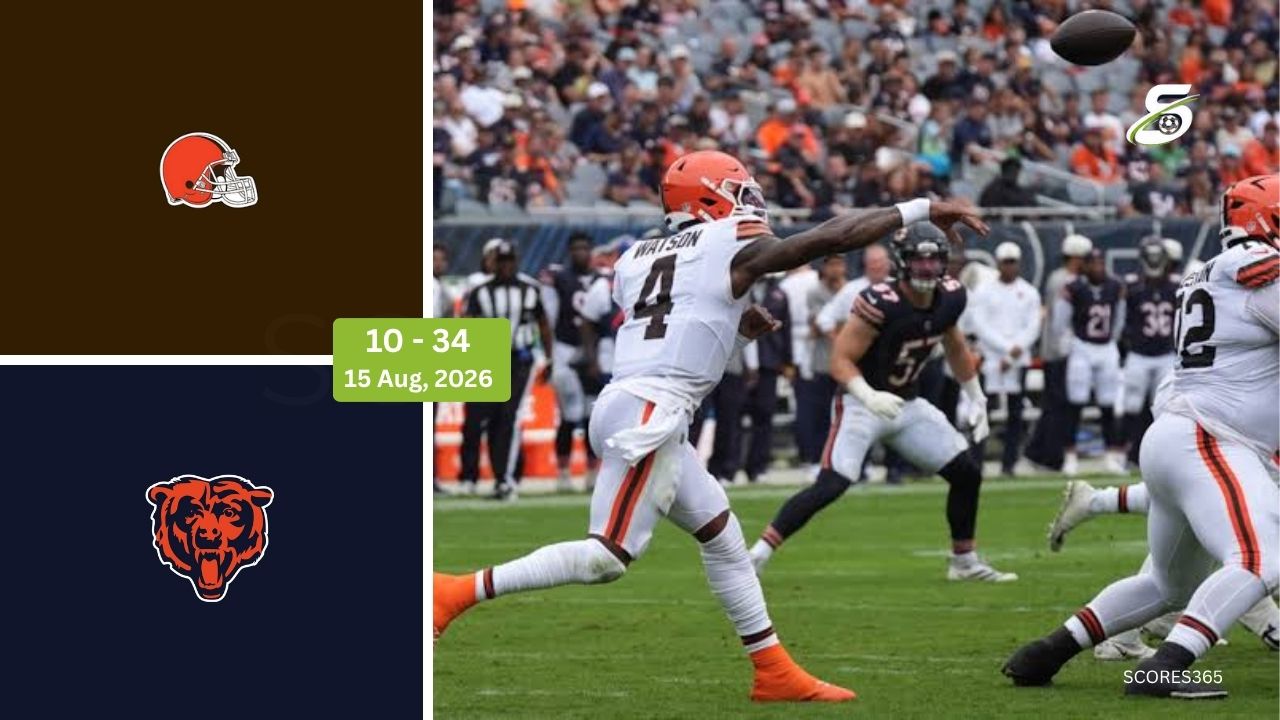
Cleveland Browns vs Chicago Bears Final Score, Highlights August 15, 2026
The Cleveland Browns vs Chicago Bears preseason matchup on Saturday, August 15, 2026, turned into a convincing victory for Chicago. The Bears defeated the Browns 34–10 at Soldier Field after Cleveland opened the scoring and briefly led 10–0.
Chicago responded with 34 unanswered points, taking control in the second half and producing its biggest offensive stretch after halftime. The game also featured important quarterback evaluations, with Deshaun Watson returning to game action for Cleveland and Shedeur Sanders receiving extended work later in the contest.
Cleveland Browns vs Chicago Bears Final Score
The official ESPN scorecard shows the following quarter-by-quarter result:
| Team | 1st Quarter | 2nd Quarter | 3rd Quarter | 4th Quarter | Final |
|---|---|---|---|---|---|
| Cleveland Browns | 3 | 7 | 0 | 0 | 10 |
| Chicago Bears | 0 | 10 | 14 | 10 | 34 |
Cleveland scored three points in the first quarter and seven in the second. Chicago answered with 10 points in the second quarter, then added 14 in the third and another 10 in the fourth. The result gave Chicago a 34–10 preseason victory, while Cleveland began its preseason with a defeat.
Deshaun Watson Returns to Game Action
One of the biggest stories surrounding the Cleveland Browns vs Chicago Bears game was Deshaun Watson's return to live NFL action.
Watson had not played since October 2024, making his appearance particularly significant. He started for Cleveland and played the first half alongside much of the Browns' projected offense.
Watson completed 11 of 15 passes for 126 yards and did not throw an interception. His quarterback rating was 98.2, according to ESPN's official box score. He also led Cleveland on two scoring drives. The performance was not perfect, however. Watson was sacked once and lost a fumble during the second quarter.
Still, completing 11 of 15 passes and moving the offense effectively during his first game back gave Cleveland an encouraging element to take from the loss. Read more Carolina Panthers vs Buffalo Bills.
Watson Helps Cleveland Build an Early Lead
Cleveland's offense moved the ball effectively during the opening half. The Browns opened the scoring with a 50-yard field goal from Andre Szmyt with 7:42 remaining in the first quarter. ESPN's play-by-play records the kick as Cleveland's first scoring play of the game.
The Browns then extended their advantage early in the second quarter. On the first play of the second quarter, KC Concepcion ran 14 yards for a touchdown. That scoring play completed an 81-yard Cleveland drive that lasted 6:25 and featured 10 plays. The touchdown pushed Cleveland's lead to 10–0. At that point, the Browns appeared to be in control.
KC Concepcion Makes His Presence Felt
Rookie wide receiver KC Concepcion was one of Cleveland's most encouraging offensive performers. Concepcion scored on a 14-yard rushing touchdown and also caught three passes for 27 yards.
His involvement was notable because Cleveland selected him in the first round of the 2026 NFL draft. Using Concepcion as both a receiver and a runner demonstrated the ways the Browns can potentially manufacture touches for their young playmaker. The rushing touchdown also gave him one of the game's clearest individual highlights.
Chicago Responds Before Halftime
The Bears did not remain scoreless for long.
After Cleveland moved ahead 10–0, Chicago produced its first touchdown with a 25-yard pass from Tyson Bagent to Maurice Alexander.
The touchdown came with 9:16 remaining in the second quarter and cut the Browns' advantage to 10–7.
Chicago then tied the game before halftime with a 51-yard field goal by Cairo Santos.
That kick came as the second quarter expired, sending the teams into halftime tied at 10–10.
The momentum had completely changed.
Tyson Bagent Leads Chicago's First-Half Offense
Quarterback Tyson Bagent played the first half for Chicago.
He completed 13 of 22 passes for 169 yards, with one touchdown and one interception. His quarterback rating was 79.5.
Bagent's 169 passing yards gave Chicago enough offensive production to overcome Cleveland's early advantage.
One of his biggest plays came on a 41-yard pass to Kendre Miller, helping the Bears move deep into Cleveland territory during the second quarter. ESPN's play-by-play records the 41-yard completion as part of Chicago's drive following Concepcion's touchdown.
Chicago Changes the Game in the Third Quarter
The Bears took complete control after halftime.
Chicago scored 14 points in the third quarter, while Cleveland failed to score.
The first touchdown came on a 49-yard pass from Case Keenum to Salvon Ahmed with 13:05 remaining in the quarter.
The scoring play covered nearly the entire field and gave Chicago a 17–10 advantage.
The Bears then extended their lead later in the third quarter.
Keenum connected with Brittain Brown for a six-yard touchdown, pushing Chicago ahead 24–10.
That 14-point quarter effectively changed the game from a competitive preseason contest into a comfortable Chicago advantage.
Case Keenum Delivers an Efficient Performance
Keenum was one of Chicago's standout offensive players.
He completed 9 of 10 passes for 151 yards and two touchdowns, producing a perfect 158.3 passer rating.
His 151 yards came on only 10 attempts, demonstrating how effectively Chicago generated explosive plays.
The 49-yard touchdown pass to Salvon Ahmed was especially important.
Keenum also connected with Brittain Brown for the six-yard touchdown.
Together, those two scoring passes helped Chicago pull away from Cleveland during the third quarter.
Bears Continue to Add Points in the Fourth Quarter
Chicago did not slow down in the final period.
The Bears added a 49-yard field goal from Cairo Santos with 8:41 remaining.
That increased the score to 27–10.
Chicago then produced its final touchdown of the afternoon.
Coleman Bennett scored on a three-yard rushing touchdown with 2:38 remaining, completing a seven-play, 70-yard drive.
The touchdown made the final score 34–10.
Shedeur Sanders Gets Extended Opportunity
The quarterback competition in Cleveland was another major storyline.
After Watson played the first half, Shedeur Sanders took over during the third quarter and remained in the game into the fourth.
Sanders completed 6 of 11 passes for 79 yards and threw one interception. ESPN lists his quarterback rating at 39.6.
His performance was less efficient than Watson's.
The Browns entered the preseason with Watson and Sanders among the quarterbacks competing for the starting job, so the contrast between their performances will naturally receive attention.
Sanders' Fourth-Quarter Interception
Sanders' biggest mistake came late in the fourth quarter.
He threw an interception to Bears defensive back Bishop, who returned the ball 21 yards. ESPN's play-by-play records the interception with 9:12 remaining in the fourth quarter.
The turnover ended another Cleveland possession and gave Chicago additional field position.
For Sanders, it was one of the less positive moments of an otherwise important opportunity to gain preseason experience.
Dillon Gabriel Also Sees Action
Cleveland used a third quarterback as the game progressed.
Dillon Gabriel completed 5 of 8 passes for 23 yards and threw one interception. He was also sacked twice.
The Browns therefore finished the game with three quarterbacks receiving meaningful opportunities.
Collectively, Cleveland's quarterbacks completed 22 of 34 passes for 206 yards, with no passing touchdowns and two interceptions.
Chicago Rests Caleb Williams
The Bears did not play starting quarterback Caleb Williams.
Chicago head coach Ben Johnson chose to rest most of his starters, giving the team's backup quarterbacks an extended opportunity.
That decision makes Chicago's offensive production particularly notable.
Despite Williams remaining on the sideline, the Bears generated 348 passing yards and three passing touchdowns.
The performance demonstrated the depth available behind the starting quarterback.
Antwaan Randle El Calls Plays
Another interesting aspect of the Chicago performance was the change in play-calling during the second half.
Wide receivers coach Antwaan Randle El called plays after halftime.
Coach Ben Johnson described the experience positively and said the players rallied around Randle El.
The change gave Randle El an opportunity to take on additional responsibility while Johnson evaluated the team from a different perspective.
It also added another developmental element to the preseason contest.
Chicago's Passing Attack Produces 348 Yards
The Bears finished with 348 passing yards, compared with Cleveland's 206.
Their three quarterbacks combined for:
- 25 completions
- 40 attempts
- 348 yards
- 3 touchdowns
- 1 interception
- 2 sacks
The combined quarterback rating was 107.1.
That passing advantage became one of the biggest statistical reasons for Chicago's victory.
Cleveland's Passing Game Has Mixed Results
The Browns' 206 passing yards were respectable, but the offense struggled to maintain the efficiency it showed with Watson.
Watson finished 11-of-15, while Sanders and Gabriel combined for 11-of-19 with two interceptions.
The team also suffered three total sacks.
Cleveland's quarterback rotation therefore produced a mixture of encouraging moments and costly mistakes.
Chicago's Explosive Plays Make the Difference
Several long plays helped Chicago turn the game around.
The most notable included:
- 41-yard pass from Bagent to Kendre Miller
- 49-yard touchdown pass from Keenum to Salvon Ahmed
- 25-yard touchdown pass from Bagent to Maurice Alexander
- 49-yard field goal by Santos
These explosive plays helped Chicago overcome its early 10-point deficit.
The First-Half Score Shows How Quickly the Game Changed
At one point, Cleveland led 10–0.
By halftime, the score was tied 10–10.
After three quarters, Chicago led 24–10.
And by the final whistle, the Bears had extended their advantage to 34–10.
The progression illustrates how dramatically the game shifted after Cleveland's early success.
Cleveland's Offense Goes Scoreless After Halftime
The Browns did not score a single point during the second half.
After Concepcion's touchdown made it 10–0, Cleveland's offense failed to find the end zone again.
Chicago's defense and offensive production combined to keep the Browns under pressure for the remainder of the contest.
The second-half shutout was one of the clearest indicators of Chicago's control.
Chicago's Defense Creates Key Turnovers
The Bears recorded interceptions from Bishop against Sanders and B. Bishop against Cleveland's later quarterback rotation, according to ESPN's game data.
Chicago's defense also produced a sack against Watson, with former Browns offensive tackle Jedrick Wills Jr. allowing a sack by Julian Okwara late in the first half.
The turnover and pressure numbers helped Chicago prevent Cleveland from regaining momentum.
Jedrick Wills Jr. Faces His Former Team
One of the more interesting individual storylines was the appearance of Jedrick Wills Jr. against Cleveland.
Wills previously played for the Browns and was part of Chicago's evaluation at left tackle.
He allowed a sack by Julian Okwara late in the first half.
Chicago was also evaluating Kiran Amegadjie at left tackle, meaning the preseason game provided another opportunity for the coaching staff to assess its options at the position.
Chicago's Left-Tackle Competition Continues
Amegadjie started at left tackle, while Wills also received playing time.
The Bears are still evaluating their options at the position, and the preseason provides an important setting for comparing different combinations.
Ben Johnson acknowledged after the game that it was too early to make a definitive judgment about the position.
That makes the remaining preseason games important for the Bears' offensive-line evaluation.
What the Result Means for Chicago
The 34–10 victory gave the Bears a strong start to the preseason.
Chicago demonstrated:
- Efficient quarterback play
- Explosive passing
- Strong second-half production
- Three passing touchdowns
- 348 passing yards
- Effective backup quarterback play
- A successful defensive response after falling behind
The result was particularly encouraging because Caleb Williams did not play.
What the Result Means for Cleveland
The Browns have more questions to answer following the defeat.
Watson's return was positive, but the team needs to evaluate his overall performance after nearly two years away from game action.
Sanders' performance also becomes relevant because he is competing for the quarterback job.
The Browns must also address the turnover problems that emerged during the second half.
Key Turning Points
Cleveland Takes a 10–0 Lead
Andre Szmyt's 50-yard field goal and KC Concepcion's 14-yard touchdown gave Cleveland an early 10-point advantage.
Chicago Answers Before Halftime
Maurice Alexander's 25-yard touchdown reception and Santos' 51-yard field goal tied the game at 10–10.
Keenum's 49-Yard Touchdown
Case Keenum connected with Salvon Ahmed for a 49-yard touchdown, putting Chicago ahead in the third quarter.
Brittain Brown Extends the Lead
Keenum's six-yard touchdown pass to Brown pushed Chicago's advantage to 24–10.
Chicago Adds 10 More Points
Santos' 49-yard field goal and Coleman's three-yard rushing touchdown completed the 34-point Chicago scoring effort.
Cleveland Browns vs Chicago Bears Statistics
The official ESPN passing statistics were:
| Quarterback | Completions/Attempts | Passing Yards | TD | INT |
|---|---|---|---|---|
| Deshaun Watson | 11/15 | 126 | 0 | 0 |
| Shedeur Sanders | 6/11 | 79 | 0 | 1 |
| Dillon Gabriel | 5/8 | 23 | 0 | 1 |
| Cleveland Total | 22/34 | 206 | 0 | 2 |
| Tyson Bagent | 13/22 | 169 | 1 | 1 |
| Case Keenum | 9/10 | 151 | 2 | 0 |
| Miller Moss | 3/8 | 48 | 0 | 0 |
| Chicago Total | 25/40 | 348 | 3 | 1 |
These figures come from ESPN's official game box score.
Final Analysis
The Cleveland Browns vs Chicago Bears preseason matchup ultimately became a 34–10 Chicago victory, but the final score does not tell the entire story.
Cleveland looked like the better team during the opening stages.
Deshaun Watson returned to live action and completed 11 of 15 passes for 126 yards. He led two scoring drives and helped Cleveland establish a 10–0 advantage.
KC Concepcion was another bright spot. The rookie scored on a 14-yard run and added three receptions for 27 yards.
However, Chicago gradually turned the contest around.
Tyson Bagent produced 169 passing yards and a touchdown during the first half, while Case Keenum was particularly effective after halftime. Keenum completed nine of 10 passes for 151 yards and two touchdowns, including the 49-yard scoring strike to Salvon Ahmed.
Chicago's offense scored 24 unanswered points after halftime.
The Bears also benefited from not needing to play Caleb Williams, allowing the coaching staff to evaluate its quarterback depth. The decision produced meaningful game repetitions for Bagent and Keenum.
For Cleveland, the biggest takeaway was the return of Watson and the continued quarterback competition involving Sanders.
Watson's 126 passing yards were encouraging, but his lost fumble was a reminder that there is still work to do. Sanders finished with 79 yards and an interception, while Gabriel also threw a pick.
More Update SCORES365