 NFL
NFL
Tennessee Titans vs San Francisco 49ers Final Score, Key Highlights August 13, 2026
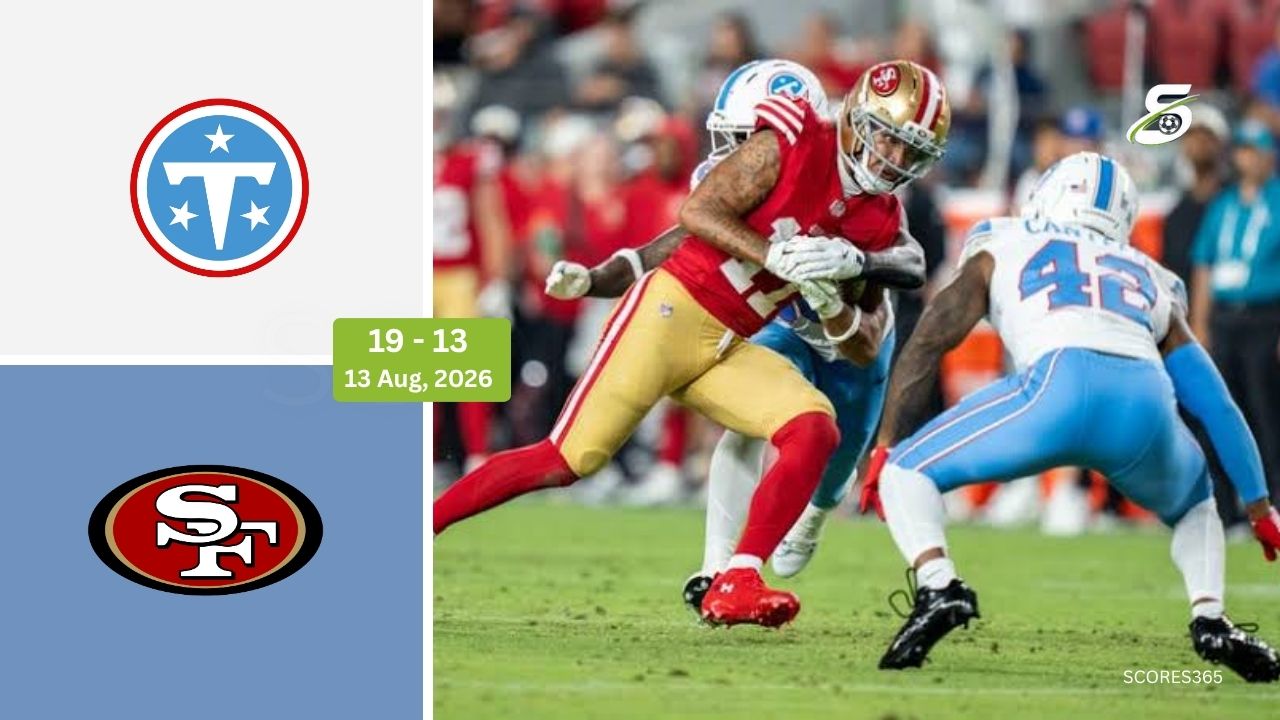
The Tennessee Titans vs San Francisco 49ers preseason matchup ended with the Titans earning a 19–13 victory at Levi's Stadium. Tennessee built an early advantage and held off San Francisco despite a strong second-half push from the 49ers.
The game itself was played on Thursday, August 13, 2026, while detailed postgame coverage was published on August 14, 2026. For consistency with the requested keyword and publication date, this article uses August 14, 2026 in its headline. The 49ers' official game center confirms Tennessee's 19–13 victory.
Match Overview
The Tennessee Titans vs San Francisco 49ers preseason opener brought together two teams looking to evaluate young players, new additions and depth across their rosters.
The matchup also had an interesting coaching storyline. Tennessee head coach Robert Saleh faced his former team, the 49ers, after previously serving as San Francisco's defensive coordinator. Saleh spent five seasons in that role across two periods, making the preseason meeting a notable return to Levi's Stadium.
Despite San Francisco controlling possession for much of the game and finishing with more than 300 total yards, Tennessee did enough in key moments to secure the win.
Tennessee Titans vs San Francisco 49ers Final Score
The official 49ers game center lists the quarter-by-quarter scoring as follows:
| Team | 1st Quarter | 2nd Quarter | 3rd Quarter | 4th Quarter | Final |
|---|---|---|---|---|---|
| Tennessee Titans | 7 | 6 | 3 | 3 | 19 |
| San Francisco 49ers | 0 | 7 | 3 | 3 | 13 |
Tennessee scored in every quarter, while San Francisco also produced points in each period except the opening quarter. The Titans' early lead ultimately proved important because the 49ers were unable to completely erase it.
Tennessee Starts Fast
According to Tennessee head coach Robert Saleh, the offense produced a 95-yard touchdown drive to begin the game. That drive immediately gave Tennessee confidence and put San Francisco in an early deficit.
The opening touchdown was especially encouraging because the Titans were facing a 49ers defense that included several players competing for important roles.
Rather than allowing San Francisco to establish control at home, Tennessee created early momentum and forced the 49ers to spend the rest of the game trying to catch up.
Cam Ward Gets Valuable Preseason Reps
Ward received important live-game experience as the Titans evaluated their young quarterback in a real NFL environment. The preseason contest gave Ward an opportunity to work through timing, reads and communication with his receivers after spending training camp primarily in practice situations.
After the game, Ward acknowledged that there were areas to improve in the passing game, particularly his timing and communication with receivers. He also emphasized the value of preseason repetitions for getting back into the rhythm of a full game.
For a young quarterback, those live repetitions can be extremely useful before the regular season begins.
Titans' Running Game Provides a Positive
Saleh specifically praised the way the Titans ran the football after the game, noting that the team was excited about its rushing performance even though the passing offense did not consistently settle into a rhythm.
That balance helped Tennessee maintain its lead.
A productive rushing attack also reduced pressure on Ward and allowed the Titans to control portions of the game without needing to rely entirely on the passing game.
San Francisco Responds in the Second Quarter
San Francisco put together a lengthy scoring drive in the second quarter, with quarterback Kurtis Rourke leading the offense.
Rourke completed 12 of 14 passes for 101 yards and directed a 68-yard touchdown drive. He repeatedly targeted rookie wide receiver De'Zhaun Stribling, who became one of the biggest offensive stories of the game.
The drive ended with running back Patrick Taylor Jr. scoring on a one-yard rushing touchdown.
That score brought San Francisco back into the game and gave the 49ers' offense some much-needed momentum.
De'Zhaun Stribling Makes an Impression
Rookie wide receiver De'Zhaun Stribling was one of the standout players for San Francisco.
Stribling finished with seven receptions for 63 yards, leading the 49ers in catches and providing Rourke with a reliable target throughout the first half.
His biggest play came on a 32-yard reception on third-and-five. The catch helped San Francisco sustain its scoring drive and move into position for Taylor's touchdown.
Stribling also made an 11-yard reception on third-and-six, demonstrating his ability to contribute in important down-and-distance situations.
For a rookie trying to establish himself during preseason, seven catches in the opening game represented a highly encouraging start.
Kurtis Rourke Shows Accuracy
Rourke's 12-for-14 passing performance was another positive for San Francisco.
He showed good accuracy during his time on the field and helped the 49ers move efficiently through their opening possessions.
His performance was especially notable because this was his first NFL game action. Rourke demonstrated that he could operate the offense, find open receivers and make accurate throws under game conditions.
Adrian Martinez Takes Over
After Rourke left the game, Adrian Martinez assumed control of the San Francisco offense.
Martinez completed 16 of 30 passes for 159 yards and also added a 10-yard scramble.
He produced several useful plays, including an 18-yard completion to Trenton Irwin, a 10-yard run and a nine-yard completion to Jordan Watkins during a second-quarter drive.
Martinez continued to work with the offense into the second half and helped San Francisco maintain pressure on Tennessee.
His performance gave the coaching staff additional information about the quarterback depth chart.
Jordan Watkins Provides Another Receiving Option
Wide receiver Jordan Watkins also had a productive night for the 49ers.
Watkins finished with six receptions for 59 yards on 10 targets. He remained involved after halftime and made two consecutive catches early in the fourth quarter, including a 20-yard reception that helped move San Francisco from its own 40-yard line to Tennessee's 13-yard line.
That drive demonstrated Watkins' ability to contribute beyond the opening half.
With several veteran players sitting out, performances from receivers such as Stribling and Watkins were particularly valuable for San Francisco's roster evaluation.
Patrick Taylor Jr. Scores for San Francisco
Running back Patrick Taylor Jr. provided the 49ers' only touchdown of the game.
Taylor scored on a one-yard rushing attempt after San Francisco completed its 68-yard scoring drive.
The touchdown gave the 49ers seven points and kept the game competitive.
San Francisco continued to move the football throughout the contest, but the offense struggled to finish enough drives with touchdowns.
That inability to consistently convert opportunities into touchdowns ultimately contributed to the six-point defeat.
49ers Move the Ball but Struggle to Finish
San Francisco's statistics showed that the offense was capable of sustaining drives.
The 49ers finished with:
- 322 total yards
- 22 first downs
- 9-for-19 on third down
- 32:48 time of possession
Those numbers indicate that San Francisco was able to move the ball and maintain possession. However, the team did not turn enough of those opportunities into touchdowns.
The 49ers scored only 13 points despite controlling the ball for almost five minutes longer than Tennessee.
That difference between yardage and points became one of the central themes of the game.
San Francisco's Defense Improves After Halftime
San Francisco recorded multiple sacks of Titans quarterback Will Levis, including plays by Ogbo Okoronkwo and Tatum Bethune.
Okoronkwo recorded the team's first official sack of the game, bringing Levis down for an eight-yard loss.
Bethune then added a 10-yard sack, continuing the defensive pressure.
Later in the fourth quarter, James Thompson Jr. and Larry Worth III combined to bring Levis down.
The increased pass rush was one of the more encouraging aspects of San Francisco's defensive performance.
Will Levis Faces Defensive Pressure
Titans quarterback Will Levis experienced increasing pressure as the game progressed.
San Francisco's defensive front generated more consistent pressure after halftime, forcing Tennessee to deal with negative plays and difficult passing situations.
Although the 49ers' defense did not completely shut down Tennessee, its second-half performance prevented the Titans from running away with the game.
The pressure also gave young defensive players valuable opportunities to demonstrate their ability against an NFL quarterback.
Eddy Piñeiro Adds Three Points
San Francisco kicker Eddy Piñeiro contributed two field goals.
One of his kicks came from 41 yards, while another was a 52-yard field goal.
The kicks helped the 49ers stay within striking distance.
After entering the game behind Tennessee, San Francisco continued to chip away at the deficit with field goals.
However, the 49ers needed a touchdown late in the contest to complete the comeback, and they were unable to produce one.
Titans Hold Their Lead
The most important part of Tennessee's performance was its ability to maintain the advantage.
The Titans did not need a huge offensive output to win the game. Instead, they scored enough points early and then relied on defense, rushing production and field position to protect the lead.
That approach proved effective.
San Francisco moved the ball repeatedly, but Tennessee kept the 49ers from turning those drives into enough touchdowns.
Tennessee's Defense Delivers
The Titans' defense was particularly effective early in the game.
Saleh said afterward that he liked the way the defense started, emphasizing the importance of keeping points off the scoreboard.
The defense also benefited from facing San Francisco's young offensive players.
As the game progressed, the Titans continued to limit the 49ers to field goals rather than allowing repeated touchdowns.
That proved critical because the 49ers were consistently able to move into scoring territory. Read more Arizona Cardinals vs Las Vegas Raiders
The Coaching Connection Adds Interest
The game had additional significance because of the relationship between the two coaching staffs.
Tennessee head coach Robert Saleh previously served as San Francisco's defensive coordinator. His return to Levi's Stadium gave the preseason contest a unique storyline.
Saleh and 49ers head coach Kyle Shanahan had worked together for years, making their meeting on opposite sidelines notable.
The two teams had also held joint practices earlier in the week, giving players an opportunity to compete against unfamiliar teammates while coaches evaluated their rosters.
What the Result Means for Tennessee
The Titans can take several positives from the 19–13 victory.
Strong Opening Drive
The 95-yard touchdown drive immediately established momentum and showed the offense could execute effectively against San Francisco's defense.
Productive Running Game
Saleh specifically praised the rushing attack after the game.
Valuable Cam Ward Reps
Ward received live-game experience and an opportunity to work on timing with his receivers.
Defensive Stability
The Titans held San Francisco to 13 points despite allowing 322 total yards.
What the Result Means for San Francisco
The 49ers' loss also provided several positives.
Stribling's Breakout Performance
Seven catches for 63 yards made the rookie receiver one of the game's standout players.
Rourke's Accurate Start
Rourke completed 12 of 14 passes for 101 yards before leaving with a rib injury.
Martinez Gains Valuable Reps
Martinez completed 16 passes for 159 yards and showed some mobility.
Second-Half Pass Rush
The defensive line and linebackers increased pressure after halftime, recording multiple sacks.
The Biggest Concern for San Francisco
The main concern was finishing drives.
The 49ers had 322 total yards and 22 first downs, but those numbers produced only 13 points.
San Francisco's ability to move the ball was encouraging, but the offense needs to turn more long drives into touchdowns rather than field goals.
That will be an important focus as the preseason continues.
Kurtis Rourke Injury Becomes a Storyline
Rourke's rib injury was another important development.
The rookie quarterback had performed well before leaving, completing 12 of 14 passes and leading a touchdown drive.
After the game, Kyle Shanahan discussed the injury and the importance of evaluating Rourke's status. The 49ers' official coverage confirmed that Rourke was ruled out after suffering the rib issue.
The injury is particularly relevant because preseason games are intended to evaluate young players, and losing game reps can affect a player's development.
The Importance of Preseason Repetitions
For both teams, the matchup was about more than winning.
Players need live-game repetitions to understand the speed and physicality of NFL competition.
49ers linebacker Jaden Dugger discussed the value of playing against Tennessee's starters and getting experience against an actual offensive line rather than only seeing teammates in practice.
Cam Ward also explained that preseason reps help him regain the rhythm and flow of an actual game.
These comments highlight why preseason contests remain important even though the results do not count toward the regular-season standings.
Key Turning Points
Tennessee's 95-Yard Opening Drive
The Titans immediately established momentum with a 95-yard scoring drive.
Stribling's 32-Yard Catch
Stribling's third-down reception helped San Francisco sustain its second-quarter touchdown drive.
Taylor's One-Yard Touchdown
Patrick Taylor Jr.'s rushing touchdown put San Francisco on the scoreboard.
San Francisco's Second-Half Pass Rush
Okoronkwo, Bethune and other defenders generated pressure on Will Levis after halftime.
Piñeiro's Long Field Goals
Piñeiro's 41-yard and 52-yard field goals helped San Francisco remain within reach.
Tennessee's Ability to Protect the Lead
The Titans continued scoring through the final three quarters and never allowed San Francisco to complete the comeback.
Final Result
Tennessee Titans 19, San Francisco 49ers 13
The Titans opened their preseason with a six-point victory at Levi's Stadium.
San Francisco finished with more than 300 total yards and controlled possession for nearly 33 minutes, but Tennessee's ability to score early and protect its advantage ultimately proved decisive.
Final Analysis
The Tennessee Titans vs San Francisco 49ers preseason matchup produced a competitive six-point game and several important individual storylines.
Tennessee's 19–13 victory was built around a strong opening drive, an effective running game and defensive consistency. The Titans did not dominate statistically, but they were able to score enough points and prevent San Francisco from converting its long drives into enough touchdowns.
For San Francisco, the biggest positive was the performance of its young offensive players. De'Zhaun Stribling led the team with seven catches for 63 yards, while Jordan Watkins added six receptions for 59 yards.
Kurtis Rourke also provided an encouraging debut before leaving with a rib injury. His 12-of-14 passing performance and 101 yards demonstrated accuracy and command of the offense during his time on the field.
Adrian Martinez then stepped in and added 159 passing yards, giving the 49ers another opportunity to evaluate their quarterback depth.
Defensively, San Francisco became more effective after halftime. The pass rush produced several sacks of Will Levis, and the secondary added pressure through pass breakups.
Still, the final score came down to Tennessee's ability to finish drives more effectively.
The 19–13 result is ultimately a useful preseason outcome for both organizations. Tennessee can build on its rushing attack, defensive performance and Cam Ward's live-game experience, while San Francisco has plenty of positive individual performances to evaluate despite the loss.
More Update Scores365