

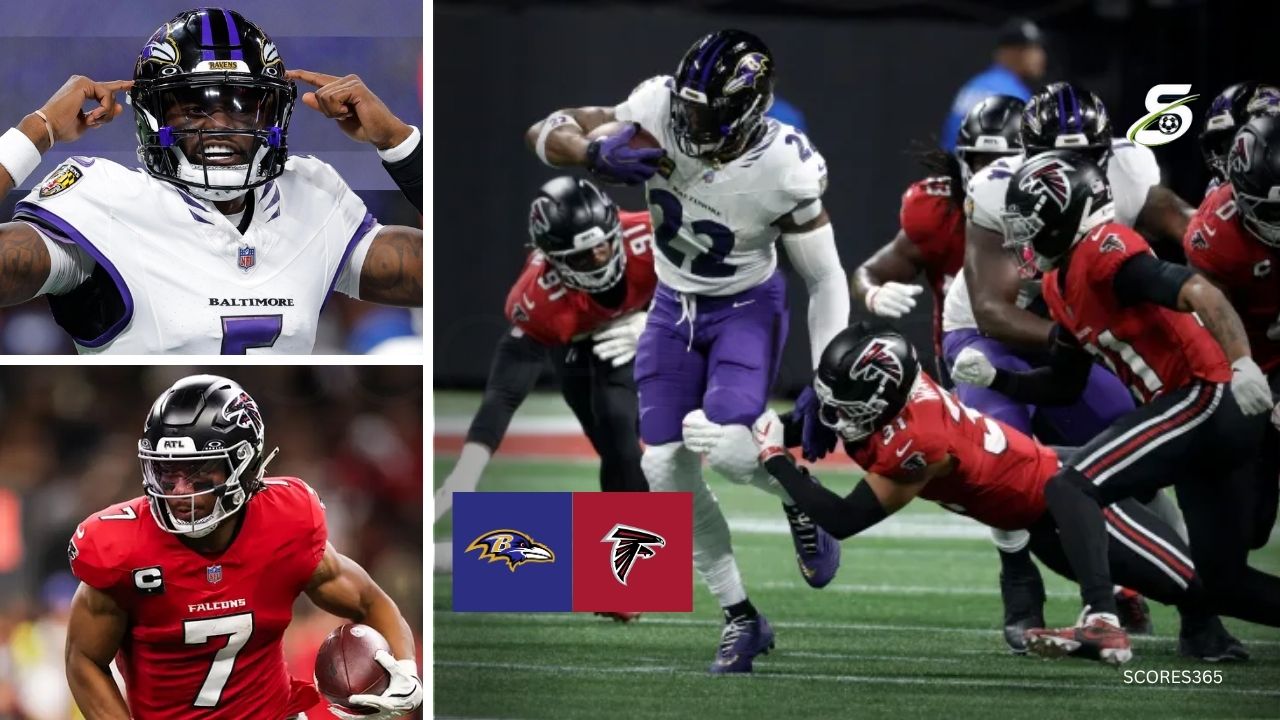
The Baltimore Ravens vs Atlanta Falcons Match Player Stats and Key Highlights tell the story of a dramatic Week 5 NFL matchup decided in overtime. Baltimore defeated Atlanta 30–23 on October 11, 2026, at Mercedes-Benz Stadium after overcoming a late eight-point deficit. The Ravens were without starting quarterback Lamar Jackson, so Tyler Huntley took responsibility for leading the offense. He delivered a clutch touchdown pass in the final minute of regulation before scoring the winning touchdown himself in overtime.
Atlanta appeared close to securing the victory after Nick Folk’s third field goal of the second half gave the Falcons a 23–15 lead with 2:31 remaining. Baltimore responded with a six-play, 71-yard drive, capped by Huntley’s seven-yard touchdown pass to Devontez Walker and Derrick Henry’s successful two-point conversion. In overtime, Huntley ran for a one-yard touchdown, and safety Kyle Hamilton intercepted Tua Tagovailoa on Atlanta’s next possession. The result moved Baltimore to 4–1 and dropped Atlanta to 2–3.
Final Score
| Team | Q1 | Q2 | Q3 | Q4 | OT | Final |
|---|---|---|---|---|---|---|
| Baltimore Ravens | 3 | 6 | 6 | 8 | 7 | 30 |
| Atlanta Falcons | 7 | 7 | 3 | 6 | 0 | 23 |
Baltimore started the game with a 21-yard field goal from Tyler Loop, but Atlanta quickly took the lead after Jessie Bates III recovered a Mark Andrews fumble and returned it 36 yards for a touchdown. The Ravens added two more field goals in the first half, including a 51-yard kick, but Michael Penix Jr.’s touchdown pass to Kyle Pitts helped Atlanta establish a 14–9 halftime advantage. The Falcons’ defense and opportunistic scoring kept Baltimore from turning its early possession advantage into a lead.
Atlanta extended its advantage to 17–9 in the third quarter with a field goal, but Huntley answered with an 18-yard touchdown pass to Henry. The Falcons continued to lead through the fourth quarter and added field goals from 34 and 48 yards. Baltimore’s late touchdown and two-point conversion tied the game at 23–23, sending it to overtime. Huntley’s rushing touchdown then put the Ravens ahead for the first time since the opening quarter, and Hamilton’s interception ended Atlanta’s comeback hopes.
Tyler Huntley Player Stats and Quarterback Performance
Tyler Huntley completed 24 of 32 passes for 201 yards and two touchdowns without an interception. He also rushed six times for 20 yards and scored the decisive one-yard touchdown in overtime. Huntley entered the game in place of the injured Lamar Jackson and showed composure during Baltimore’s most important possessions. His short passing game helped the Ravens move the chains, while his mobility gave the offense another option near the goal line.
Huntley’s most important passing play came with 40 seconds remaining in regulation, when he connected with Devontez Walker for a seven-yard touchdown. Baltimore then used Henry on the two-point conversion to tie the score. In overtime, Huntley capped the Ravens’ possession with a quarterback sneak for the winning touchdown. His performance was particularly significant because Baltimore had trailed for much of the game, and the backup quarterback had to deliver under pressure in a hostile road environment.
Explore San Francisco 49ers vs Seattle Seahawks Match Player Stats Full Game Analysis
Derrick Henry Rushing and Receiving Stats
Derrick Henry led Baltimore’s rushing attack with 24 carries for 102 yards, averaging 4.3 yards per attempt. His physical running helped the Ravens finish with 208 rushing yards as a team, providing an important foundation for their comeback. Henry repeatedly gained positive yardage and helped Baltimore maintain possession, even when the passing game was not producing explosive plays. His ability to handle a heavy workload was especially valuable with Jackson unavailable.
Henry also caught one pass for 18 yards and a touchdown, scoring on a screen pass from Huntley in the third quarter. The play reduced Atlanta’s lead and showed that Henry could create a scoring opportunity as a receiver as well as a runner. He later converted the game-tying two-point attempt by taking a direct snap and running into the end zone. His combined rushing and receiving impact made him one of Baltimore’s most important contributors in the 30–23 victory.
Justice Hill and Baltimore’s Ground Game
Justice Hill provided Baltimore with a major spark on limited rushing attempts. He carried the ball four times for 73 yards, averaging more than 18 yards per carry. His longest run covered 47 yards, giving the Ravens a big-play threat alongside Henry’s more physical running style. Hill’s explosive gains helped Baltimore stretch the field and put pressure on an Atlanta defense that had entered the game with a strong reputation against the run.
The contrast between Hill’s long gains and Henry’s high-volume workload gave Baltimore useful variety. Henry handled most of the carries and short-yardage situations, while Hill provided speed and open-field potential. Together, they helped the Ravens produce 208 rushing yards and sustain the late drive needed to force overtime. Their combined contribution was a key part of Baltimore’s comeback, particularly because Huntley did not need to rely exclusively on passing to move the offense downfield.
Zay Flowers, Rashod Bateman and Baltimore’s Receivers
Zay Flowers led Baltimore in receptions, finishing with eight catches for 53 yards on nine targets. Although he did not score a touchdown, his involvement gave Huntley a dependable option throughout the game. Flowers helped Baltimore maintain drives with short and intermediate catches, and he remained a key target during the late comeback attempt. His role was particularly important because Atlanta had kept the Ravens’ passing yardage under control for much of the contest.
Rashod Bateman added five receptions for 62 yards, while tight end Mark Andrews recorded four catches for 28 yards before his early fumble led to Atlanta’s defensive touchdown. Josh Cuevas contributed two catches for 26 yards, and Walker finished with two receptions for nine yards, including the crucial seven-yard touchdown. Baltimore’s receiving group produced its most important play late in regulation, when Walker found space in the end zone to give the Ravens a chance to tie the game.
Michael Penix Jr. and Atlanta’s Passing Attack
Michael Penix Jr. completed 19 of 32 passes for 240 yards and one touchdown before leaving the game late in regulation with a rib injury. His touchdown pass to Kyle Pitts gave Atlanta a 14–6 lead in the second quarter, and his downfield connections helped the Falcons build an advantage despite Baltimore’s strong rushing production. Penix was productive for much of his appearance, moving the offense into scoring range and helping Atlanta maintain control of the scoreboard.
Penix’s injury became an important late-game development because it forced Tua Tagovailoa into action during the final possession. Tagovailoa completed two of three passes for 34 yards but threw the interception that ended the game. The change at quarterback came at a difficult moment, with Atlanta needing to answer Huntley’s overtime touchdown. While Penix’s passing numbers were respectable, the Falcons could not close out the game after Baltimore tied the score in the final minute.
Drake London and Atlanta’s Receiving Leaders
Drake London was Atlanta’s leading receiver, recording seven receptions for 118 yards. His production gave the Falcons a consistent downfield threat and helped Penix move the offense into scoring territory. London gained valuable yardage on intermediate and deeper routes, forcing Baltimore’s defense to account for him throughout the game. His performance was one of Atlanta’s strongest offensive contributions, even though the team ultimately lost after overtime.
Bijan Robinson also delivered a productive all-around performance, finishing with 118 total yards according to the Ravens’ official recap. His versatility helped Atlanta move the ball, while Pitts’ five-yard touchdown reception provided a key first-half score. However, the Falcons were unable to turn their offensive production into enough points to finish the game. Baltimore’s late defensive stops and Hamilton’s interception prevented Atlanta from responding after the Ravens took the lead in overtime.
Defensive Highlights and Turnovers
Atlanta’s defense created the game’s opening major swing when Jessie Bates III recovered Andrews’ fumble and returned it 36 yards for a touchdown. The play gave the Falcons a 7–3 lead and punished Baltimore for a costly mistake. It was Bates’ fifth career touchdown, and it briefly placed Atlanta in control of the contest. The Ravens also struggled to turn their early possession advantage into touchdowns, relying on field goals to remain within reach.
Baltimore’s defense made the decisive play in overtime. After Huntley’s rushing touchdown, Tagovailoa took over for Atlanta and threw an interception to Kyle Hamilton, ending the game. The Ravens also recorded eight tackles for loss, with Mike Green and Malaki Starks each credited with two. Those defensive plays helped limit Atlanta’s ability to build a larger lead and ultimately gave Baltimore the opportunity to complete its comeback. The final interception was the defining moment of a game in which turnovers repeatedly influenced the scoreboard.
Read more Detroit Lions vs Arizona Cardinals Match Player Stats and Final Score
Team Statistics and Key Player Comparison
Baltimore’s offensive identity in this game centered on the running attack and timely execution. The Ravens rushed for 208 yards, led by Henry’s 102 yards and Hill’s 73. Huntley threw for 201 yards and two touchdowns, and he added the overtime rushing score. Atlanta produced 240 passing yards from Penix and 118 receiving yards from London, but its offense could not secure a decisive score during the final regulation possession or after Baltimore took the lead in overtime.
| Key statistic | Baltimore Ravens | Atlanta Falcons |
|---|---|---|
| Final score | 30 | 23 |
| Starting quarterback | Tyler Huntley | Michael Penix Jr. |
| Passing yards (starter) | 201 | 240 |
| Passing touchdowns (starter) | 2 | 1 |
| Rushing yards | 208 | — |
| Leading rusher | Derrick Henry: 102 yards | Bijan Robinson: 118 total yards |
| Leading receiver | Rashod Bateman: 62 yards | Drake London: 118 yards |
| Game-changing defensive play | Kyle Hamilton interception in OT | Jessie Bates fumble-return TD |
The comparison highlights two different approaches. Atlanta relied heavily on Penix’s passing and London’s receiving production, while Baltimore used Henry and Hill to create a powerful ground game. The Falcons also benefited from Bates’ defensive touchdown and three field goals from Nick Folk, but they could not stop the Ravens’ late tying drive. Baltimore’s ability to run effectively and execute in the final moments proved more important than Atlanta’s early lead.
Overtime Finish and Key Turning Points
The game’s defining sequence began when Atlanta led 23–15 with 2:31 left in regulation. Baltimore moved quickly downfield, and Huntley found Walker for a seven-yard touchdown with 40 seconds remaining. Henry then converted the two-point attempt, making the score 23–23. That drive forced overtime and shifted pressure onto Atlanta, which had been close to winning after controlling much of the second half.
In overtime, Baltimore sustained a long possession and Huntley finished it with a one-yard rushing touchdown, giving the Ravens a 30–23 lead. Atlanta then needed a touchdown to extend the game, but Tagovailoa’s pass was intercepted by Hamilton. The turnover ended the contest and completed Baltimore’s comeback. The final sequence demonstrated the importance of execution under pressure: Huntley made the key offensive plays, Henry converted the tie, and Hamilton delivered the decisive defensive stop.
Conclusion
The Baltimore Ravens vs Atlanta Falcons Match Player Stats and Key Highlights show how Baltimore turned a difficult road game into a 30–23 overtime victory. Tyler Huntley completed 24 of 32 passes for 201 yards and two touchdowns, then ran for the winning score. Derrick Henry rushed for 102 yards and caught an 18-yard touchdown, while Justice Hill added 73 rushing yards. Baltimore’s 208 rushing yards and its late fourth-quarter drive were central to the comeback.
Atlanta had strong individual performances from Penix and London, while Bates’ fumble-return touchdown and Folk’s three field goals helped the Falcons hold a late lead. But Penix’s injury, the late tying drive, and Hamilton’s overtime interception changed the outcome. The Ravens improved to 4–1, and the Falcons fell to 2–3. For Baltimore, the victory showed resilience without Jackson; for Atlanta, it was a missed opportunity after leading deep into the fourth quarter.
Explore More SCORES 365