

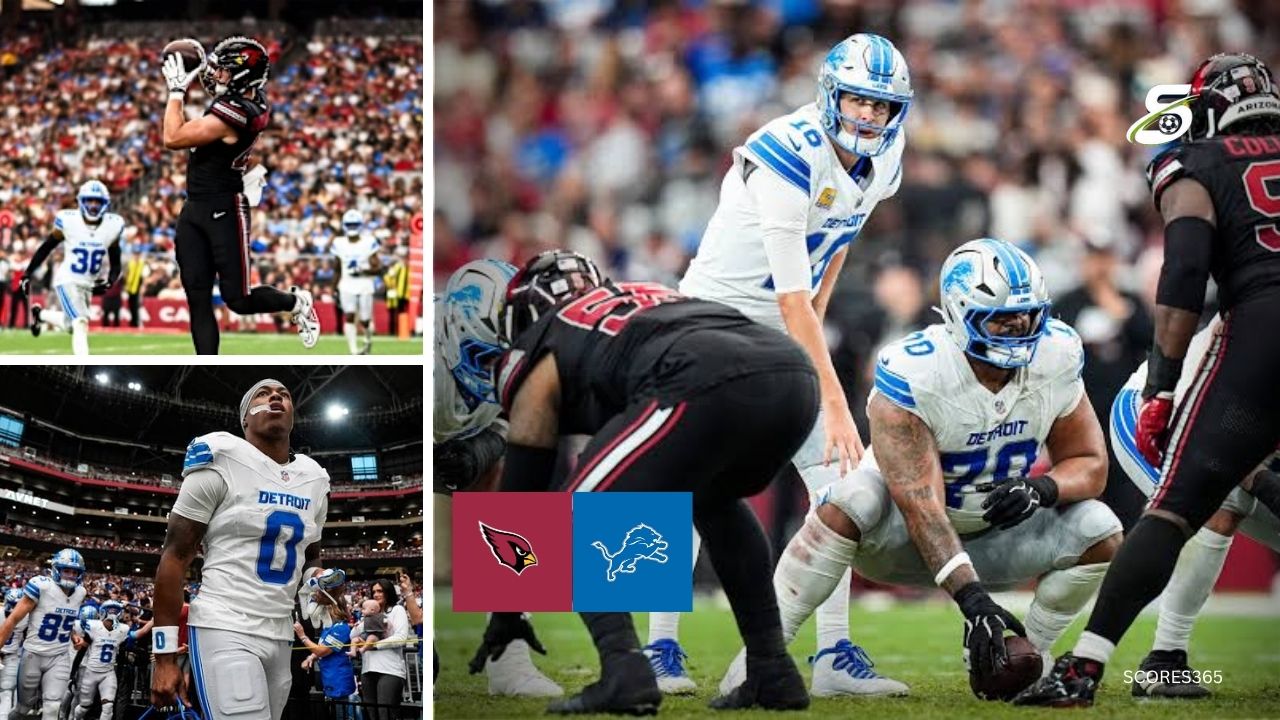
The Detroit Lions vs Arizona Cardinals Match Player Stats and Final Score tell the story of a dramatic turnaround in Detroit’s Week 5 victory on October 11, 2026. The Lions beat the Cardinals 45–21 at State Farm Stadium in Glendale, Arizona, after falling behind 7–0 in the first quarter. Detroit’s offense struggled during its opening possessions, but the team found its rhythm in the second quarter and continued scoring throughout the game. The result gave Detroit a valuable win before its Week 6 bye.
Quarterback Jared Goff, running back Jahmyr Gibbs, tight end Sam LaPorta, and wide receiver Jameson Williams led the Lions’ offensive response. Goff finished with three passing touchdowns and one rushing score, while Gibbs delivered more than 200 yards from scrimmage. Arizona quarterback Jacoby Brissett threw three touchdown passes, but the Cardinals struggled to sustain drives and were unable to keep pace with Detroit’s offense. The final statistics show how the Lions combined efficient passing, productive rushing, defensive pressure, and effective special teams to secure the win.
Final Score
| Team | Q1 | Q2 | Q3 | Q4 | Final |
|---|---|---|---|---|---|
| Detroit Lions | 0 | 24 | 14 | 7 | 45 |
| Arizona Cardinals | 7 | 0 | 7 | 7 | 21 |
Detroit scored 45 points, while Arizona finished with 21. The quarter-by-quarter result highlights the Lions’ strong middle periods: they scored 24 points in the second quarter and another 14 in the third. Arizona’s only first-half points came on its opening touchdown drive, after which Detroit’s defense limited the Cardinals’ opportunities. The Lions entered halftime leading 24–7 and extended the advantage to 38–14 before adding another touchdown in the fourth quarter.
The opening quarter belonged to Arizona, but the game changed dramatically in the second. Detroit scored three touchdowns and a field goal during that period, turning a seven-point deficit into a 17-point lead. The Lions then maintained their momentum after halftime, with Williams catching his second touchdown pass and Goff adding a rushing score. Gibbs scored again in the fourth quarter, while Arizona’s late touchdown reduced the margin without changing the outcome. The scoring sequence reflects Detroit’s ability to recover from a slow start and control the game.
Explore Denver Broncos vs Los Angeles Chargers Match Player Stats Week 5 Recap
Jared Goff Player Stats and Passing Performance
Jared Goff completed 19 of 30 passes for 271 yards, three touchdowns, and no interceptions. His completion rate was 63.3%, and he averaged 9.0 yards per attempt. More importantly, Goff converted several crucial opportunities into touchdowns, including scoring passes to LaPorta and Williams. His ability to distribute the ball to different receivers helped Detroit’s offense become more balanced as the game progressed. After the Lions’ opening struggles, Goff settled into the pocket and guided a series of productive scoring drives.
Goff also contributed on the ground, scoring on a one-yard rushing attempt in the third quarter. That gave him four total touchdowns for the game: three through the air and one rushing. His performance was notable for both efficiency and ball security, as he finished without an interception. Goff benefited from Gibbs’ powerful running and the receiving contributions of LaPorta, Williams, and Amon-Ra St. Brown. The combination made it difficult for Arizona’s defense to concentrate on one player or one type of offensive play.
Jahmyr Gibbs Player Stats and Rushing Impact
Jahmyr Gibbs was one of the biggest difference-makers in the matchup. He carried the ball 25 times for 151 rushing yards and two touchdowns, averaging 6.0 yards per attempt. His touchdown runs came from one yard and three yards, but his influence extended beyond those short finishes. Gibbs repeatedly gained meaningful yardage and helped Detroit sustain drives after its early offensive problems. His explosive running also forced Arizona to respect the ground game, creating additional opportunities for Goff to attack through the air.
Gibbs added five receptions for 56 yards, bringing his total to 207 yards from scrimmage. That receiving production gave Detroit another way to get him into space when the Cardinals focused on stopping his runs. His combination of rushing power, acceleration, and receiving ability made him difficult to contain across four quarters. Gibbs’ 151 rushing yards were especially important because they helped Detroit control possession and maintain pressure on Arizona’s defense. His two touchdowns also provided a direct contribution to the Lions’ 45-point total.
Jameson Williams and Sam LaPorta Receiving Stats
Jameson Williams delivered a major impact despite recording only two receptions. He finished with 47 receiving yards and two touchdowns, catching scoring passes of eight and 39 yards from Goff. The first touchdown came on a fourth-down opportunity in the second quarter, and the second arrived in the third quarter on a deep pass. Williams’ ability to stretch the field gave Detroit an explosive element that complemented Gibbs’ work on the ground. His two-touchdown performance was the first multi-receiving-touchdown game of his career.
Sam LaPorta also played an important role in the passing game, finishing with five catches for 88 yards and one touchdown. His 38-yard scoring reception helped Detroit take the lead during the second quarter, and his catches continued to move the offense forward. LaPorta’s production gave Goff a dependable option over the middle and on important downs. Together, Williams and LaPorta accounted for all three of Goff’s passing touchdowns, showing how Detroit used both vertical passing and tight-end routes to create scoring opportunities.
Amon-Ra St. Brown and Detroit’s Supporting Receivers
Amon-Ra St. Brown recorded six receptions for 69 yards on 11 targets. Although he did not score a touchdown, his involvement helped keep Detroit’s passing attack varied. St. Brown’s routes and reliable hands offered Goff another option when Arizona adjusted to the deep threat posed by Williams. His receiving work also complemented LaPorta’s production over the middle and Gibbs’ contributions as a pass catcher. The Lions did not depend on one receiver to produce every major play, which made their offense harder to predict.
Gibbs’ five receptions for 56 yards were another important part of the receiving picture. Brock Wright added a catch for 11 yards, while Williams produced two touchdowns from his two receptions. These contributions illustrate how Detroit could attack through multiple personnel groupings and different areas of the field. The Lions finished with 271 passing yards, distributed across several targets. Even when a receiver did not score, the ability to gain yards and move the chains helped keep drives alive and created favorable situations near the goal line.
Explore Chicago Bears vs Green Bay Packers Match Player Stats Week 5 Recap
Jacoby Brissett and Arizona Cardinals Player Stats
Jacoby Brissett completed 29 of 47 passes for 292 yards, three touchdowns, and one interception. He found Teagan Quitoriano for two touchdown passes and connected with Trey McBride for another late in the game. Brissett’s passing total showed that Arizona could move the ball through the air, but the overall offensive performance was inconsistent. Detroit’s defense put pressure on the quarterback and forced the Cardinals into difficult situations, especially during the first half, when Arizona struggled to sustain drives after its opening score.
Brissett’s three touchdown passes were not enough to keep Arizona close because the Cardinals could not match Detroit’s scoring pace. The offense finished with only 56 rushing yards as a team, limiting its balance and making it more difficult to control possession. The interception also gave Detroit a valuable defensive play, while pressure and failed drives reduced Arizona’s opportunities to build momentum. Brissett continued to compete after the Lions opened a large lead, but the Cardinals needed more consistent production on early downs and a stronger running game to challenge Detroit.
Trey McBride and Teagan Quitoriano Receiving Performances
Trey McBride finished with nine receptions for 66 yards and one touchdown. His nine-yard scoring catch in the fourth quarter provided Arizona’s final points of the afternoon. McBride remained a key target for Brissett, particularly when the Cardinals needed a dependable option in the short and intermediate passing game. His reception total demonstrated his involvement in the offense, even as Detroit held a substantial lead. McBride’s touchdown also gave Arizona a late scoring highlight in a game where the team struggled to sustain enough drives to close the gap.
Teagan Quitoriano caught two touchdown passes from Brissett. His first score, a two-yard reception, capped Arizona’s opening drive and put the Cardinals ahead 7–0. He added a second touchdown on a 13-yard reception in the third quarter, briefly providing another positive moment for the home team. Quitoriano’s two scores were significant because they accounted for two of Arizona’s three passing touchdowns. However, the Cardinals needed additional production from their rushing attack and defense to turn those individual scoring plays into a more competitive result.
Team Statistics and Offensive Comparison
Detroit’s offensive performance was defined by balance. The Lions combined Goff’s 271 passing yards with a strong rushing effort led by Gibbs. Detroit’s leading players created scoring chances through the air and on the ground, and the team did not turn the ball over. Arizona generated 292 passing yards through Brissett, but its rushing game managed only 56 yards. The contrast between Detroit’s productive ground attack and Arizona’s limited rushing output was an important part of the final result.
| Key statistic | Detroit Lions | Arizona Cardinals |
|---|---|---|
| Final score | 45 | 21 |
| Passing yards | 271 | 292 |
| Team rushing yards | 174 | 56 |
| Total offensive yards | 445 | 348 |
| Passing touchdowns | 3 | 3 |
| Rushing touchdowns | 3 | 0 |
| Interceptions thrown | 0 | 1 |
The statistical comparison shows why the Lions were able to win by 24 points despite Arizona recording more passing yards. Detroit’s offense was more productive on the ground and added three rushing touchdowns, including scores from Gibbs and Goff. Arizona relied heavily on Brissett’s passing, but its limited rushing production made the offense less balanced. Detroit also protected the football more effectively, avoiding interceptions while taking advantage of Arizona’s mistake. The combined effect of rushing production, scoring efficiency, and defensive pressure gave the Lions control after the first quarter.
Defensive Performance and the Turning Point
Detroit’s defense was central to the comeback. After allowing Arizona to score on the opening possession, the Lions forced five consecutive Cardinals three-and-outs during the first half. Those stops gave Detroit’s offense time to recover from its slow beginning and helped create the conditions for the second-quarter scoring surge. Defensive pressure disrupted Arizona’s rhythm, while disciplined coverage limited the Cardinals’ ability to maintain long drives. Detroit’s defense also recorded an interception, and its pass rush helped make several possessions difficult for Brissett.
The game’s turning point came after Arizona’s opening touchdown and Detroit’s three initial possessions ended without a score. Instead of allowing the deficit to grow, the Lions began winning field position and converting important downs. LaPorta’s 38-yard touchdown reception and Williams’ first scoring catch helped transform the game, while Gibbs’ running strengthened Detroit’s control. By halftime, the Lions led 24–7. Arizona managed to score twice more after the break, but Detroit answered each challenge and preserved a comfortable margin through the final quarter.
What the Result Means for Both Teams
The victory moved Detroit to 3–2, giving the Lions momentum before their Week 6 bye. The result was encouraging because the team recovered from a poor opening period and produced a complete performance across offense, defense, and special teams. Goff protected the ball, Gibbs delivered a major rushing performance, and the receiving group produced three passing touchdowns. The defensive response after Arizona’s first drive was equally important. Detroit showed that it could adjust during a game rather than allowing an early setback to determine the result.
Arizona fell to 1–4 after the loss, extending a difficult stretch in which defensive problems and inconsistent offensive drives made it hard to keep pace with opponents. Brissett’s passing numbers and Quitoriano’s two touchdowns offered some positives, while McBride remained a productive target. However, the Cardinals’ limited rushing production and the defense’s inability to stop Detroit’s second-quarter surge were costly. Arizona needed more sustained possessions and better defensive execution to turn the opening lead into a closer contest. The final score underlined the gap between its strong start and its performance over the remaining three quarters.
Conclusion
The Detroit Lions vs Arizona Cardinals Match Player Stats and Final Score highlight a decisive 45–21 victory built on a powerful response after an early deficit. Jared Goff threw for 271 yards and three touchdowns while adding a rushing score, and Jahmyr Gibbs contributed 151 rushing yards, two rushing touchdowns, and 56 receiving yards. Jameson Williams caught two touchdown passes, and Sam LaPorta added 88 receiving yards and a score. Detroit’s offense became increasingly effective as the game progressed, turning a 7–0 deficit into a commanding win.
Arizona’s passing game produced three touchdowns, with Brissett throwing for 292 yards and McBride and Quitoriano contributing receiving scores. Yet the Cardinals could not match Detroit’s rushing production or sustain enough drives to remain competitive. The Lions’ defensive pressure, turnover advantage, and second-quarter scoring burst shaped the outcome. For Detroit, the win offered a strong boost heading into the bye week; for Arizona, it highlighted the need for more consistent defense and a more productive ground game. The final statistics show that Detroit won through balance, execution, and timely big plays.
Explore More SCORES 365