 NFL
NFL
Denver Broncos vs Atlanta Falcons Score, Result and Full Preseason August 15, 2026
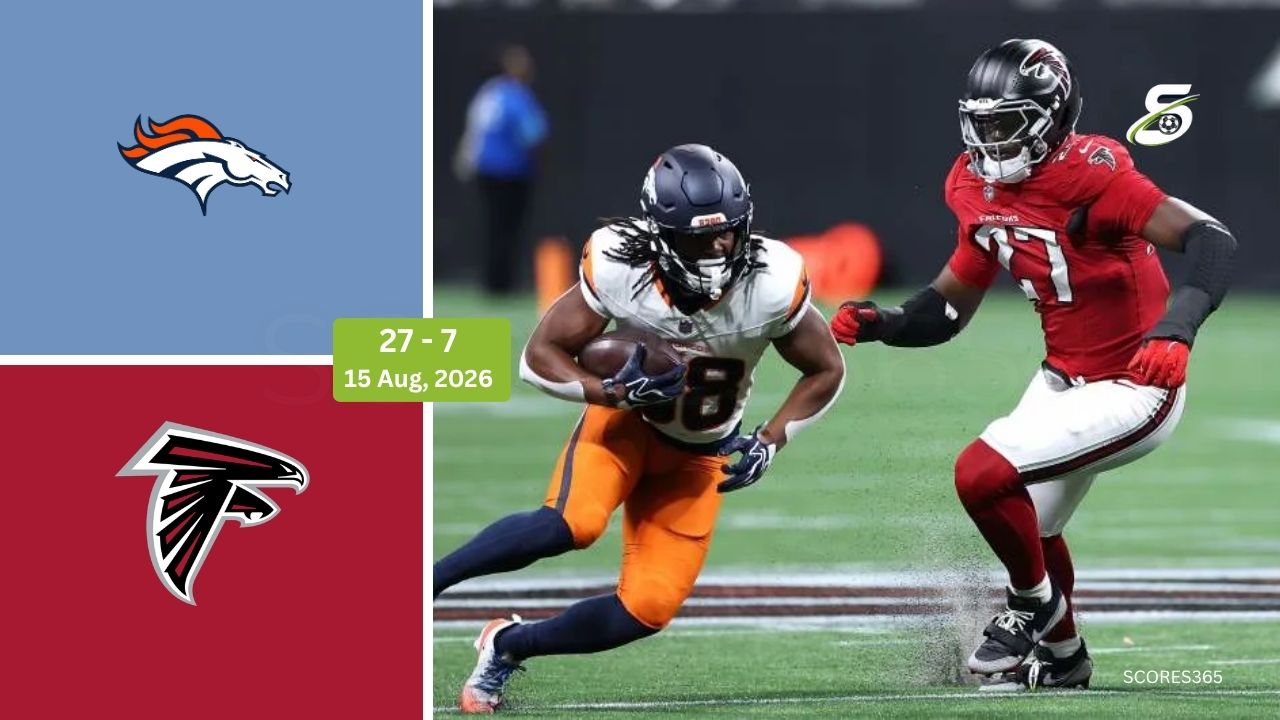
The Denver Broncos vs Atlanta Falcons preseason matchup delivered a convincing performance from Denver, as the Broncos defeated Atlanta 27–7 at Mercedes-Benz Stadium. Denver established control early, scored 17 points in the second quarter and relied on a strong rushing attack and opportunistic defense to secure the victory.
One date clarification is important: although this article is part of your August 15 content list, the game itself was played on Friday, August 14, 2026. The Broncos' official schedule confirms the August 14 date, while the Falcons' official game center also lists the contest as a preseason Week 1 game on August 14.
Denver Broncos vs Atlanta Falcons Final Score
| Team | 1st Quarter | 2nd Quarter | 3rd Quarter | 4th Quarter | Final |
|---|---|---|---|---|---|
| Denver Broncos | 7 | 17 | 0 | 3 | 27 |
| Atlanta Falcons | 0 | 0 | 7 | 0 | 7 |
Denver Takes Control From the Opening Drive
The Broncos did not need much time to establish their advantage.
Denver opened the scoring with a touchdown drive that set the tone for the night. The offense moved efficiently, while the defense limited Atlanta's opportunities.
The Broncos' official postgame analysis noted that Denver scored a touchdown on its opening drive and allowed Atlanta only one first down during the first quarter.
That early defensive pressure was particularly important because Atlanta entered the contest expecting several starters to receive limited playing time.
Adam Prentice Opens the Scoring
Fullback Adam Prentice scored Denver's opening touchdown on the ground.
The Broncos' official highlight identifies Prentice's rushing touchdown as the play that opened the preseason scoring.
The score immediately gave Denver confidence and demonstrated the effectiveness of its rushing attack.
Denver continued to find success on the ground throughout the contest.
Denver's Running Game Becomes a Major Factor
The Broncos finished with 162 rushing yards, averaging 4.2 yards per carry.
That was one of the clearest statistical advantages in the game.
Atlanta, by comparison, managed only 59 rushing yards and averaged 2.6 yards per carry.
The difference allowed Denver to control possession and keep Atlanta's offense off the field.
Head coach Sean Payton also praised the Broncos' running game after the contest, emphasizing the performance of the runners and offensive line.
Jonah Coleman Shows His Balance
Rookie running back Jonah Coleman was one of Denver's notable offensive performers.
Coleman carried the ball four times for 24 yards, averaging six yards per attempt.
His longest run was 13 yards, a play in which he ran through contact and spun away to gain additional yardage. Denver's official postgame report specifically highlighted the run as one of the impressive moments from the rookie.
Coleman's ability to maintain his balance through contact was one of the positive signs for Denver's running-back depth.
Jarrett Stidham Starts at Quarterback
With Bo Nix not playing in the preseason opener, Denver turned to Jarrett Stidham as its starting quarterback.
Stidham completed 9 of 15 passes for 131 yards and one touchdown, without throwing an interception.
His most productive play came early in the contest when he connected with Courtland Sutton for a 40-yard completion.
That explosive pass helped Denver put together its opening scoring drive.
Courtland Sutton Provides a Big Play
Veteran receiver Courtland Sutton recorded three receptions for 60 yards, including a 40-yard catch.
The Broncos' official postgame coverage singled out the Stidham-to-Sutton connection as an important early play.
The 40-yard reception demonstrated Denver's ability to create explosive plays even though its starting quarterback, Nix, was held out of the game.
Sutton's experience also provided a reliable target for Stidham during his limited appearance.
Stidham's Efficient Performance
Stidham's 9-for-15 performance translated into a completion rate of 60%.
He finished with 131 yards and one touchdown, giving Denver enough passing production to complement its strong ground attack.
The Broncos' official game center also confirms that Stidham was not intercepted.
His performance gave Denver another positive from a game in which the team was primarily evaluating depth.
Sam Ehlinger Takes Over
After Stidham's playing time ended, Sam Ehlinger received an extended opportunity at quarterback.
Ehlinger completed 10 of 14 passes for 67 yards and did not throw an interception. He also rushed six times for 21 yards.
Although his passing yardage was lower than Stidham's, Ehlinger kept the offense operating effectively and avoided turnovers.
That provided the Broncos with a second consecutive quarterback performance without an interception.
Denver's Offensive Operation Looks Smooth
Another notable development was the debut of Davis Webb calling plays as Denver's offensive coordinator.
According to the Broncos' postgame report, Payton described the offensive operation as smooth and praised the quarterbacks for getting in and out of the huddle effectively.
That efficiency was reflected in Denver's ability to sustain drives and maintain control.
The Broncos also committed eight penalties for 64 yards, meaning there are still details to clean up, but the overall offensive operation was productive. Explore more Miami Dolphins vs Washington Commanders.
Denver Creates Two First-Half Takeaways
The Broncos' defense produced two first-half takeaways, and both directly led to points.
That was one of the biggest reasons Denver was able to turn its early lead into a commanding halftime advantage.
The Broncos entered halftime ahead 24–0, giving Atlanta a significant deficit to overcome.
Denver's official analysis specifically noted that the two first-half takeaways directly produced 14 points.
Jahdae Barron Scores on a 97-Yard Pick-Six
The defensive highlight belonged to cornerback Jahdae Barron.
Late in the second quarter, Atlanta quarterback Cooper Rush threw a pass that was tipped by linebacker Karene Reid.
Barron intercepted the deflected pass and raced 97 yards for a touchdown.
The Broncos' official report described the play as a major moment in the 27–7 victory.
The pick-six gave Denver another seven points and further extended its advantage.
The Pick-Six Changes the Momentum
The 97-yard interception return was particularly damaging for Atlanta because the Falcons had begun putting together a promising drive.
According to Atlanta's official game breakdown, the Falcons had driven to the Denver 7-yard line before the interception.
Instead of potentially scoring a touchdown, Atlanta gave Denver seven points.
That 14-point swing effectively summarized the difference between the two teams during the first half.
Atlanta's Offense Struggles Early
The Falcons were unable to establish consistent offensive production during the opening half.
Atlanta finished the game with 192 total yards, compared with Denver's 359.
The Broncos also dominated time of possession, holding the ball for 36:20 compared with Atlanta's 23:40.
Those numbers demonstrate how effectively Denver controlled the pace of the game.
Cooper Rush Gets Extended Work
Falcons quarterback Cooper Rush completed 7 of 19 passes for 62 yards and threw two interceptions.
One of those interceptions became Barron's 97-yard touchdown.
Rush did have one promising possession late in the second quarter, completing passes to several different receivers as Atlanta moved deep into Denver territory.
However, the drive ended with the costly interception.
Tua Tagovailoa Appears for Atlanta
Tua Tagovailoa started at quarterback for Atlanta and completed 3 of 5 passes for 22 yards.
His playing time was limited, consistent with the preseason approach Atlanta had announced before the game.
The Falcons were also without quarterback Michael Penix Jr., who had not yet been cleared for full-team work or game action. Atlanta's official coverage confirmed that Penix did not play.
Kyle Pitts Gets Involved
Tight end Kyle Pitts caught three passes for 22 yards.
During Tagovailoa's short appearance, Pitts was targeted frequently. Atlanta's official breakdown noted that four of Tagovailoa's five throws went in Pitts' direction, resulting in 22 receiving yards.
The limited sample size makes it difficult to draw broad conclusions, but it showed that Pitts remained an important part of the early offensive plan.
Chris Blair Stands Out for Atlanta
Wide receiver Chris Blair was one of Atlanta's more encouraging individual performers.
He caught two passes for 37 yards, including a 21-yard reception.
Atlanta's official postgame breakdown named Blair its standout performer and noted his strong training-camp work leading into the contest.
His performance gave the Falcons another positive to build on despite the lopsided final score.
Atlanta Finally Gets on the Scoreboard
The Falcons' only touchdown came during the third quarter.
Quarterback John Michael Schmitz? No according to the official game statistics, the touchdown was scored through Atlanta's offensive rotation, with Jared Strand recording a rushing touchdown.
Strand finished with two carries for three yards and a rushing touchdown.
That touchdown reduced Denver's lead to 24–7.
However, Atlanta could not generate another sustained scoring drive.
Denver Adds a Fourth-Quarter Field Goal
The Broncos' final points came in the fourth quarter.
Denver added a field goal to move the score to 27–7.
That score effectively ended any remaining comeback hopes for Atlanta.
The Broncos' defense then closed out the game without allowing another Falcons score.
Denver's Defense Dominates the Line of Scrimmage
One of the most impressive aspects of the Broncos' performance was their defensive work against the run.
Denver held Atlanta to just 59 rushing yards.
That meant the Falcons struggled to establish a consistent ground game and were forced into more passing situations.
The Broncos' official postgame analysis described the performance as a strong showing at the line of scrimmage.
Broncos Control Time of Possession
Denver possessed the football for 36 minutes and 20 seconds, nearly 13 minutes more than Atlanta.
That advantage was created through successful rushing, efficient quarterback play and the defense's ability to force turnovers.
Keeping the Falcons' offense off the field also limited Atlanta's opportunities to recover from the early deficit.
Denver's Total Offensive Production
The Broncos finished with 359 total net yards.
Their offense produced:
- 197 passing yards
- 162 rushing yards
- One passing touchdown
- Two rushing touchdowns
- No interceptions
The combination of passing and rushing efficiency allowed Denver to maintain pressure throughout the game.
Atlanta's Offensive Numbers
Atlanta finished with 192 total net yards.
The Falcons produced:
- 133 passing yards
- 59 rushing yards
- One rushing touchdown
- Two interceptions
The 167-yard total-yardage difference was a major reason Denver was able to win comfortably.
The Broncos' Preseason Winning Streak Continues
The victory extended Denver's active preseason winning streak to eight games, according to the Broncos' official postgame coverage.
Head coach Sean Payton emphasized that the team still approaches preseason games with the goal of winning despite the developmental nature of the contests.
That streak became one of the notable storylines surrounding Denver's preseason opener.
What the Victory Means for Denver
The Broncos can take several positives from the game.
The biggest include:
- 162 rushing yards
- 27 points
- Two first-half takeaways
- A 97-yard defensive touchdown
- Efficient quarterback play
- Strong defensive performance
- 36:20 time of possession
- Only seven points allowed
Denver also showed that its depth players can maintain the team's offensive structure when the starters leave the field.
What Atlanta Can Take From the Game
The 27–7 loss was not entirely negative for the Falcons.
The preseason gives coaching staffs an opportunity to evaluate players who are competing for roster positions.
Chris Blair's performance was encouraging, while the extended work for Cooper Rush, John Michael Schmitz and other young players gave the coaching staff valuable game film.
Atlanta's official analysis emphasized that the result itself does not determine the team's regular-season outlook.
Key Turning Points
Denver's Opening Touchdown
Adam Prentice's rushing touchdown gave Denver an early 7–0 advantage.
Stidham to Sutton for 40 Yards
The 40-yard connection helped Denver establish offensive momentum.
Denver's First-Half Takeaways
Two turnovers created 14 points for Denver and put Atlanta in a difficult position.
Barron's 97-Yard Pick-Six
Jahdae Barron's interception return was the biggest single play of the contest.
Atlanta's Third-Quarter Touchdown
The Falcons finally scored to make it 24–7, but the deficit remained too large.
Denver's Fourth-Quarter Field Goal
The Broncos' final three points produced the 27–7 final score.
Final Analysis
The Denver Broncos vs Atlanta Falcons preseason opener was a strong all-around performance from Denver.
The Broncos won 27–7, controlling the game through their rushing attack, efficient quarterback play and opportunistic defense.
Denver's 162 rushing yards were particularly important. The team averaged 4.2 yards per carry while holding Atlanta to just 59 rushing yards.
Jarrett Stidham also performed efficiently in place of Bo Nix. He completed nine of 15 passes for 131 yards and a touchdown, while Sam Ehlinger added 67 passing yards without an interception.
Courtland Sutton's three catches for 60 yards, including a 40-yard reception, provided Denver with an explosive element in the passing game.
But the defensive performance may have been even more encouraging.
Denver forced two first-half takeaways, both of which led directly to touchdowns. The biggest play was Jahdae Barron's 97-yard interception return, which came after Karene Reid tipped Cooper Rush's pass.
Atlanta's offense struggled to establish consistency. The Falcons finished with only 192 total yards and threw two interceptions.
There were still some positives for Atlanta. Chris Blair produced 37 receiving yards, Kyle Pitts caught three passes, and several young players received important preseason snaps.
The game also gave Atlanta an opportunity to evaluate its quarterback depth while Michael Penix Jr. remained unavailable for game action.
For Denver, the victory continued an impressive preseason run and gave Sean Payton's staff plenty of positive film to study.
The 27–7 final score does not determine what either team will accomplish during the regular season, but it does show that Denver's depth players executed effectively in the first preseason test.
More Update Scores365