 NFL
NFL
Miami Dolphins vs Washington Commanders Final Score, Result August 15, 2026
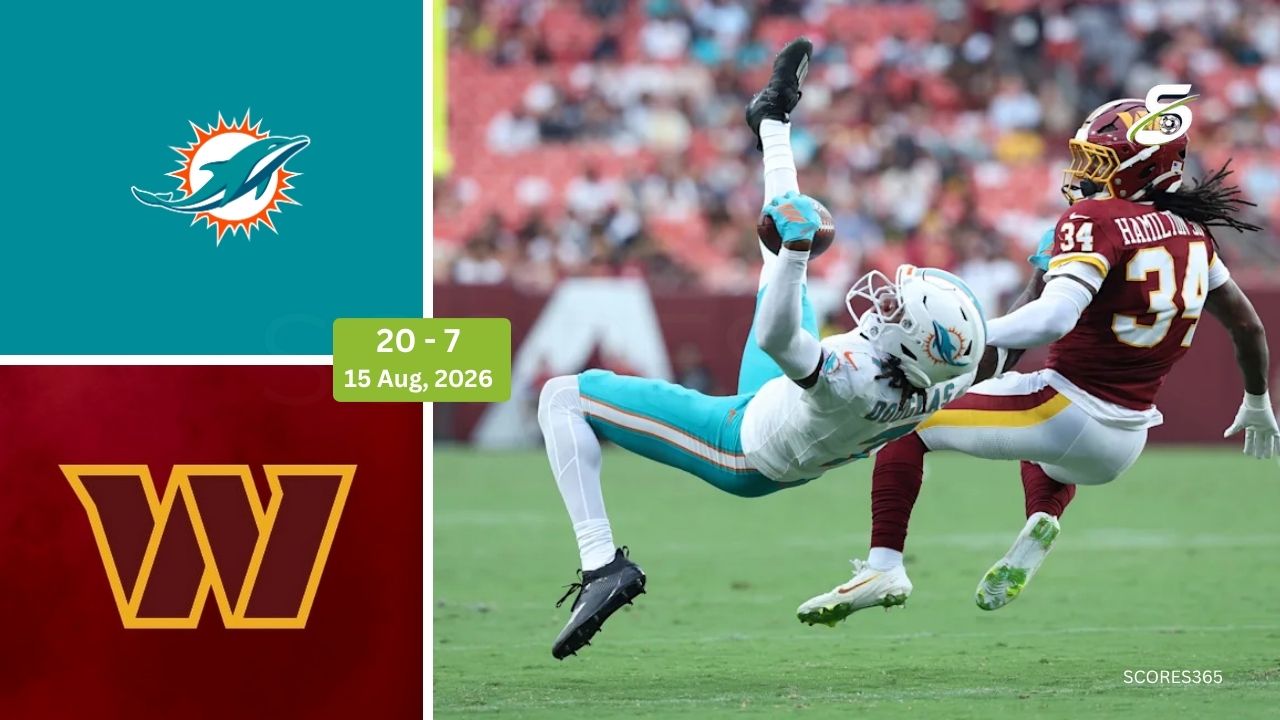
The Miami Dolphins vs Washington Commanders preseason matchup ended with the Washington Commanders earning a 20–7 victory over the Dolphins at Northwest Stadium. Miami started strongly with an opening touchdown drive, but Washington responded with 17 points in the second quarter and controlled the game from there.
There is a small date distinction worth noting for accuracy. The game was officially played on Friday, August 14, 2026, while the Dolphins published their postgame recap on August 15. ESPN's game record also identifies the contest as an August 14 preseason game.
For readers searching for the Miami Dolphins vs Washington Commanders August 15, 2026 result, the key outcome remains the same: Washington defeated Miami 20–7.
Miami Dolphins vs Washington Commanders Final Score
| Team | 1st Quarter | 2nd Quarter | 3rd Quarter | 4th Quarter | Final |
|---|---|---|---|---|---|
| Miami Dolphins | 7 | 0 | 0 | 0 | 7 |
| Washington Commanders | 0 | 17 | 0 | 3 | 20 |
The Dolphins scored the only points of the first quarter, but Washington completely changed the game in the second period. The Commanders scored 17 unanswered second-quarter points, taking a 17–7 advantage into halftime. They then held Miami scoreless during the second half and added a fourth-quarter field goal.
Miami Starts With an Impressive Opening Drive
The Dolphins looked sharp on their first offensive possession.
Quarterback Malik Willis directed a lengthy scoring drive that covered 93 yards over 14 plays. The drive lasted more than seven minutes and immediately put Miami ahead 7–0. ESPN's play-by-play records the opening touchdown drive as 14 plays and 93 yards.
That opening possession was one of the biggest positives for Miami.
Willis was able to move the offense efficiently, while the Dolphins also incorporated their running game to keep Washington's defense from simply focusing on the passing attack.
The drive showed what Miami's offense could look like when Willis was able to establish rhythm early.
Malik Willis Provides an Encouraging Start
Willis finished his night 4-of-5 passing for 43 yards, according to ESPN's official box score. He did not throw an interception and posted a 102.5 passer rating.
His numbers were limited because the preseason contest was designed to evaluate several players, but the efficiency of his opening stint was encouraging.
The Dolphins were able to move the football consistently on their opening drive, and Willis also contributed with his mobility.
NFL's Week 1 analysis noted that Willis took off twice during the opening possession and that Miami repeatedly used running back De'Von Achane during the drive. Read more Tampa Bay Buccaneers vs New York Jets
De'Von Achane Plays an Important Role
Running back De'Von Achane was involved heavily during Miami's opening offensive series.
The Dolphins used Achane seven times on the opening drive, according to NFL's analysis of the game. That usage demonstrated the team's ability to combine its rushing attack with Willis' mobility.
Although preseason statistics need to be considered in the context of limited playing time, Achane's involvement was one of the notable offensive details from Miami's opening possession.
The Dolphins were clearly interested in seeing how the offense operated with Willis at quarterback and Achane contributing in the backfield.
Caleb Douglas Makes an Impression
Wide receiver Caleb Douglas also received attention during the game.
NFL's Week 1 analysis pointed out that Willis primarily targeted Douglas and Malik Washington during his opening series.
That usage provided an early look at how Miami's passing game could distribute opportunities beyond its most established offensive players.
The preseason is particularly important for receivers competing for roster roles because every target can provide useful evidence for coaches evaluating depth.
Washington Turns the Game Around
The biggest change came in the second quarter.
After trailing 7–0, Washington scored 17 points before halftime.
The Commanders' offense found more consistency, while the defense began creating problems for Miami's quarterbacks.
That 17-point explosion completely changed the shape of the game.
Instead of entering halftime with Miami holding a narrow lead, Washington went into the break ahead 17–7.
The Commanders never surrendered that advantage.
Washington's Defense Creates Turnovers
Turnovers were one of the major differences between the two teams.
Miami's quarterbacks combined for three interceptions, while Washington's defense recorded those takeaways at important moments. ESPN's box score credits Ale Kaho, Quan Martin and Malik Spencer with interceptions for the Commanders.
Those turnovers prevented Miami from building momentum after its strong opening drive.
Once Washington established a lead, the Dolphins were unable to produce another scoring possession.
Miami's Quarterback Rotation
The Dolphins used three quarterbacks during the game:
- Malik Willis
- Cam Miller
- Quinn Ewers
Willis completed 4 of 5 passes for 43 yards.
Cam Miller completed 3 of 11 attempts for 39 yards and threw two interceptions.
Quinn Ewers completed 1 of 8 passes for 27 yards, threw one interception and was credited with a sack.
As a group, Miami's quarterbacks finished 8-of-24 for 109 yards with three interceptions.
The sharp contrast between Willis' opening efficiency and the later struggles of the passing game became one of the clearest statistical stories of the matchup.
Cam Miller Faces a Difficult Stretch
Miller received more opportunities after Willis left the game, but his passing numbers were difficult.
He completed only three of 11 attempts and threw two interceptions.
Those mistakes gave Washington additional possessions and made it difficult for Miami to sustain drives.
For a preseason quarterback, the game still provides valuable experience, but the performance also gives the coaching staff several areas to evaluate before the next matchup.
Quinn Ewers Also Gets Game Reps
Ewers completed one of eight passes for 27 yards and threw an interception.
His playing time allowed Miami to evaluate another young quarterback against Washington's defensive depth.
The numbers were not strong, but preseason games are designed specifically to provide these opportunities.
Miami's coaching staff can use the film to determine how Ewers handled pressure, reads and decision-making.
Washington's Quarterback Rotation
The Commanders also rotated quarterbacks.
The official ESPN box score shows Washington using multiple passers during the contest, with the team producing enough offensive consistency to turn the early deficit into a comfortable victory.
Washington's ability to score 20 points despite being held scoreless in the opening quarter demonstrated the improvement of its offense as the game progressed.
Commanders Score 17 Points in the Second Quarter
The second quarter was the decisive period.
Washington scored 17 points, while Miami failed to score.
That 17-point swing turned a 7–0 Dolphins lead into a 17–7 Commanders advantage.
Once Washington took control, the Dolphins could not generate another touchdown.
The Commanders' defense deserves credit for keeping Miami off the scoreboard during the final three quarters.
Miami's Offense Goes Quiet After the First Quarter
The Dolphins' biggest problem was their inability to reproduce the success of the opening drive.
After scoring seven points in the first quarter, Miami finished the game without another point.
The Dolphins were held scoreless in the second, third and fourth quarters.
That offensive decline was particularly noticeable because Miami had moved 93 yards for its opening touchdown.
The contrast between the first drive and the remainder of the game will be an important point for the coaching staff to examine.
Washington Adds a Fourth-Quarter Field Goal
The Commanders' final points came in the fourth quarter.
Washington added a field goal to move the score to 20–7.
The three-point play effectively ended any realistic chance of a Miami comeback.
The Commanders had already kept the Dolphins scoreless for two full quarters, and the fourth-quarter field goal extended their advantage to 13 points.
Commanders Defense Closes the Game
Washington's defense was particularly effective after halftime.
Miami could not find the end zone again, and the Commanders protected their 17–7 halftime lead before adding the final three points.
The three interceptions were also important because they prevented Miami's backup quarterbacks from establishing rhythm.
For a preseason defense, forcing turnovers from young quarterbacks can be especially valuable during roster evaluation.
The Game Was Played at Northwest Stadium
The matchup took place at Northwest Stadium in Landover, Maryland, home of the Washington Commanders.
The official Dolphins game center lists the contest as Preseason Week 1, with Miami entering the game on the road.
Miami's official game information had originally listed the contest for Friday, August 14, at 7 p.m.
Joint Practices Added Context
The Dolphins and Commanders also held joint practices before their preseason meeting.
That provided both teams with additional opportunities to evaluate players against an unfamiliar opponent before the game.
Washington's official coverage noted that the teams worked together during the week ahead of the preseason matchup.
Joint practices can be particularly useful for young players because they offer competitive repetitions without requiring every evaluation to occur during the game itself.
What the Result Means for Miami
The 20–7 defeat gives Miami several areas to review.
The biggest positive was the opening drive.
Willis efficiently moved the offense, and Miami used Achane effectively in the running game.
However, the later quarterback performances were less consistent.
The Dolphins' three interceptions were also costly.
The coaching staff will likely focus on ball security, passing efficiency and the ability to sustain drives after the initial offensive unit leaves the field.
What the Result Means for Washington
Washington can take considerable confidence from the comeback.
The Commanders did not panic after falling behind 7–0.
Instead, they scored 17 points in the second quarter and then completely shut down Miami's offense after halftime.
Three interceptions were among the biggest defensive positives.
The team also demonstrated that its depth players could contribute after the initial units rotated out.
Key Turning Points
Miami's 93-Yard Touchdown Drive
The Dolphins opened the game with a 14-play, 93-yard touchdown drive led by Malik Willis.
Washington's 17-Point Second Quarter
The Commanders responded with 17 points in the second period and took a 17–7 halftime lead.
Miami's First Interception
Washington's defense began creating turnovers, changing the momentum after Miami's promising opening.
Three Commanders Interceptions
Ale Kaho, Quan Martin and Malik Spencer each recorded an interception, according to ESPN's box score.
Miami Held Scoreless After the First Quarter
The Dolphins failed to score during the final three quarters.
Washington Adds the Final Three Points
A fourth-quarter field goal completed the scoring and gave Washington its 20–7 victory.
Miami Dolphins vs Washington Commanders Match Statistics
The most important passing statistics were:
| Player | Completions/Attempts | Passing Yards | TD | INT |
|---|---|---|---|---|
| Malik Willis | 4/5 | 43 | 0 | 0 |
| Cam Miller | 3/11 | 39 | 0 | 2 |
| Quinn Ewers | 1/8 | 27 | 0 | 1 |
| Miami Total | 8/24 | 109 | 0 | 3 |
ESPN's official box score confirms the individual and team passing figures.
The numbers underline how dramatically Miami's passing production changed after Willis left the game.
The Biggest Positive for Miami
The opening possession remains the clearest positive.
A 14-play, 93-yard touchdown drive demonstrated that Miami could execute its offensive plan effectively when Willis was behind center.
The combination of Willis' mobility, Achane's involvement and targeted passing to Douglas and Malik Washington gave the Dolphins a promising start.
The challenge will be maintaining that level of efficiency throughout the game.
The Biggest Positive for Washington
Washington's defensive response was arguably the most impressive aspect of the victory.
After giving up a long touchdown drive, the Commanders adjusted and prevented Miami from scoring again.
Three interceptions helped turn the game in Washington's favor.
The defense's ability to create turnovers also gave the offense additional opportunities to build its lead.
Why the Final Score Matters Less in Preseason
Although Washington's 20–7 victory is the official result, preseason games are primarily about evaluation.
Coaches are looking at:
- Young quarterbacks
- Backup offensive linemen
- Running-back depth
- Wide receiver competition
- Defensive roster battles
- Special-teams roles
- Turnover production
- Overall execution
That makes individual performances and game film more important than the final standings.
Neither team was expected to treat the preseason opener exactly like a regular-season game.
Final Analysis
The Miami Dolphins vs Washington Commanders preseason matchup produced a clear lesson in momentum and quarterback depth.
Miami looked excellent during its opening possession. Malik Willis completed four of five passes for 43 yards and led a 93-yard touchdown drive. His mobility and the involvement of De'Von Achane helped the Dolphins move efficiently down the field.
But after that opening success, the game moved sharply in Washington's direction.
The Commanders scored 17 points in the second quarter, turning a 7–0 deficit into a 17–7 halftime lead. Washington's defense then prevented Miami from scoring during either the third or fourth quarter.
Turnovers were a major factor.
Miami's three quarterbacks combined for three interceptions, while Washington's defense received interceptions from Ale Kaho, Quan Martin and Malik Spencer.
The Dolphins therefore finished with only 109 passing yards and no passing touchdowns.
For Miami, the performance of Willis was encouraging, while the later quarterback play highlighted areas that need improvement. The team will want to protect the football and find greater consistency from its younger quarterbacks.
For Washington, the comeback victory offered a positive start to the preseason. Falling behind 7–0 did not prevent the Commanders from finding their rhythm, and the defense's second-half performance was particularly encouraging.
The final 20–7 score accurately reflects the second-half control Washington established.
One final date clarification is important for anyone publishing this article: the matchup was played on August 14, 2026, not August 15. The Dolphins' official postgame article was published on August 15, which likely explains the date appearing in the requested article list.
For SEO purposes, the keyword “Miami Dolphins vs Washington Commanders” can still be used naturally throughout the article, while the actual game date should remain August 14 to preserve factual accuracy.
More Update SCORES365