 NFL
NFL
Minnesota Vikings vs New York Giants Final Score, Highlights August 15, 2026
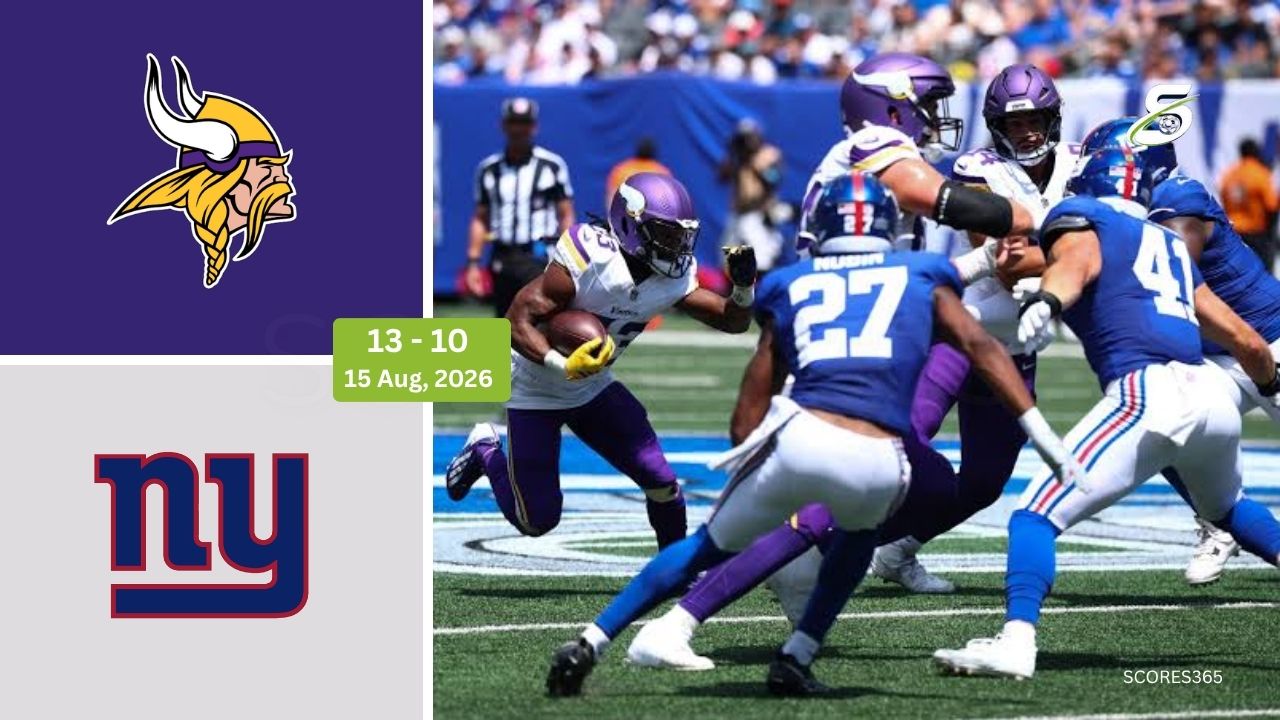
The Minnesota Vikings vs New York Giants preseason matchup on August 15, 2026, produced a closely contested game at MetLife Stadium, with Minnesota holding on for a 13–10 victory over New York. The Vikings controlled the opening stages, the Giants responded with 10 points in the second quarter, and Minnesota eventually regained the lead in the third before shutting out New York in the final period.
Unlike some of the other games in this series, the date here is straightforward: the matchup was officially played on Saturday, August 15, 2026, as the opening preseason game for both teams. The Vikings' official schedule lists the game as Preseason Week 1, with Minnesota winning 13–10 at MetLife Stadium.
Minnesota Vikings vs New York Giants Final Score
| Team | 1st Quarter | 2nd Quarter | 3rd Quarter | 4th Quarter | Final |
|---|---|---|---|---|---|
| Minnesota Vikings | 3 | 0 | 10 | 0 | 13 |
| New York Giants | 0 | 10 | 0 | 0 | 10 |
Minnesota opened the scoring with a first-quarter field goal. New York responded by scoring 10 points in the second quarter to take a 10–3 halftime lead. The Vikings then produced their best offensive stretch of the afternoon in the third quarter, scoring 10 unanswered points to regain the lead.
Kyler Murray Makes His Vikings Debut
One of the biggest storylines entering the game was the Minnesota debut of quarterback Kyler Murray.
Head coach Kevin O'Connell had announced before the game that Murray would start the preseason opener, with J.J. McCarthy also expected to play. Murray received the opening series before giving way to McCarthy.
Murray completed 2 of 3 passes for 10 yards during his brief appearance.
Although those numbers were modest, his first preseason series provided an initial glimpse of how Minnesota intends to use its new quarterback in the offense.
The Vikings did not ask Murray to carry the entire offense. Instead, he operated the opening possession and handed the ball to established running backs while also making a couple of short completions.
Murray Connects With Jordan Addison
Murray's most notable completion came on a third-down situation to Jordan Addison.
The Vikings' official game report said Murray completed a pass to rookie fullback Max Bredeson for a short gain before connecting with Addison for an eight-yard completion that converted a third-and-7.
That play was particularly useful because it demonstrated Murray's ability to make a timely throw when the offense needed to extend the drive.
The reception also gave Addison an early opportunity to work with Murray in a live-game environment.
Minnesota Opens With a Field Goal
The Vikings' opening drive produced points, although it ended with a field goal rather than a touchdown.
Minnesota moved the ball effectively on the ground, with the running game accounting for much of the early production.
The drive ended with a 35-yard field goal, giving the Vikings a 3–0 lead.
That opening possession provided one of the most encouraging early signs for Minnesota: its revamped rushing attack immediately generated explosive plays.
Aaron Jones Jr. Makes an Early Impact
Running back Aaron Jones Sr. was one of the biggest contributors on Minnesota's opening possession.
Jones carried the ball three times for 27 yards, averaging an impressive 9.0 yards per carry.
His first carry of the game went for 18 yards, immediately putting the Giants' defense on notice.
The Vikings' official analysis noted that Jones and fellow running back Jordan Mason combined for 44 of Minnesota's first 54 yards.
That was an important indication of the direction Minnesota wanted to take offensively.
Jordan Mason Adds Another Explosive Run
Jordan Mason also produced an efficient opening series.
Mason carried three times for 17 yards, averaging 5.7 yards per attempt.
His longest run covered 15 yards.
Together, Jones and Mason helped Minnesota gain 44 yards on the ground during the opening possession.
The Vikings entered the preseason with expectations surrounding their revamped running game, and the opening drive provided an early reason for optimism.
The Offensive Line Creates Running Lanes
Minnesota's rushing success was not simply the result of its running backs.
The Vikings' offensive line featured Christian Darrisaw at left tackle and rookie Donovan Jackson at left guard during the opening series.
The combination helped create space for Jones and Mason to make explosive plays.
Minnesota's official game observations specifically highlighted the work of Darrisaw and Jackson as part of the reason the Vikings produced 44 rushing yards on their first possession.
For Minnesota, the performance was encouraging because a stronger running game could influence how defenses approach the team's offense during the regular season.
J.J. McCarthy Plays Most of the First Half
After Murray completed his opening series, J.J. McCarthy took over.
McCarthy played the majority of the first half, giving the Vikings a more extended opportunity to evaluate him in live action.
The Vikings had entered the preseason with considerable interest in how McCarthy would operate alongside Murray, particularly because the team had already named Murray the starter for the opening game.
The preseason opener therefore provided important game repetitions for both quarterbacks.
Giants Take Control in the Second Quarter
New York responded strongly after Minnesota's early field goal.
The Giants scored 10 points during the second quarter, turning the Vikings' 3–0 advantage into a 10–3 halftime deficit for Minnesota.
That reversal demonstrated that the Giants were capable of slowing Minnesota's offense once the game moved beyond the opening series.
New York's defense also managed to prevent the Vikings from adding to their first-quarter total before halftime.
Minnesota's Defense Keeps the Game Close
Although the Giants held the lead at halftime, Minnesota's defense prevented the deficit from becoming larger.
The Vikings entered the second half trailing by only seven points.
That gave the offense an opportunity to take control again without needing multiple scoring possessions.
The defensive performance became increasingly important as Minnesota adjusted after halftime.
Minnesota Scores 10 Points in the Third Quarter
The third quarter was the decisive period. Minnesota scored 10 points, while New York failed to score. That changed the game from a 10–3 Giants advantage into a 13–10 Vikings lead.
The Vikings' ability to reverse the momentum without allowing a Giants response proved crucial. From that point forward, Minnesota's defense protected the three-point lead. Explore more Denver Broncos vs Atlanta Falcons.
Myles Price Provides a Major Offensive Moment
Wide receiver Myles Price was one of the Vikings' most memorable players.
He caught a one-yard touchdown pass from Carson Wentz, giving Minnesota the lead during the third quarter. The Vikings' official coverage specifically highlighted Price's touchdown as one of the key moments of the game.
Price also made a notable 28-yard catch and run, providing another explosive play for the Vikings.
His performance was especially important because preseason games give young receivers opportunities to establish themselves in the competition for roster roles.
Carson Wentz Delivers the Go-Ahead Touchdown
Veteran quarterback Carson Wentz was responsible for the touchdown pass to Price.
The one-yard scoring connection gave Minnesota the lead after the Vikings had trailed 10–3 at halftime.
Wentz's experience also provided Minnesota with another veteran presence at quarterback after Murray and McCarthy had taken their early snaps.
The touchdown became one of the defining offensive plays of the game.
Jacob Thomas Records an Interception
The Vikings also received an important defensive contribution from Jacob Thomas.
Thomas intercepted Giants quarterback Brandon Allen, producing one of Minnesota's key defensive plays.
The Vikings' official coverage highlighted Thomas' interception as one of the game's notable moments.
For a young defensive player, producing a turnover during the preseason can be valuable because it creates a tangible highlight for coaches evaluating the depth chart.
Vikings Defense Shuts Out Giants in Second Half
The most important defensive statistic for Minnesota was the fact that the Giants failed to score after halftime.
New York entered the second half leading 10–3, but Minnesota's defense shut the Giants out during both the third and fourth quarters.
That allowed the Vikings to score only 10 points after halftime and still win the game.
The ability to protect a narrow lead late in the contest was one of Minnesota's most encouraging aspects of the preseason opener.
Justin Jefferson Adds to the Atmosphere
Vikings star receiver Justin Jefferson was also involved in the broadcast during the third quarter.
The Vikings had announced before the game that Jefferson would join the simulcast during the third quarter.
While Jefferson's role was not about producing statistics on the field, his presence added another interesting element to Minnesota's preseason opener.
The team was able to evaluate its young players while one of its established stars observed the action.
Giants Enter a New Era Under John Harbaugh
The matchup also represented the beginning of a new era for the New York Giants.
John Harbaugh was coaching his first game as the Giants' head coach.
The Vikings' official preview noted that Harbaugh had been hired in January as the Giants' 21st head coach.
That made the preseason opener significant for New York even beyond the final score.
The coaching staff had its first opportunity to evaluate players in a live game while establishing the standards and systems that will define the new regime.
Giants Quarterback Rotation
New York used multiple quarterbacks during the contest.
Brandon Allen received an opportunity during the game and was intercepted by Jacob Thomas.
The Giants' quarterback rotation was part of the broader preseason evaluation process, with the coaching staff giving several players opportunities rather than relying exclusively on one quarterback throughout the game.
For a new coaching staff, these repetitions can help establish the team's depth chart.
Vikings' New Players Make Their Debuts
The game also marked NFL debuts for several Minnesota players.
The Vikings' official postgame coverage highlighted the debuts of Max Bredeson and Jacob Thomas, among others.
First-round defensive lineman Caleb Banks also discussed the emotions of playing his first NFL game after the 13–10 victory.
These preseason appearances are significant for rookies because they provide their first opportunity to experience the speed and physicality of professional football in an actual game.
Caleb Banks Begins His NFL Journey
Banks was one of Minnesota's notable rookies entering the preseason.
His first NFL game came in a competitive environment at MetLife Stadium.
Although a preseason box score cannot fully capture a defensive lineman's performance, the experience of playing against NFL competition is an important developmental step.
The Vikings' official coverage emphasized that several newcomers experienced the excitement and nerves associated with their first professional game.
The Vikings' Running Game Is a Major Takeaway
Perhaps the most encouraging aspect of Minnesota's performance was the early rushing production.
Jones and Mason combined for 44 yards on six carries during the opening possession.
Jones averaged 9.0 yards per carry, while Mason averaged 5.7.
Those numbers suggest that Minnesota's offensive line and running backs were able to create explosive plays against New York's defense.
The Vikings will want to build on that production as the preseason continues.
The Importance of the 13–10 Victory
The final score was close, but Minnesota's victory contained several meaningful takeaways.
The Vikings:
- Won their preseason opener
- Scored 13 points
- Held the Giants to 10 points
- Produced 44 rushing yards on the opening drive
- Got a touchdown from Myles Price
- Recorded an interception through Jacob Thomas
- Gave Kyler Murray his Minnesota debut
- Gave J.J. McCarthy significant first-half snaps
- Evaluated several rookies
The result therefore provided plenty of information for Minnesota's coaching staff.
What the Result Means for New York
The Giants' 10–13 loss was a narrow defeat rather than a blowout.
New York led 10–3 at halftime and demonstrated that it could compete with Minnesota.
However, the Giants were unable to score after halftime.
That second-half offensive decline will be something the coaching staff can examine during film review.
At the same time, the Giants received valuable game repetitions for players competing for roster positions.
Preseason Context Matters
The final score should be considered within the context of preseason football.
Both teams were evaluating players and limiting the workload of key starters.
Minnesota's first-team offense was limited to only 10 snaps, according to the Vikings' postgame mailbag coverage.
That means the 13–10 result should not be treated as a prediction of how the teams will perform during the regular season.
Instead, the game was primarily about development, evaluation and establishing rhythm.
Key Turning Points
Minnesota's 35-Yard Field Goal
The Vikings opened the scoring after an effective rushing drive featuring Jones and Mason.
Giants' 10-Point Second Quarter
New York responded with 10 unanswered points to take a 10–3 halftime lead.
Minnesota's Third-Quarter Comeback
The Vikings scored 10 points in the third quarter to regain the lead.
Myles Price's Touchdown
Wentz connected with Price for the go-ahead one-yard touchdown.
Jacob Thomas' Interception
Thomas picked off Giants quarterback Brandon Allen, providing an important defensive turnover.
Giants Held Scoreless Late
New York failed to score during the fourth quarter, allowing Minnesota to protect its 13–10 advantage.
Minnesota Vikings vs New York Giants Match Summary
The game followed a relatively simple pattern.
Minnesota controlled the opening moments and led 3–0.
New York responded strongly in the second quarter and went into halftime ahead 10–3.
The Vikings then produced their best stretch after halftime, scoring 10 points in the third quarter.
The Giants could not answer.
The fourth quarter ended without additional points, leaving Minnesota with a 13–10 victory.
Final Score
Minnesota Vikings 13, New York Giants 10
The Vikings scored three points in the first quarter and 10 in the third.
The Giants scored all 10 of their points in the second quarter.
Neither team scored in the fourth quarter.
Final Analysis
The Minnesota Vikings vs New York Giants preseason opener delivered a competitive 13–10 Minnesota victory at MetLife Stadium on August 15, 2026. The game featured several important storylines for the Vikings. The most prominent was the debut of Kyler Murray, who started the contest and completed two of three passes for 10 yards. His brief appearance gave Minnesota its first live-game look at its new starting quarterback. J.J. McCarthy then played most of the first half, giving the Vikings another opportunity to evaluate their quarterback room.
The running game was arguably the biggest offensive positive. Aaron Jones Sr. gained 27 yards on three carries, while Jordan Mason added 17 yards on three attempts during the opening drive. The pair combined for 44 yards and helped Minnesota move into scoring position.
The offensive line also looked promising, with Christian Darrisaw and first-round rookie Donovan Jackson contributing to the early rushing success. Another major positive was the emergence of Myles Price, who caught a one-yard touchdown pass from Carson Wentz and also produced a 28-yard catch and run. Defensively, Jacob Thomas' interception of Brandon Allen was an important play and gave Minnesota another encouraging moment from a young player.
For the Giants, the game showed both promise and areas for improvement. New York responded well after falling behind 3–0, scoring 10 points in the second quarter and entering halftime with the lead. However, the Giants were unable to produce any points after the break. The final 13–10 score therefore reflected a game decided by Minnesota's second-half response rather than a dominant performance by either side.
More Update SCORES365