

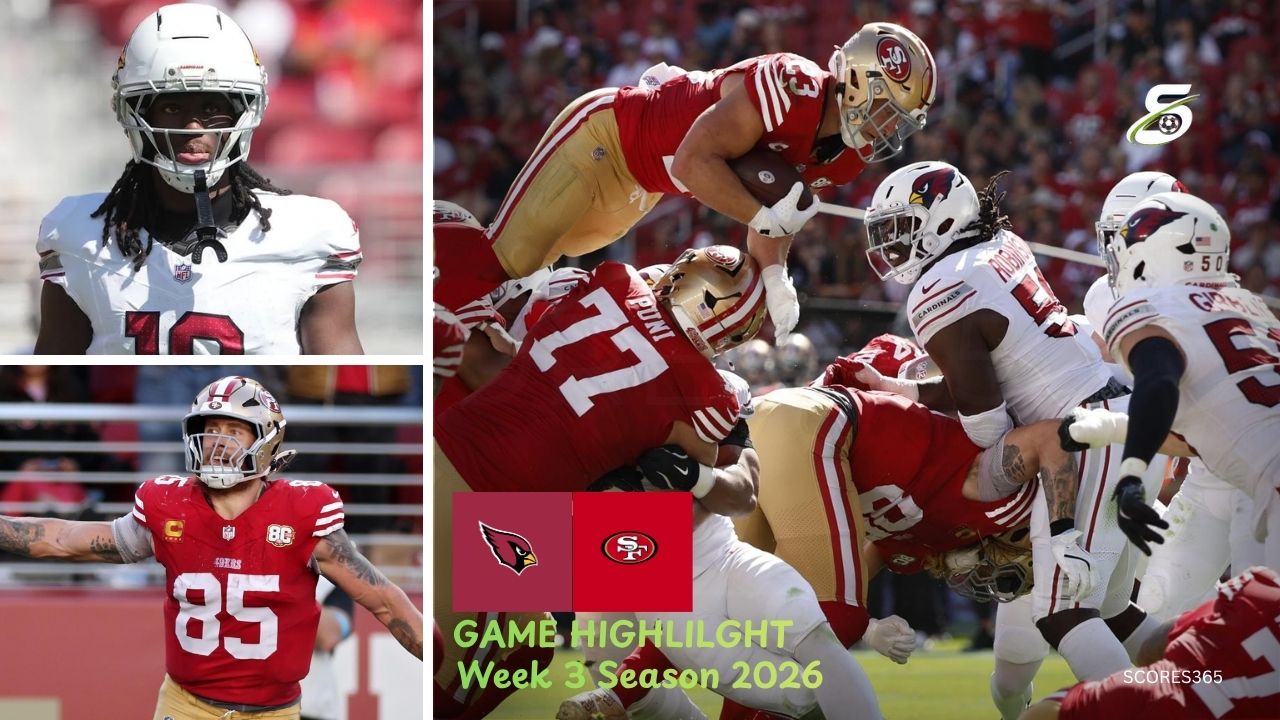
The Arizona Cardinals faced the San Francisco 49ers on September 27, 2026, in an exciting NFC matchup at Levi’s Stadium. San Francisco came away with a 36-30 victory after holding off a strong fourth-quarter comeback from Arizona. The 49ers improved to 3-0, while the Cardinals moved to 1-2. Brock Purdy was the central figure for San Francisco, throwing four touchdown passes, while Arizona quarterback Jacoby Brissett produced 280 passing yards and two touchdowns.
The game featured a significant difference in offensive efficiency. Arizona ran 81 offensive plays and controlled possession for 38:44, but San Francisco gained 437 yards on only 50 plays. The 49ers averaged 8.7 yards per play compared with Arizona’s 4.5. Despite Arizona finishing with no turnovers, San Francisco’s explosive passing attack allowed the home team to maintain enough of a lead to survive the Cardinals’ late push.
Final Score and Scoring Summary
| Quarter | Cardinals | 49ers |
|---|---|---|
| 1st | 0 | 7 |
| 2nd | 6 | 10 |
| 3rd | 7 | 6 |
| 4th | 17 | 13 |
| Final | 30 | 36 |
San Francisco started quickly, taking a 7-0 lead in the first quarter after a creative play involving Brock Purdy and Deebo Samuel. The 49ers extended the advantage in the second quarter with another touchdown pass from Purdy to Mike Evans, followed by a 57-yard field goal from Eddy Piñeiro. Arizona responded with two field goals from Chad Ryland, but San Francisco still led 17-6 at halftime.
The second half became much more competitive. Christian McCaffrey scored on a one-yard run in the third quarter, but Arizona began closing the gap through Brissett’s passing game. Michael Wilson caught a touchdown, Jeremiyah Love added another receiving score, and Brissett ran for a touchdown. San Francisco answered with two fourth-quarter touchdown receptions by George Kittle before Ryland’s late 49-yard field goal brought Arizona within six points.
Arizona Cardinals Team Statistics
Arizona finished with 365 total yards according to the game data, including 280 passing yards and 93 rushing yards. The Cardinals ran 81 plays and converted 9 of 18 third-down opportunities. They also converted both of their fourth-down attempts. Arizona’s long possessions helped keep the 49ers’ offense on the sideline, with the Cardinals holding the ball for 38:44.
The Cardinals’ biggest statistical problem was their efficiency compared with San Francisco. Arizona averaged only 4.5 yards per play, while the 49ers averaged 8.7. Arizona also committed 10 penalties for 86 yards. Although the Cardinals did not turn the ball over, they struggled to turn enough of their long possessions into touchdowns and ultimately fell short by six points.
San Francisco 49ers Team Statistics
San Francisco produced 437 total yards, with 297 passing yards and 140 rushing yards. The 49ers needed only 50 offensive plays to reach that total, highlighting the effectiveness of their explosive plays. Their 8.7 yards per play was almost twice Arizona’s average, and the team finished with 23 first downs.
The 49ers also protected their lead despite holding the football for only 21:16. San Francisco committed one turnover and was penalized seven times for 69 yards. The team’s ability to generate large gains quickly was particularly important because Arizona controlled possession for more than 17 minutes longer.
Important Team Statistics
| Statistic | Arizona Cardinals | San Francisco 49ers |
|---|---|---|
| Total Yards | 365 | 437 |
| Passing Yards | 280 | 297 |
| Rushing Yards | 93 | 140 |
| First Downs | 27 | 23 |
| Third Down | 9/18 | 5/8 |
| Fourth Down | 2/2 | 0/0 |
| Turnovers | 0 | 1 |
| Penalties | 10-86 | 7-69 |
| Possession | 38:44 | 21:16 |
Jacoby Brissett Player Stats
Jacoby Brissett completed 38 of 52 passes for 280 yards and two touchdowns without throwing an interception. He posted a strong completion percentage and kept Arizona’s offense moving throughout the game. Brissett also added four rushing attempts for four yards and scored a rushing touchdown during Arizona’s fourth-quarter comeback.
Brissett’s performance was especially important because Arizona was forced to throw frequently in the second half. His connection with Michael Wilson and Trey McBride helped the Cardinals sustain long drives. However, the 49ers’ explosive offensive production meant that Arizona needed almost every possession to produce points.
| Player | Passing Stats |
|---|---|
| Jacoby Brissett | 38/52, 280 yards, 2 TD, 0 INT |
Brock Purdy Leads the 49ers Offense
Brock Purdy delivered one of the most productive quarterback performances of the matchup. He completed 15 of 27 passes for 297 yards and four touchdowns without an interception. His 11.0 yards per pass attempt reflected the big-play nature of San Francisco’s passing attack. Purdy also ran twice for 34 yards, including a 35-yard run.
Purdy’s four touchdown passes came through several different types of plays. Deebo Samuel scored on an 82-yard play, Mike Evans caught a 23-yard touchdown, and George Kittle scored twice in the fourth quarter. The late connections with Kittle proved particularly important as Arizona continued to reduce the deficit.
George Kittle Makes the Difference
George Kittle finished with six receptions for 82 yards and two touchdowns. His 20-yard touchdown reception in the fourth quarter gave San Francisco a crucial scoring response after Arizona had moved within striking distance. Kittle’s second touchdown helped the 49ers maintain a two-score advantage before Arizona scored again.
Kittle was one of the most important targets in San Francisco’s passing game. His six catches averaged 13.7 yards, and his two touchdowns provided the finishing plays that the 49ers needed. With the Cardinals controlling possession for much of the game, Kittle’s ability to produce explosive plays helped San Francisco compensate for its limited number of offensive possessions.
Michael Wilson Leads Cardinals Receivers
Michael Wilson was Arizona’s leading receiver, recording 11 receptions for 89 yards and one touchdown. His 11 catches gave Brissett a consistent target throughout the game, particularly as Arizona attempted to close the gap during the second half.
Wilson’s five-yard touchdown reception in the third quarter started Arizona’s comeback. He later made an important 18-yard catch during the final stages of the game, helping move the Cardinals into position for another score. His overall performance made him one of the most productive offensive players for Arizona.
Trey McBride Provides Reliable Production
Trey McBride caught nine passes for 75 yards. While he did not score a touchdown, his receiving production helped Arizona sustain drives and maintain possession. McBride averaged 8.3 yards per reception and was targeted 11 times.
McBride was particularly important because Arizona repeatedly needed short and intermediate completions to keep drives alive. His nine receptions represented the second-highest reception total on the Cardinals. The 49ers eventually stopped Arizona’s final comeback attempt, but McBride remained an important part of the offense throughout the contest.
Jeremiyah Love Leads Arizona’s Rushing Attack
Rookie running back Jeremiyah Love led Arizona in rushing with 21 carries for 90 yards. He averaged 4.3 yards per carry and produced consistent gains despite San Francisco’s defensive pressure. Love also caught five passes for 19 yards and scored a receiving touchdown in the fourth quarter.
Love’s workload showed how heavily Arizona relied on him during the matchup. His 90 rushing yards represented nearly all of the Cardinals’ meaningful running-back production. His one-yard touchdown reception from Brissett helped Arizona reduce San Francisco’s advantage to 23-20 early in the fourth quarter.
Christian McCaffrey Adds a Touchdown
Christian McCaffrey rushed 15 times for 75 yards and one touchdown. He averaged exactly five yards per carry and provided San Francisco with a steady rushing option alongside Purdy’s passing production. McCaffrey also caught four passes for 41 yards.
His one-yard touchdown run came in the third quarter and extended the 49ers’ advantage to 23-6 before Arizona’s comeback began. McCaffrey’s combined rushing and receiving contribution gave San Francisco another way to move the football while Arizona attempted to contain Purdy and the passing game.
Deebo Samuel’s 82-Yard Touchdown
Deebo Samuel produced one of the game’s most unusual scoring plays. Early in the first quarter, San Francisco used a trick play that resulted in Samuel scoring on an 82-yard touchdown. The play immediately gave the 49ers a 7-0 lead and demonstrated the explosive nature of their offense.
Samuel’s official receiving line did not resemble a conventional receiving performance because the touchdown came through the unusual play design. He was credited with 80 receiving yards and the touchdown on the explosive sequence. He also added two rushing attempts for 14 yards, contributing in multiple ways.
Key Player Statistics
The game featured several standout individual performances on both sides. Purdy’s four touchdown passes and Kittle’s two receiving touchdowns were central to San Francisco’s victory, while Brissett, Wilson and Love helped Arizona remain competitive into the final minutes.
Arizona’s offensive numbers were built through volume, while San Francisco relied more heavily on explosive plays. The contrast was clear in the play count: Arizona ran 81 plays compared with only 50 for San Francisco. Despite that difference, the 49ers generated 437 yards and six more points.
| Player | Team | Key Statistics |
|---|---|---|
| Brock Purdy | 49ers | 15/27, 297 yards, 4 TD, 0 INT |
| Jacoby Brissett | Cardinals | 38/52, 280 yards, 2 TD, 0 INT |
| George Kittle | 49ers | 6 rec, 82 yards, 2 TD |
| Michael Wilson | Cardinals | 11 rec, 89 yards, 1 TD |
| Christian McCaffrey | 49ers | 15 rush, 75 yards, 1 TD |
| Jeremiyah Love | Cardinals | 21 rush, 90 yards |
| Trey McBride | Cardinals | 9 rec, 75 yards |
| Deebo Samuel | 49ers | 80 receiving yards, 1 TD |
Fourth-Quarter Comeback Attempt
Arizona entered the fourth quarter trailing 23-13 and continued to apply pressure. Brissett’s touchdown pass to Jeremiyah Love reduced the margin to three points, putting the Cardinals in position to potentially take control. San Francisco responded with Purdy’s second touchdown connection to Kittle, pushing the lead back to nine.
Arizona answered again when Brissett scored on a one-yard rushing touchdown, making it 29-27 before the extra point. Kittle then caught his second touchdown of the afternoon, restoring a two-score advantage. Ryland’s 49-yard field goal cut the deficit to six with less than a minute remaining, but San Francisco recovered the ensuing onside kick and secured the victory.
Penalties and Offensive Efficiency
Arizona’s 10 penalties for 86 yards were another important part of the statistical picture. San Francisco was penalized seven times for 69 yards. Although neither team committed an unusually large number of turnovers, the penalties affected Arizona’s ability to maintain efficiency during several drives.
The most notable difference was yards per play. San Francisco averaged 8.7 yards per play compared with Arizona’s 4.5. That gap explains why the 49ers could gain more yards despite running 31 fewer offensive plays. San Francisco’s explosive plays allowed the team to score quickly and preserve its lead.
Final Analysis
The Arizona Cardinals vs San Francisco 49ers matchup was ultimately decided by San Francisco’s explosive offensive efficiency. Arizona possessed the ball for 38:44 and ran 81 plays, but the 49ers generated 437 yards on just 50 plays. Purdy’s four touchdown passes and Kittle’s two fourth-quarter scores provided the decisive difference.
Arizona showed significant resilience and nearly completed a late comeback. Brissett threw for 280 yards and two touchdowns, while Wilson and Love played important roles in the Cardinals’ fourth-quarter scoring surge. However, San Francisco’s ability to create large gains and answer each major Arizona scoring drive allowed the 49ers to finish with a 36-30 victory and remain unbeaten at 3-0.
Final Result
The San Francisco 49ers defeated the Arizona Cardinals 36-30 on September 27, 2026, at Levi’s Stadium. Brock Purdy completed 15 of 27 passes for 297 yards and four touchdowns without an interception. George Kittle caught six passes for 82 yards and two touchdowns, while Christian McCaffrey added 75 rushing yards and a touchdown.
For Arizona, Jacoby Brissett completed 38 of 52 passes for 280 yards and two touchdowns. Michael Wilson led the Cardinals with 89 receiving yards and a touchdown, while Jeremiyah Love rushed for 90 yards. Arizona finished with more offensive plays and longer possession time, but San Francisco’s explosive plays ultimately produced the six-point victory.
VISIT MORE SCORES365