

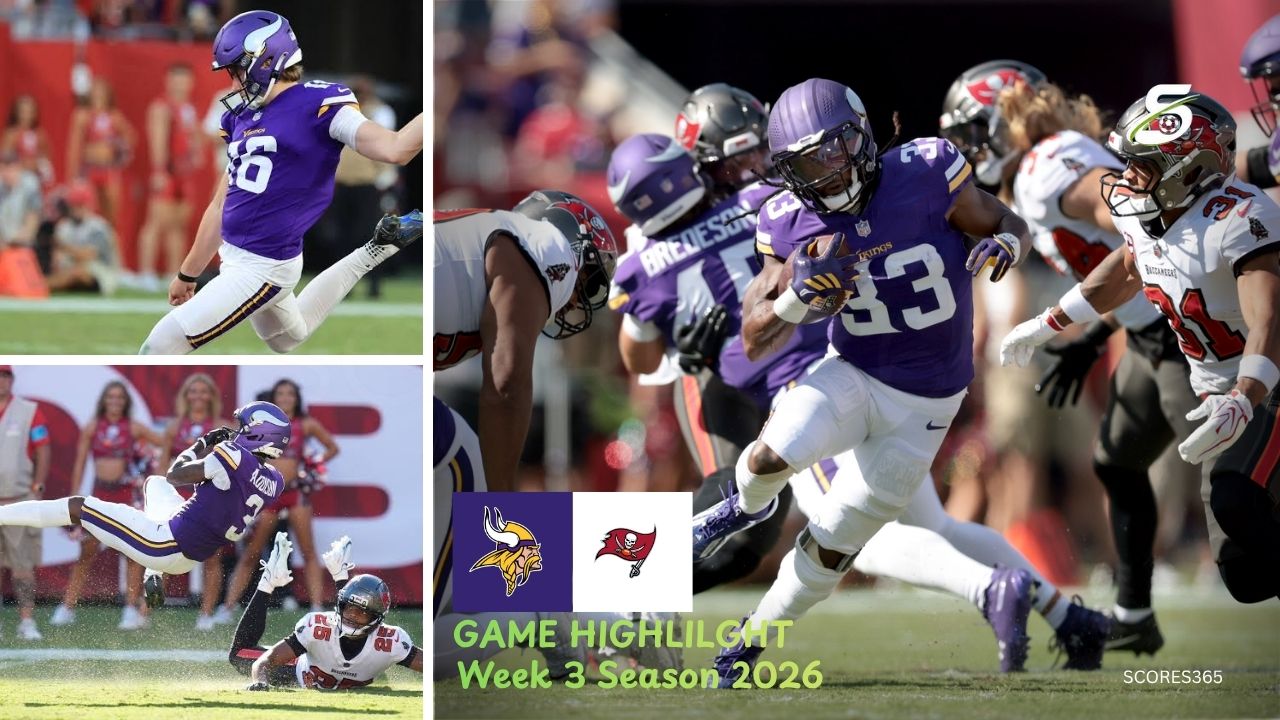
The Minnesota Vikings defeated the Tampa Bay Buccaneers 23–16 in an important Week 3 matchup on September 27, 2026, at Raymond James Stadium. Minnesota improved to 3–0, while Tampa Bay fell to 0–3. The Vikings built a 17–10 halftime advantage and then relied on their defense, special teams and late field goals to secure the victory. The game featured several major individual performances, including Kyler Murray’s passing, Jordan Addison’s touchdown reception and Myles Price’s explosive punt return.
Tampa Bay remained within one score throughout much of the second half, but Minnesota consistently found ways to prevent the Buccaneers from completing the comeback. The Vikings finished with 230 total yards compared with Tampa Bay’s 243, but they produced two takeaways against the Buccaneers’ two turnovers and received a major boost from special teams. The final six points came from Will Reichard field goals of 56 and 43 yards, giving Minnesota enough separation to protect its unbeaten record.
Final Score
| Team | Q1 | Q2 | Q3 | Q4 | Final |
|---|---|---|---|---|---|
| Minnesota Vikings | 10 | 7 | 0 | 6 | 23 |
| Tampa Bay Buccaneers | 7 | 3 | 3 | 3 | 16 |
Minnesota opened the game with a 10–7 first quarter and extended the advantage to 17–10 before halftime. Tampa Bay responded with field goals in the second half, but the Buccaneers could not produce a touchdown after Ted Hurst III’s 40-yard score in the opening quarter. Minnesota’s defense held Tampa Bay to field-goal attempts while the Vikings added two fourth-quarter kicks from Reichard.
The scoring pattern showed how important Minnesota’s early advantage became. The Vikings did not score during the third quarter, but they remained ahead 17–13. Tampa Bay later closed the gap to 20–16, creating a one-possession game entering the final minutes. Reichard’s 43-yard field goal with 37 seconds remaining made it 23–16, and Isaiah Rodgers then intercepted Jalon Daniels on the final Tampa Bay possession to officially end the comeback attempt.
Kyler Murray Performance for Minnesota
Kyler Murray completed 15 of 29 passes for 168 yards, one touchdown and one interception. His most important throw came in the second quarter when he connected with Jordan Addison on a 41-yard touchdown pass. That play restored Minnesota’s lead after Tampa Bay had tied the game at 10–10. Murray also contributed 17 rushing yards on two carries, giving the Vikings another element on offense.
Although Minnesota did not produce a huge offensive yardage total, Murray avoided turning the game into a high-volume passing contest. His 168 passing yards were enough to support a balanced approach built around Aaron Jones and the Vikings’ special teams. The interception was one of Minnesota’s two total turnovers, but the defense prevented Tampa Bay from turning it into a decisive scoring opportunity late in the game.
Jordan Addison Leads Vikings Receiving
Jordan Addison was Minnesota’s leading receiver, finishing with five receptions for 90 yards and one touchdown. His biggest contribution came on the 41-yard touchdown reception from Murray in the second quarter. Addison averaged 18 yards per reception, making his production particularly valuable in a game where explosive offensive plays were limited.
Aaron Jones Sr. also contributed five receptions for 34 yards, while Justin Jefferson recorded two catches for 32 yards before leaving the game with a right ankle injury. The Vikings therefore received their biggest receiving production from Addison, while Jefferson’s early exit reduced Minnesota’s available offensive options for the remainder of the contest.
Aaron Jones Provides the Vikings’ Ground Production
Aaron Jones Sr. led Minnesota’s rushing attack with 17 carries for 58 yards. His longest run covered 14 yards, and he remained an important part of Minnesota’s offensive approach as the Vikings attempted to control the game and protect their lead. Kyler Murray added 17 rushing yards on two attempts, while DeeJay Dallas contributed two yards on one carry.
Jones also played a role in the passing game, catching five passes for 34 yards. His combined rushing and receiving work helped Minnesota maintain possession despite finishing with only 230 total yards. The Vikings ran 55 offensive plays compared with Tampa Bay’s 64, showing that Minnesota’s efficiency and field-position advantages mattered more than simply producing a larger number of offensive snaps.
Baker Mayfield’s Tampa Bay Statistics
Baker Mayfield completed 17 of 34 passes for 217 yards, one touchdown and one interception. He connected with Ted Hurst III for a 40-yard touchdown in the first quarter, which brought Tampa Bay back into the game after Minnesota had opened a 10–0 advantage. Mayfield’s 217 passing yards were the highest passing total of the game, but Tampa Bay struggled to turn those yards into enough points.
Mayfield’s night ended late in the fourth quarter after he injured his right thumb while trying to make a play under pressure. Rookie Jalon Daniels entered for the final possession. Daniels completed none of his three pass attempts and threw an interception to Isaiah Rodgers with eight seconds remaining, ending Tampa Bay’s final opportunity.
Emeka Egbuka and Tampa Bay Receiving Stats
Emeka Egbuka led the Buccaneers in receiving production with five receptions for 62 yards. His 12.4-yard average showed that he remained a consistent target for Tampa Bay despite Minnesota limiting the Buccaneers to 16 points. Cade Otton added three catches for 56 yards, including a 37-yard reception that helped provide some of Tampa Bay’s bigger passing plays.
Ted Hurst III produced the Buccaneers’ only offensive touchdown of the game. He caught a 40-yard pass from Mayfield in the first quarter for his first NFL touchdown. That play briefly shifted momentum after Minnesota’s early field goal and punt-return touchdown, but Tampa Bay could not find another touchdown during the remaining three quarters.
Read New York Jets vs Detroit Lions Match Player Stats and Team Statistics
Myles Price Delivers a Major Special Teams Play
One of the biggest Minnesota Vikings vs Tampa Bay Buccaneers match player stats stories came from special teams. Myles Price returned a punt 86 yards for a touchdown in the first quarter. The return immediately gave Minnesota a 10–0 advantage and proved decisive in a game where neither offense consistently produced long scoring drives.
The special-teams touchdown was particularly important because Tampa Bay’s offense later moved the ball but struggled to finish drives with touchdowns. Minnesota also received strong field-position value from its kicking game. The combination of Price’s return and Reichard’s late field goals allowed the Vikings to win despite being outgained 243–230 in total yards.
Important Team Statistics
| Statistic | Minnesota Vikings | Tampa Bay Buccaneers |
|---|---|---|
| Total Yards | 230 | 243 |
| Plays | 55 | 64 |
| Yards per Play | 4.2 | 3.8 |
| Possession | 29:03 | 30:57 |
| Turnovers | 1 | 2 |
| Penalties | 9 | 8 |
| Penalty Yards | 95 | 81 |
The overall numbers show a relatively close statistical game. Tampa Bay had more total yards and held the ball for almost two additional minutes, but Minnesota produced the better scoring efficiency. The Vikings also benefited from Tampa Bay’s two turnovers. Minnesota’s defense and special teams converted key moments into points, which ultimately compensated for the Buccaneers’ modest advantage in offensive yardage.
Minnesota ran 55 plays and averaged 4.2 yards per play, while Tampa Bay ran 64 plays at 3.8 yards per play. The Buccaneers also committed eight penalties for 81 yards, compared with nine Minnesota penalties for 95 yards. Neither team was particularly efficient offensively, making the Vikings’ explosive special-teams touchdown and late kicking performance even more influential in determining the final result.
Fourth-Quarter Key Highlights
The fourth quarter became the decisive period. Tampa Bay entered the quarter trailing 17–13 and cut the deficit to one possession with a Chase McLaughlin field goal. Minnesota answered with Reichard’s 56-yard field goal, giving the Vikings a 20–16 lead. The Buccaneers then had another opportunity to score, but Minnesota’s defense continued to prevent a touchdown and forced Tampa Bay to rely on field goals.
Reichard’s 43-yard field goal with 37 seconds remaining pushed Minnesota’s advantage to 23–16. Tampa Bay received one final chance, but Daniels’ deep pass was intercepted by Isaiah Rodgers at the Minnesota 3-yard line with eight seconds left. Rodgers’ interception preserved the seven-point victory and completed Minnesota’s third straight win of the season.
Minnesota Vikings vs Tampa Bay Buccaneers Match Player Stats Summary
| Player | Team | Key Statistics |
|---|---|---|
| Kyler Murray | Vikings | 15/29, 168 yards, 1 TD, 1 INT |
| Aaron Jones Sr. | Vikings | 17 carries, 58 yards; 5 receptions, 34 yards |
| Jordan Addison | Vikings | 5 receptions, 90 yards, 1 TD |
| Justin Jefferson | Vikings | 2 receptions, 32 yards |
| Myles Price | Vikings | 86-yard punt return TD |
| Baker Mayfield | Buccaneers | 17/34, 217 yards, 1 TD, 1 INT |
| Bucky Irving | Buccaneers | 15 carries, 46 yards |
| Emeka Egbuka | Buccaneers | 5 receptions, 62 yards |
| Cade Otton | Buccaneers | 3 receptions, 56 yards |
| Ted Hurst III | Buccaneers | 1 reception, 40 yards, 1 TD |
These individual numbers underline the contrasting paths taken by the two teams. Murray produced Minnesota’s key passing touchdown, Addison delivered the largest receiving performance, and Price supplied the game’s most explosive special-teams moment. For Tampa Bay, Mayfield led the passing production while Egbuka and Otton supplied most of the receiving yardage, but the Buccaneers could not convert enough of their opportunities into touchdowns.
The final statistics also show why the score remained competitive despite Minnesota controlling the scoreboard for most of the afternoon. Tampa Bay generated 243 yards to Minnesota’s 230, yet the Vikings produced the game’s two most important scoring advantages: Price’s punt-return touchdown and Reichard’s fourth-quarter field goals. Minnesota’s defense also came through when it mattered most, with Rodgers’ late interception sealing the victory.
Final Analysis
The Minnesota Vikings’ 23–16 victory was built on timely plays rather than overwhelming offensive production. Murray finished with 168 passing yards, Jones supplied 58 rushing yards, and Addison recorded 90 receiving yards with a touchdown. Price’s 86-yard punt return provided an early seven-point swing, while Reichard converted two long fourth-quarter field goals. Those contributions allowed Minnesota to remain unbeaten at 3–0 despite being outgained by Tampa Bay.
For Tampa Bay, Mayfield’s 217 passing yards and Hurst’s 40-yard touchdown provided promising moments, but the Buccaneers struggled to finish drives. Mayfield’s late injury forced Daniels into the final possession, and Rodgers’ interception ended the contest. The 23–16 result moved Tampa Bay to 0–3, while Minnesota continued its perfect start to the 2026 NFL season.
VISIT MORE SCORES365