

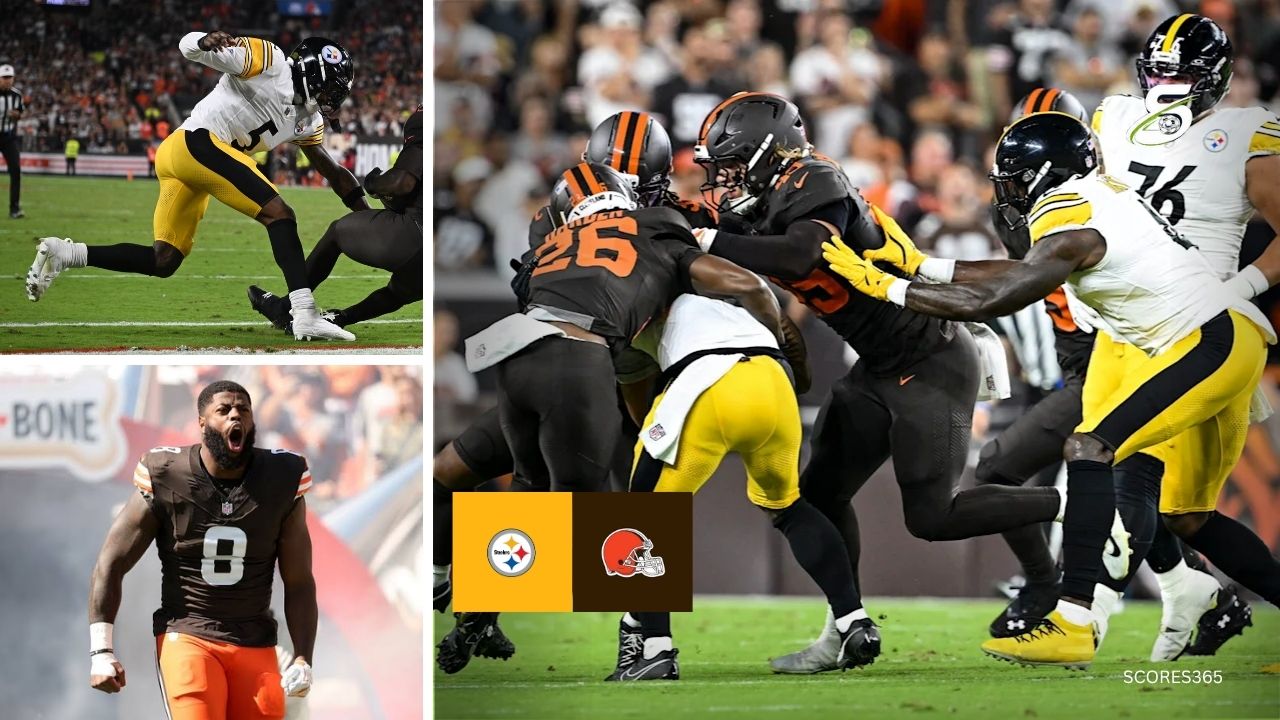
The Pittsburgh Steelers vs Cleveland Browns Match Player Stats from the 2026 NFL Week 4 matchup tell the story of a closely contested AFC North game decided in the final seconds. Cleveland defeated Pittsburgh 27–24 on Thursday, October 1, 2026, at Huntington Bank Field in Cleveland. The Steelers built an early lead, but the Browns responded with three touchdowns in the second quarter. Pittsburgh then produced a fourth-quarter comeback to tie the game at 24–24, before Cleveland kicker Andre Szmyt converted a 56-yard field goal with 10 seconds remaining.
The result moved Cleveland to a 3–1 record, while Pittsburgh fell to 2–2. Deshaun Watson completed 24 of 33 passes for 268 yards, one touchdown and one interception for the Browns. Aaron Rodgers threw for 299 yards and three touchdowns for the Steelers, but also had two interceptions. Jaylen Warren contributed 126 yards from scrimmage, and DK Metcalf recorded 115 receiving yards. Cleveland’s defense made five sacks and two interceptions, while Grant Delpit’s late interception ended Pittsburgh’s final attempt to respond.
Final Score
| Match Detail | Information |
|---|---|
| Match | Pittsburgh Steelers vs Cleveland Browns |
| Date | October 1, 2026 |
| NFL Week | Week 4 |
| Competition | NFL Regular Season |
| Venue | Huntington Bank Field, Cleveland |
| Steelers | 24 |
| Browns | 27 |
| Halftime Score | Steelers 10–21 Browns |
| Steelers Record | 2–2 |
| Browns Record | 3–1 |
Cleveland finished the game with 27 points, three more than Pittsburgh’s 24. The Browns’ victory came after they had surrendered an 11-point lead entering the fourth quarter. Pittsburgh scored 14 points in the final period to draw level, but Cleveland created one last scoring opportunity and converted it into the winning field goal. The game’s final sequence highlighted how quickly the result could change, with the Browns taking the lead again just seconds before the final whistle.
The game was played in Cleveland on October 1, which may appear as October 2 in some international time zones. The official game center and postgame reports list it as a Thursday night Week 4 fixture. Cleveland’s 3–1 record after the win reflected its third consecutive victory, while Pittsburgh’s loss brought its record to 2–2. The teams remained divisional rivals, making the result relevant to their early-season AFC North standings.
Quarter-by-Quarter Score Breakdown
| Quarter | Pittsburgh Steelers | Cleveland Browns |
|---|---|---|
| First | 7 | 0 |
| Second | 3 | 21 |
| Third | 0 | 0 |
| Fourth | 14 | 6 |
| Final | 24 | 27 |
Pittsburgh opened the scoring in the first quarter through Roman Wilson’s 12-yard touchdown reception from Aaron Rodgers. The Steelers’ opening drive covered 78 yards over 17 plays and lasted 9 minutes and 48 seconds. Cleveland did not score in the opening period, but the Browns changed the game in the second quarter with three touchdowns. Jaleel McLaughlin scored on a 28-yard run, Quinshon Judkins added a two-yard rushing touchdown, and Deshaun Watson connected with Harold Fannin Jr. for a two-yard score.
The Browns carried a 21–10 advantage into halftime after Chris Boswell made a 31-yard field goal for Pittsburgh with eight seconds remaining in the second quarter. Neither team scored in the third period, leaving the Browns with an 11-point lead heading into the final quarter. Pittsburgh then scored twice, including a touchdown pass to Darnell Washington and a late scoring connection with Pat Freiermuth, along with a successful two-point conversion. Cleveland’s 44-yard field goal and late 56-yard kick supplied the points needed for the 27–24 result.
Pittsburgh Steelers Passing Stats
| Player | Completions/Attempts | Passing Yards | TD | INT |
|---|---|---|---|---|
| Aaron Rodgers | 22/40 | 299 | 3 | 2 |
Aaron Rodgers completed 22 of 40 passes for 299 yards, three touchdowns and two interceptions. He was sacked five times for a loss of 30 yards, and his passer rating was 83.2. Rodgers connected with Roman Wilson for the game’s opening touchdown and later found Darnell Washington and Pat Freiermuth in the fourth quarter. His passing production helped Pittsburgh recover from the second-quarter deficit and tie the score late in the game.
Rodgers’ two interceptions were significant turnovers in a contest decided by a field goal. Cleveland’s Denzel Ward intercepted a pass intended for Michael Pittman Jr. during the first half, helping set up the Browns’ scoring surge. Grant Delpit intercepted Rodgers’ final pass with one second remaining, ending Pittsburgh’s last opportunity. Rodgers’ 299 passing yards and three touchdown passes reflected his role in the Steelers’ comeback, while the turnovers and five sacks also formed part of the game’s statistical picture.
Cleveland Browns Passing Stats
| Player | Completions/Attempts | Passing Yards | TD | INT |
|---|---|---|---|---|
| Deshaun Watson | 24/33 | 268 | 1 | 1 |
Deshaun Watson completed 24 of 33 passes for 268 yards, one touchdown and one interception. He also recorded seven rushing attempts for 22 yards. Watson’s touchdown pass went to Harold Fannin Jr. late in the second quarter, capping an 11-play, 62-yard drive. He connected with Denzel Boston for a 60-yard gain earlier in the quarter, a key play that helped Cleveland move into scoring position for Judkins’ rushing touchdown.
Watson’s passing production helped Cleveland answer Pittsburgh’s opening touchdown and build a lead. His interception in the fourth quarter gave the Steelers an opportunity to begin their comeback, but he later directed the Browns’ final possession after Pittsburgh tied the score. Watson moved Cleveland 36 net yards over seven plays, putting Andre Szmyt in position for the winning field goal. His final passing line combined efficient completion volume with one interception, while his late-game drive contributed directly to the result.
Rushing Player Stats
| Team | Player | Carries | Rushing Yards | TD |
|---|---|---|---|---|
| Steelers | Jaylen Warren | 17 | 93 | 0 |
| Steelers | Travis Homer | 2 | -1 | 0 |
| Browns | Quinshon Judkins | 17 | 53 | 1 |
| Browns | Jaleel McLaughlin | 1 | 28 | 1 |
| Browns | Deshaun Watson | 7 | 22 | 0 |
| Browns | Raheim Sanders | 2 | 9 | 0 |
Jaylen Warren led Pittsburgh in rushing with 93 yards on 17 carries, averaging approximately 5.5 yards per attempt. He also caught three passes for 33 yards, finishing with 126 yards from scrimmage. Warren’s combined rushing and receiving output gave the Steelers production from the backfield, although he did not score a rushing touchdown. Travis Homer had two carries for minus-one yard in the recorded rushing statistics.
For Cleveland, Quinshon Judkins rushed 17 times for 53 yards and a touchdown, while Jaleel McLaughlin scored on his only carry, a 28-yard touchdown run. Watson added 22 rushing yards, and Raheim Sanders gained nine yards on two attempts. Judkins’ short touchdown run came during the Browns’ second-quarter scoring stretch, while McLaughlin’s long run tied the game at 7–7. Cleveland’s rushing scores helped the team turn its second-quarter opportunities into a lead.
Receiving Player Stats
| Team | Player | Receptions | Receiving Yards | TD |
|---|---|---|---|---|
| Steelers | DK Metcalf | 5 | 115 | 0 |
| Steelers | Roman Wilson | 3 | 74 | 1 |
| Steelers | Darnell Washington | 3 | 27 | 1 |
| Steelers | Pat Freiermuth | 3 | 17 | 1 |
| Steelers | Michael Pittman Jr. | 2 | 15 | 0 |
| Browns | Denzel Boston | 4 | 89 | 0 |
| Browns | KC Concepcion | 5 | 64 | 0 |
| Browns | Jerry Jeudy | 3 | 36 | 0 |
| Browns | Harold Fannin Jr. | 3 | 27 | 1 |
| Browns | Quinshon Judkins | 6 | 43 | 0 |
DK Metcalf led the Steelers with five receptions for 115 yards, including a 43-yard gain during the fourth-quarter comeback. Roman Wilson caught three passes for 74 yards and scored Pittsburgh’s opening touchdown on a 12-yard reception. Darnell Washington also caught a touchdown, finishing with three receptions for 27 yards, while Pat Freiermuth caught three passes for 17 yards and recorded the late touchdown that tied the score. These receiving contributions accounted for all three of Rodgers’ touchdown passes.
Denzel Boston led Cleveland in receiving yards with 89 on four catches, including a 60-yard reception that helped set up Judkins’ touchdown. KC Concepcion added five receptions for 64 yards, and Jerry Jeudy recorded three catches for 36 yards. Harold Fannin Jr. finished with three receptions for 27 yards and the Browns’ only passing touchdown. Quinshon Judkins also contributed six receptions for 43 yards, giving Cleveland a receiving option out of the backfield in addition to his rushing production.
Team Statistics Comparison
| Statistic | Steelers | Browns |
|---|---|---|
| Total Yards | 361 | 372 |
| Passing Yards | 269 | 260 |
| Rushing Yards | 92 | 112 |
| Total Plays | 64 | 62 |
| Yards per Play | 5.6 | 6.0 |
| Time of Possession | 31:11 | 28:49 |
| Turnovers | 2 | 2 |
| Penalties | 8 | 14 |
| Penalty Yards | 50 | 88 |
Cleveland recorded 372 total yards, narrowly exceeding Pittsburgh’s 361. The Browns gained 260 passing yards and 112 rushing yards, while the Steelers produced 269 passing yards and 92 rushing yards. Pittsburgh ran 64 plays compared with Cleveland’s 62 and held the ball for 31 minutes and 11 seconds. Cleveland averaged 6.0 yards per play, compared with Pittsburgh’s 5.6. The totals show that both offenses generated yardage, with the Browns finishing slightly ahead in overall production.
Both teams committed two turnovers, while Cleveland was penalized 14 times for 88 yards and Pittsburgh was penalized eight times for 50 yards. The Browns’ penalty total was higher, but they still converted their late opportunity into the decisive score. Pittsburgh’s time-of-possession advantage did not translate into a win, as Cleveland’s second-quarter touchdowns and late field goal proved central to the result. The numbers provide context for a game in which neither team dominated every statistical category.
Defensive Performance and Turnovers
Cleveland’s defense recorded five sacks and two interceptions, applying pressure to Rodgers and creating key opportunities for the offense. Denzel Ward intercepted Rodgers in the first half, helping Cleveland take control after Pittsburgh’s opening touchdown. Grant Delpit made the final interception with one second remaining, preventing the Steelers from attempting another scoring drive. The Browns also produced a sack by Isaiah McGuire that contributed to Pittsburgh’s missed 48-yard field-goal attempt, while Mike Hall Jr. recorded a third-down sack after a Cleveland fumble in the third quarter.
Pittsburgh’s defense also generated important plays, including an interception by Robert Spears-Jennings and a strong individual contribution from T.J. Watt. Watt recorded a sack, forced a fumble and recovered a fumble, giving the Steelers chances to regain possession. Spears-Jennings’ interception in the fourth quarter helped trigger Pittsburgh’s comeback. Despite these defensive contributions, the Steelers were unable to prevent Cleveland’s final drive from reaching field-goal range. Both defenses produced turnovers, but the late interception by Delpit ended the contest.
Key Turning Points and Final Drive
The first major turning point came in the second quarter, when Cleveland scored three touchdowns after falling behind 7–0. Ward’s interception gave the Browns a valuable possession, and McLaughlin converted it into a 28-yard rushing touchdown. Boston’s 60-yard reception then helped create the opportunity for Judkins’ short touchdown run. Watson’s pass to Fannin completed the scoring run, giving Cleveland a 21–7 lead. Pittsburgh added a field goal before halftime, but the Browns still carried an 11-point advantage into the break.
Pittsburgh’s fourth-quarter response brought the score to 24–24. Rodgers threw touchdown passes to Washington and Freiermuth, and his successful two-point conversion on a quarterback sneak tied the game with 1:42 remaining. Watson then led Cleveland on a seven-play, 36-yard drive, moving the ball into position for Szmyt. The kicker converted from 56 yards with 10 seconds left, putting Cleveland ahead 27–24. Delpit intercepted Rodgers’ final pass to secure the Browns’ victory and close the game.
Conclusion
The Pittsburgh Steelers vs Cleveland Browns Match Player Stats Complete Game Breakdown reflects a game shaped by second-quarter scoring, fourth-quarter pressure and a decisive late field goal. Cleveland won 27–24 after scoring three touchdowns in the second quarter and responding to Pittsburgh’s late comeback. Deshaun Watson passed for 268 yards and a touchdown, Quinshon Judkins and Jaleel McLaughlin scored rushing touchdowns, and Harold Fannin Jr. caught a touchdown pass. Andre Szmyt’s 56-yard field goal with 10 seconds remaining supplied the winning points.
Aaron Rodgers finished with 299 passing yards and three touchdowns for Pittsburgh, while Jaylen Warren recorded 126 yards from scrimmage and DK Metcalf gained 115 receiving yards. The Steelers’ fourth-quarter scoring brought the game level, but Cleveland’s final possession and Delpit’s interception ended Pittsburgh’s chance to take the lead. The result gave Cleveland a 3–1 record and moved Pittsburgh to 2–2 after Week 4. The game’s statistical record highlights offensive production from both sides and the impact of defensive turnovers at important moments.
More Update SCORES365