

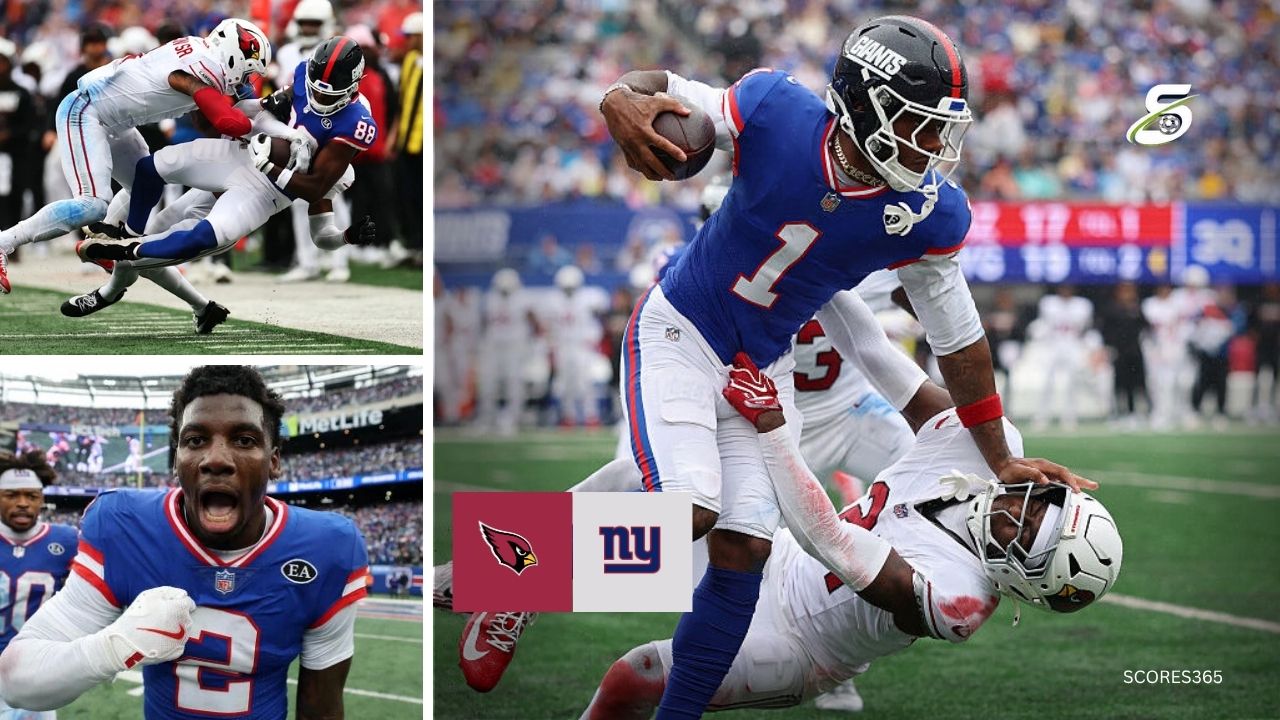
The Arizona Cardinals vs New York Giants Match Player Stats from Week 4 of the 2026 NFL season tell the story of a game that changed direction several times before the Giants secured a 36-24 victory at MetLife Stadium on October 4, 2026. Arizona started quickly and built a 14-3 advantage in the opening quarter, but New York gradually changed the momentum through its passing game, defensive pressure, and timely field goals. The Giants entered the contest with a 2-1 record and finished the afternoon at 3-1, while the Cardinals dropped to 1-3 after their third consecutive loss.
The game produced six total turnovers and three lead changes, making the final margin more complicated than the 12-point score suggests. Jameis Winston completed 18 of 29 passes for 250 yards, three touchdowns, and two interceptions for New York. Jacoby Brissett finished with 166 passing yards, two touchdown passes, and three interceptions for Arizona. Malik Nabers recorded six catches for 112 yards and a touchdown, while Michael Wilson led the Cardinals with seven receptions for 95 yards. The decisive moment arrived with 11 seconds left when Deonte Banks intercepted Brissett and returned the ball 98 yards for a touchdown.
Final Score
The final score was New York Giants 36, Arizona Cardinals 24. Arizona controlled the opening quarter with 14 points, but the Giants answered with 16 points in the second quarter and entered halftime ahead 19-17. The Cardinals briefly regained control in the third quarter by taking a 24-19 lead, but New York responded with a touchdown and two-point conversion before adding a fourth-quarter field goal. Banks’ interception return at the end of the game completed the scoring and gave the Giants their second consecutive victory.
The overall team statistics showed that New York gained 319 total yards compared with Arizona’s 270. The Cardinals had 123 rushing yards, while the Giants finished with 87, but New York produced 232 net passing yards compared with 147 for Arizona. Possession also favored the Giants, who controlled the ball for 32:13 compared with 27:47 for the Cardinals. Both teams committed three turnovers, but the Giants converted important defensive opportunities into points while Arizona struggled to finish several promising drives.
| Match Detail | Information |
|---|---|
| Match | Arizona Cardinals vs New York Giants |
| Date | October 4, 2026 |
| Week | NFL Week 4 |
| Venue | MetLife Stadium |
| Location | East Rutherford, New Jersey |
| Final Score | Giants 36, Cardinals 24 |
| Cardinals Record | 1-3 |
| Giants Record | 3-1 |
Quarter-by-Quarter Breakdown
Arizona immediately established its offense. Jacoby Brissett connected with Marvin Harrison Jr. for a 12-yard touchdown, and Tyler Allgeier later finished a 22-yard rushing touchdown to give the Cardinals a 14-3 lead. New York’s offense produced only a field goal in the opening quarter, but Malik Nabers helped keep drives alive with important receptions. The Giants then began to find more success in the second quarter, with Malachi Fields catching a touchdown from Winston and Nabers adding a 25-yard touchdown reception.
The second half became increasingly competitive. Arizona moved back in front 24-19 after Brissett found Elijah Higgins for a two-yard touchdown in the third quarter. New York responded with a 40-yard Winston-to-Fields completion on third-and-20, followed by an 11-yard touchdown pass to Theo Johnson. Najee Harris added the successful two-point conversion to make it 27-24. In the fourth quarter, Dominic Zvada extended the lead to 30-24 with a 52-yard field goal. Banks then ended Arizona’s final possession with the game-sealing pick-six.
Read Baltimore Ravens vs Dallas Cowboys Match Player Stats and Key Highlights
Arizona Cardinals Passing and Rushing Statistics
Jacoby Brissett finished 21 of 35 passing for 166 yards, two touchdowns, and three interceptions. His passing output included several productive moments, particularly during Arizona’s early drives, but the three interceptions became decisive. The final interception was especially costly because it occurred near the Giants’ goal line with Arizona attempting to tie or win the game. Brissett also contributed 18 rushing yards on four attempts. The Cardinals’ passing game relied heavily on Michael Wilson and Trey McBride, while the rushing attack received meaningful production from Jeremiyah Love and Tyler Allgeier.
| Cardinals Player | Statistics |
|---|---|
| Jacoby Brissett | 21/35, 166 pass yards, 2 TD, 3 INT |
| Jeremiyah Love | 14 carries, 63 yards |
| Tyler Allgeier | 8 carries, 42 yards, 1 TD |
| Michael Wilson | 7 receptions, 95 yards |
| Trey McBride | 7 receptions, 31 yards |
| Elijah Higgins | 2 receptions, 19 yards, 1 TD |
Arizona’s rushing attack was one of the stronger parts of its offensive performance. Love averaged 4.5 yards per carry and produced 63 yards on 14 attempts, while Allgeier added 42 yards and a 22-yard touchdown. The Cardinals finished with 123 rushing yards, which was considerably more than New York’s 87. However, the advantage on the ground did not translate into victory because the Cardinals lost important possessions through turnovers. The offense also had difficulty sustaining late drives after the Giants increased defensive pressure.
New York Giants Passing and Rushing Statistics
Jameis Winston delivered a productive passing performance despite some costly mistakes. He completed 18 of 29 attempts for 250 yards and three touchdowns, but he also threw two interceptions and was sacked four times. His connection with Malik Nabers and Malachi Fields helped New York overcome its slow start. Nabers finished with six receptions for 112 yards and one touchdown, while Fields contributed two catches for 52 yards and a touchdown. Isaiah Likely also provided reliable production with seven receptions for 66 yards.
| Giants Player | Statistics |
|---|---|
| Jameis Winston | 18/29, 250 pass yards, 3 TD, 2 INT |
| Cam Skattebo | 18 carries, 58 yards |
| Najee Harris | 9 carries, 30 yards |
| Malik Nabers | 6 receptions, 112 yards, 1 TD |
| Isaiah Likely | 7 receptions, 66 yards |
| Malachi Fields | 2 receptions, 52 yards, 1 TD |
New York’s running game was less productive than Arizona’s. Cam Skattebo carried the ball 18 times for 58 yards, while Najee Harris had nine carries for 30 yards. Harris also scored on the two-point conversion following Theo Johnson’s touchdown. His late fumble briefly gave Arizona another opportunity, but the Giants defense responded with a stop. The Giants ultimately relied more heavily on Winston’s passing and their defensive unit than on sustained rushing production. That balance allowed New York to remain competitive after falling behind early.
Team Statistics Comparison
The statistical comparison shows why the game remained close despite the Giants eventually winning by 12 points. Arizona produced 270 total yards on 63 plays, while New York recorded 319 yards on 61 plays. The Giants averaged 5.2 yards per play compared with Arizona’s 4.3. New York also held the ball for more than 32 minutes, giving its offense additional opportunities to recover from turnovers. Arizona’s 123 rushing yards were a clear advantage, but the Giants’ passing efficiency and defensive production offset that difference.
| Team Statistic | Cardinals | Giants |
|---|---|---|
| Total Yards | 270 | 319 |
| Passing Yards | 147 | 232 |
| Rushing Yards | 123 | 87 |
| Plays | 63 | 61 |
| Yards per Play | 4.3 | 5.2 |
| Possession | 27:47 | 32:13 |
| Turnovers | 3 | 3 |
| Penalties | 7-55 | 6-44 |
| First Downs | 19 | 17 |
The first-down numbers provide another useful perspective. Arizona actually recorded 19 first downs compared with 17 for New York, yet the Giants generated more total yardage and controlled possession for longer periods. New York’s 232 passing yards compared with Arizona’s 147 passing yards proved important because the Giants repeatedly converted critical situations through the air. Arizona’s seven penalties for 55 yards also created some difficult situations, although New York committed six penalties for 44 yards. The final statistics therefore show a game decided more by efficiency and defensive execution than by simple yardage dominance.
Key Player Performances and Turning Points
Malik Nabers was central to New York’s offensive comeback. His 112 receiving yards included a 25-yard touchdown that helped the Giants move in front during the second quarter. Malachi Fields also produced an important 40-yard reception on third-and-20 during the third quarter, setting up the drive that resulted in Theo Johnson’s touchdown. Johnson’s 11-yard score gave New York a 25-24 lead before Harris converted the two-point attempt. Those plays helped the Giants recover from both an early deficit and Winston’s second interception.
For Arizona, Brissett’s early passing and the rushing contributions from Love and Allgeier created the 14-3 advantage. However, turnovers repeatedly interrupted the Cardinals’ momentum. Brissett threw three interceptions, including one in the second quarter that helped New York move into scoring range and another in the third quarter that threatened to give the Giants control. The final interception was the most consequential. With Arizona threatening at the Giants’ four-yard line, Banks stepped in front of Brissett’s pass and returned it 98 yards for the final touchdown.
Defensive Analysis
The Giants defense became increasingly effective as the game progressed. Arizona had gained substantial rushing yardage early, but New York applied more pressure and disrupted Brissett’s decision-making. Arvell Reese recorded nine tackles, an interception, and multiple pass defenses, while Tremaine Edmunds added nine tackles, two tackles for loss, and a sack. Deonte Banks contributed several pass breakups before producing the decisive interception. New York’s defense finished with three interceptions and consistently created pressure during important third- and fourth-down situations.
Arizona’s defense also generated opportunities, particularly against Winston. The Giants quarterback was intercepted twice and sacked four times, showing that New York’s offense was far from mistake-free. However, Arizona could not consistently turn those defensive plays into points. The Cardinals defense allowed Winston to complete several critical third-down throws, including the long completion to Fields during the third-quarter touchdown drive. That drive changed the game’s direction. From that point forward, New York’s defense made the stops necessary to protect its lead.
Special Teams and Late-Game Execution
Special teams played an important role throughout the contest. Giants kicker Dominic Zvada converted three field-goal attempts, including kicks from 50 and 52 yards. Those points became increasingly valuable because the Giants’ offense struggled to maintain a consistent rushing attack. Arizona kicker Chad Ryland also provided a major contribution by converting a 60-yard field goal as the second quarter expired. That kick reduced New York’s halftime advantage to only two points and kept Arizona within one possession.
Tyrone Tracy Jr. also helped New York with a 55-yard kickoff return that gave the Giants favorable field position during the first half. Punter Jordan Stout contributed field-position value as well, helping the Giants force Arizona to operate from deeper areas of the field late in the game. The final defensive sequence demonstrated how field position, pressure, and execution worked together. Arizona moved close to the end zone, but New York’s defensive backs forced incompletions before Banks intercepted the final pass.
Week 4 Significance and Final Takeaways
The victory moved the Giants to 3-1 and gave them sole possession of the NFC East lead after four weeks. New York’s record reflects a team that has shown the ability to recover from difficult situations. Against Arizona, the Giants trailed 14-3 and later 24-19, yet they continued to produce important plays on offense and defense. The win also continued a strong home start. New York’s ability to generate turnovers and make late defensive stops was particularly important because the offense did not dominate statistically in every area.
For Arizona, the 36-24 defeat dropped the Cardinals to 1-3 and extended their losing streak to three games after their season-opening victory. The Cardinals showed enough offensive production to build a 14-point lead and later regain a 24-19 advantage, but turnovers ultimately undermined those efforts. Brissett’s three interceptions were the most important negative statistic, especially because the final one directly produced a touchdown. The game therefore became a clear example of how late-game execution can outweigh an early lead and a stronger rushing performance.
Conclusion
The Arizona Cardinals vs New York Giants Match Player Stats and Team Statistics show a game defined by momentum changes, quarterback production, turnovers, and late defensive execution. Arizona gained more rushing yards and produced 19 first downs, but New York finished with more total yards, more passing production, and greater time of possession. Winston’s three touchdown passes helped the Giants overcome two interceptions, while Nabers’ 112 receiving yards and Fields’ important third-down reception provided major contributions during the comeback. The Giants also received consistent production from Zvada’s kicking and their defensive front.
The decisive difference came when New York turned defensive opportunities into points. Three Giants interceptions matched Arizona’s three turnovers, but Banks’ final 98-yard pick-six ended the contest and transformed a six-point game into a 36-24 final. New York improved to 3-1, while Arizona fell to 1-3. The box score shows a competitive game, but the late defensive stand explains the final result. For Scores365 readers tracking NFL Week 4, the matchup provided a detailed example of how turnovers and situational execution can decide a game even when the losing team controls important statistical categories.
Explore More SCORES365