

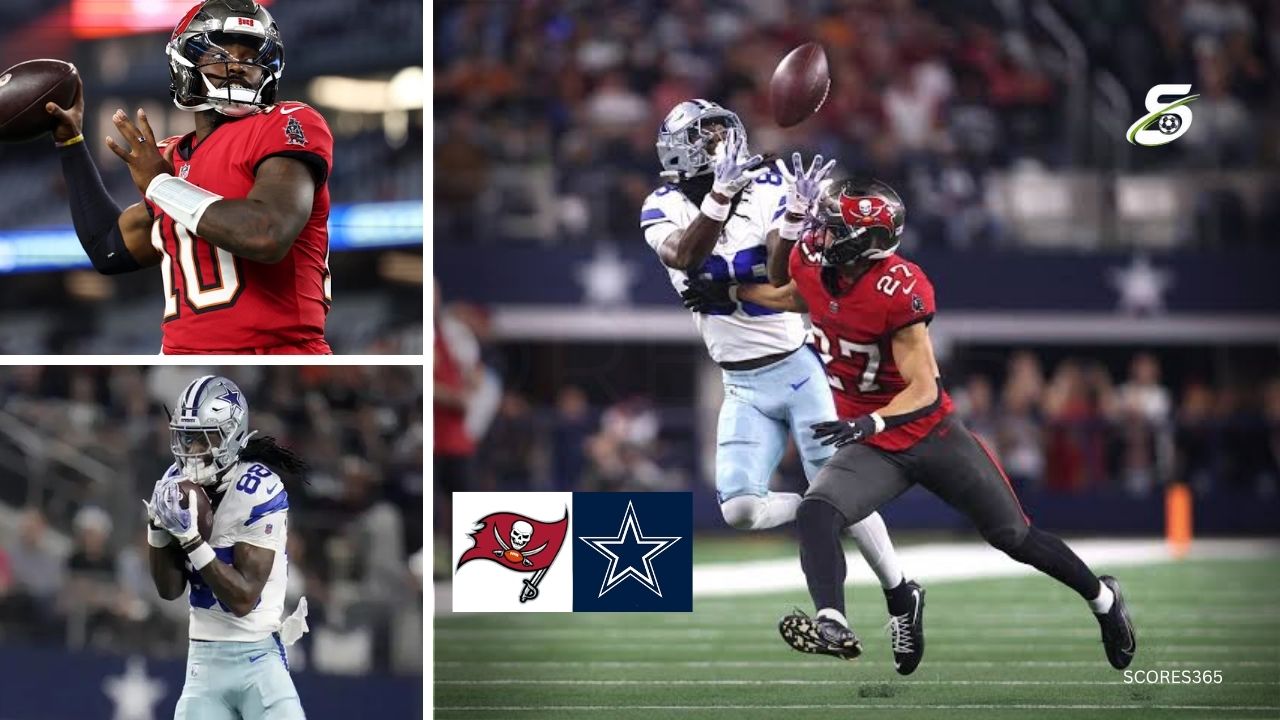
The Tampa Bay Buccaneers vs Dallas Cowboys Match Player Stats tell the story of a Week 5 contest in which Tampa Bay turned a difficult start into a valuable 24–16 road victory. Playing at AT&T Stadium on Thursday, October 8, 2026, the Buccaneers overcame a first-quarter deficit and delivered their strongest stretch of the game after halftime. The final result gave Tampa Bay its first win of the regular season and left Dallas reflecting on costly turnovers and a third quarter in which its offense struggled to maintain momentum.
The game featured standout performances from Buccaneers running back Bucky Irving and rookie quarterback Jalon Daniels, who started in place of the injured Baker Mayfield. Dallas quarterback Dak Prescott moved the ball through the air, while wide receiver George Pickens provided an important target in the passing game. However, Tampa Bay’s defense created key takeaways at critical moments, helping the visitors protect their lead despite a late Cowboys rally. The final score, player statistics, and game-changing moments explain how Tampa Bay secured the win.
Final Score and Match Details
| Match detail | Information |
|---|---|
| Matchup | Tampa Bay Buccaneers vs Dallas Cowboys |
| Date | October 8, 2026 |
| Competition | NFL regular season, Week 5 |
| Venue | AT&T Stadium, Arlington, Texas |
| Final score | Buccaneers 24, Cowboys 16 |
| Winning team | Tampa Bay Buccaneers |
Tampa Bay finished with 24 points, while Dallas scored 16. The Buccaneers trailed after the opening quarter but gained control during the third quarter, scoring 17 unanswered points in that period. Dallas managed six points in the fourth quarter, but Tampa Bay’s defense prevented the comeback from becoming complete. The eight-point margin reflected Tampa Bay’s ability to capitalize on the Cowboys’ mistakes and produce explosive plays when the game’s momentum began to shift.
The result was particularly important for Tampa Bay because the team entered the game without starting quarterback Baker Mayfield. Daniels took responsibility for directing the offense, while Irving supplied the ground production that helped the Buccaneers control key possessions. Dallas had entered the matchup looking to build on its previous victory over Houston, but the Cowboys could not sustain their early advantage. Tampa Bay’s combination of rushing efficiency, defensive pressure, and timely takeaways ultimately proved decisive.
Quarter-by-Quarter Scoring Breakdown
Dallas opened the scoring in the first quarter, taking a 7–0 lead with a rushing touchdown by Javonte Williams. The Cowboys looked comfortable early, and Tampa Bay needed a long offensive possession to answer. The Buccaneers eventually reached the end zone in the second quarter when Daniels connected with Irving for a touchdown pass. Dallas added a field goal before halftime, allowing the home team to carry a narrow 10–7 advantage into the break.
Tampa Bay changed the game after halftime. Irving broke free for a long run, setting up a scoring opportunity that Emeka Egbuka completed with a rushing touchdown. The Buccaneers added more points during a productive third quarter while Dallas failed to score, creating a 24–10 advantage entering the final period. The Cowboys scored six points in the fourth quarter and threatened to make the finish closer, but an interception by Alex Anzalone helped Tampa Bay stop the rally and preserve its lead.
| Quarter | Buccaneers | Cowboys |
|---|---|---|
| First | 0 | 7 |
| Second | 7 | 3 |
| Third | 17 | 0 |
| Fourth | 0 | 6 |
| Final | 24 | 16 |
Jalon Daniels Player Stats and Performance
Jalon Daniels delivered an important performance in his second start, completing 19 of 25 passes for 189 yards and one touchdown without throwing an interception. Those numbers gave Tampa Bay a steady passing foundation while the offense leaned heavily on Irving’s rushing production. Daniels did not need to force difficult throws throughout the night; instead, he helped the Buccaneers sustain drives, make the most of favorable field position, and convert a key scoring opportunity through the air.
Daniels’ performance also mattered because of the circumstances surrounding his start. With Mayfield unavailable, Tampa Bay needed its rookie quarterback to avoid costly mistakes against a Dallas team capable of scoring quickly. Daniels earned his first win as a starter, according to the NFL’s game recap. His passing line was not the only reason for the victory, but his ball security and ability to work within the offense complemented the ground game and allowed the defense to operate with a lead during the second half.
Explore Detroit Lions vs Carolina Panthers Match Player Stats Full Game Analysis
Bucky Irving Leads Tampa Bay’s Rushing Attack
Bucky Irving was one of the biggest difference-makers of the game. He rushed 21 times for 165 yards and a touchdown, giving Tampa Bay a consistent source of offensive production. His most memorable run covered 72 yards and dramatically changed the field position battle. Rather than relying entirely on Daniels to generate offense, the Buccaneers repeatedly used Irving to challenge Dallas’ run defense and create opportunities for explosive plays.
Irving also contributed as a receiver, catching two passes for 10 yards and a touchdown. His receiving score came on a five-yard pass from Daniels, while his rushing work helped Tampa Bay control the game after halftime. The combination of a long run, a rushing touchdown, and a receiving touchdown made Irving central to the Buccaneers’ victory. His performance gave the offense a dependable focal point and helped Tampa Bay score 17 points in the third quarter.
| Buccaneers player | Key statistic |
|---|---|
| Jalon Daniels, QB | 19/25 passing, 189 yards, 1 TD, 0 INT |
| Bucky Irving, RB | 21 carries, 165 yards, 1 rushing TD |
| Bucky Irving, receiving | 2 catches, 10 yards, 1 receiving TD |
| Emeka Egbuka, WR | 6 catches, 38 yards |
| Tez Johnson, WR | 1 catch, 64 yards |
Dak Prescott and the Dallas Passing Game
Dak Prescott completed 24 of 42 passes for 316 yards and one touchdown, but he also threw two interceptions. His yardage total showed that Dallas was able to move the ball through the air, particularly when targeting receivers downfield. However, the passing production did not translate into enough points to overcome Tampa Bay’s third-quarter surge. The interceptions were especially damaging because they ended possessions and gave the Buccaneers opportunities to maintain or extend their advantage.
George Pickens was a major target for Prescott, finishing with nine receptions for 130 yards and a touchdown. His contribution helped Dallas produce a late scoring threat, including a touchdown connection in the fourth quarter. Yet a strong individual receiving performance could not compensate for the turnovers and the team’s scoreless third quarter. For Dallas, the central lesson was that passing yardage alone is not enough when drives end in giveaways or fail to produce points at important moments.
Key Dallas Cowboys Player Stats
George Pickens led the Cowboys’ receiving production with nine catches for 130 yards and a touchdown. His ability to create separation and gain yards after the catch gave Prescott a productive option, especially as Dallas attempted to close the gap late in the contest. Pickens’ touchdown helped keep the Cowboys within reach, but Tampa Bay’s defense responded when it needed to, preventing the late push from changing the final result.
Running back Javonte Williams also contributed, recording 12 carries for 45 yards and a touchdown. He scored Dallas’ opening touchdown, giving the Cowboys an early advantage and setting the tone for the first quarter. Prescott’s 316 passing yards and Pickens’ receiving output were significant, but the offense was less effective when the Buccaneers began generating turnovers. The Cowboys’ statistics show a team that could move the ball, yet struggled to turn enough of that production into a winning performance.
| Cowboys player | Key statistic |
|---|---|
| Dak Prescott, QB | 24/42 passing, 316 yards, 1 TD, 2 INT |
| George Pickens, WR | 9 catches, 130 yards, 1 TD |
| Javonte Williams, RB | 12 carries, 45 yards, 1 rushing TD |
Defensive Plays and Turnovers
Tampa Bay’s defense played a decisive role by turning Dallas possessions into opportunities to regain control. Linebacker Yaya Diaby intercepted Prescott during the third quarter, interrupting the Cowboys’ attempt to respond to Tampa Bay’s surge. Later, Alex Anzalone intercepted Prescott during Dallas’ late comeback attempt, helping the Buccaneers protect their lead. Those plays were especially valuable because the Cowboys had been able to accumulate passing yards and remained capable of threatening the end zone.
The Buccaneers also benefited from a forced fumble by safety Miles Killebrew that cornerback Kevin Knowles recovered, contributing to Dallas’ turnover problems. The Cowboys finished the contest with three turnovers, while Tampa Bay avoided interceptions from Daniels. That contrast mattered throughout the second half: Tampa Bay protected possession while Dallas repeatedly gave the ball away. The defensive takeaways, combined with Irving’s explosive rushing, made the difference between a close contest and a road win for the Buccaneers.
Read Atlanta Falcons vs New Orleans Saints Match Player Stats Full Game Analysis
Turning Points That Decided the Game
The first major turning point came when Tampa Bay answered Dallas’ opening touchdown with a scoring drive that tied the game at seven. Although the Cowboys regained a 10–7 halftime lead, the Buccaneers had established that they could sustain long possessions and make progress without relying solely on deep passes. The early exchange kept Tampa Bay within striking distance and allowed the team to enter the second half with a realistic opportunity to change the result.
The decisive shift came after halftime, when Irving’s 72-yard run helped spark Tampa Bay’s 17-point third quarter. Dallas could not respond with points during that period, and Prescott’s interception made the comeback task more difficult. The Cowboys did score in the fourth quarter, but Anzalone’s late interception ended a key opportunity. These moments illustrate why the final score cannot be explained by passing yards alone: explosive rushing, defensive takeaways, and the timing of scoring drives shaped the outcome.
Team Statistics and Overall Game Analysis
The most important statistical contrast was the difference between Tampa Bay’s ability to capitalize on opportunities and Dallas’ difficulty protecting the football. Prescott threw for more yards than Daniels, and Pickens produced a strong receiving performance, but Dallas’ three turnovers repeatedly disrupted its offensive rhythm. Tampa Bay paired Daniels’ efficient passing line with Irving’s 165 rushing yards, allowing the offense to create explosive gains and score in a concentrated burst after halftime.
Tampa Bay’s win was also a significant result given its quarterback situation and early-season record. Daniels started in place of Mayfield, while the defense handled the challenge of slowing a Dallas offense that had scored 30 points against Houston in the previous week. Dallas entered the game hoping to improve its record, but the loss dropped the Cowboys to 2–3 while Tampa Bay earned its first win to move to 1–4. The result gave the Buccaneers a needed boost and left Dallas with clear issues to address in ball security and second-half execution.
Conclusion
The Tampa Bay Buccaneers vs Dallas Cowboys Match Player Stats highlight a 24–16 Buccaneers victory built on Bucky Irving’s dominant rushing performance, Jalon Daniels’ composed quarterback play, and a defense that produced timely takeaways. Irving recorded 165 rushing yards and contributed two touchdowns across rushing and receiving, while Daniels passed for 189 yards with one touchdown and no interceptions. Dallas had productive individual performances from Prescott and Pickens, but turnovers and a scoreless third quarter prevented the Cowboys from holding onto their early lead.
For Tampa Bay, the win offered a positive result after an 0–4 start and demonstrated that the team could win with a rookie quarterback when its rushing attack and defense performed effectively. For Dallas, the defeat showed how costly turnovers can be even when the passing game generates yardage. The final score, quarter-by-quarter breakdown, and key player statistics all point to the same conclusion: Tampa Bay made the most of its biggest opportunities, controlled the game’s pivotal stretch, and earned a hard-fought road victory in Week 5.
Explore More SCORES365