

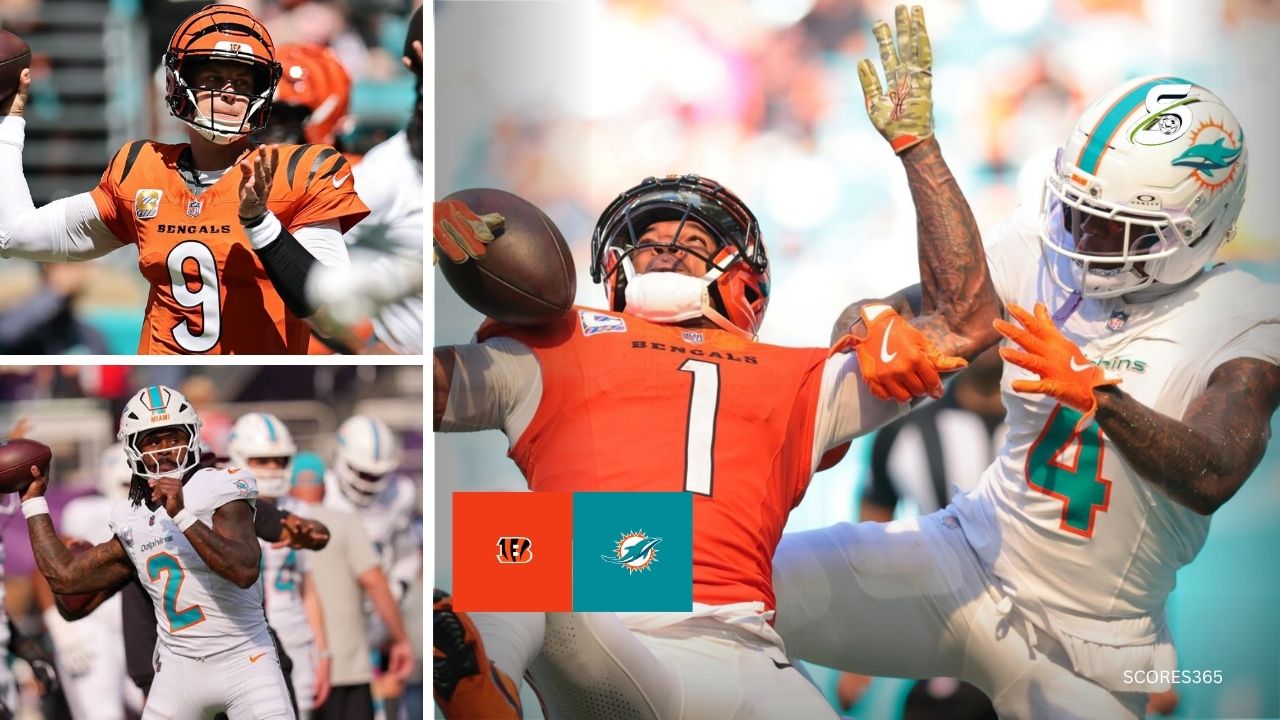
The Cincinnati Bengals vs Miami Dolphins Match Player Stats: Complete Game Breakdown covers a high-scoring Week 5 matchup that ended with Cincinnati earning a 31–24 victory on October 11, 2026. Played at Hard Rock Stadium in Miami Gardens, Florida, the game featured four touchdown passes from Joe Burrow, two interceptions by Bengals safety Jordan Battle in the first half, and an attempted late comeback by the Dolphins. Cincinnati established an early advantage and maintained enough offensive production to withstand Miami’s fourth-quarter scoring surge.
The Bengals’ victory was built on effective passing, timely defensive plays, and an ability to respond whenever Miami threatened to close the gap. Burrow completed 23 of 32 passes for 190 yards and four touchdowns, spreading the scoring between four different receivers. Ja’Marr Chase delivered the game’s most spectacular receiving touchdown, while Samaje Perine contributed as both a runner and receiver. Miami quarterback Malik Willis helped the Dolphins remain competitive with his rushing production, but two interceptions and a lost fumble hurt the home team’s chances of completing the comeback.
Final Score and Match Details
Cincinnati won the game by seven points after leading 21–7 at halftime and extending the advantage to 28–10 in the third quarter. Miami scored 14 points in the final period, creating pressure during the closing minutes, but the Bengals added a field goal and recovered the Dolphins’ onside kick to end the comeback attempt. The final score reflected Cincinnati’s stronger start and its ability to answer Miami’s late push with an important scoring drive.
| Match detail | Information |
|---|---|
| Matchup | Cincinnati Bengals vs Miami Dolphins |
| Date | October 11, 2026 |
| Competition | NFL regular season, Week 5 |
| Venue | Hard Rock Stadium, Miami Gardens, Florida |
| Final score | Bengals 31, Dolphins 24 |
| Winning team | Cincinnati Bengals |
| Bengals record after game | 3–2 |
| Dolphins record after game | 0–5 |
The result improved Cincinnati’s record to 3–2 and gave the team a positive finish heading into its Week 6 bye. Miami, meanwhile, fell to 0–5 and was left searching for answers after another defeat. The Bengals combined offensive efficiency with defensive takeaways, particularly during the first half, to build the cushion that ultimately decided the contest. Although the Dolphins gained substantial yardage and scored late, they could not erase the damage caused by their turnovers and early deficit.
Quarter-by-Quarter Scoring Breakdown
The opening quarter ended tied at 7–7. Cincinnati scored first when Burrow connected with tight end Mike Gesicki for a four-yard touchdown, taking advantage of Dohnte Meyers’ 81-yard kickoff return. Miami answered with a one-yard rushing touchdown by Ollie Gordon II. The second quarter belonged to Cincinnati, which scored twice more through Burrow’s touchdown passes to Perine and Tanner Hudson. With Battle intercepting Willis twice in the first half, the Bengals went into halftime holding a commanding 21–7 lead.
Miami managed a field goal in the third quarter, but Cincinnati responded with Chase’s 45-yard touchdown reception to make the score 28–10. The Dolphins mounted a stronger challenge in the fourth quarter, scoring a touchdown through Kevin Coleman Jr. and adding a two-point conversion. Evan McPherson’s 26-yard field goal kept Cincinnati ahead by 13, and Willis later scored on a one-yard quarterback sneak. Miami’s failed extra-point attempt left the deficit at seven, and Cincinnati recovered the ensuing onside kick to secure the win.
| Quarter | Cincinnati Bengals | Miami Dolphins |
|---|---|---|
| First | 7 | 7 |
| Second | 14 | 0 |
| Third | 7 | 3 |
| Fourth | 3 | 14 |
| Final | 31 | 24 |
Joe Burrow’s Four-Touchdown Performance
Joe Burrow completed 23 of 32 passes for 190 yards and four touchdowns without throwing an interception. Although his passing-yardage total was relatively modest, he repeatedly found the end zone and distributed the scoring across four different targets. Gesicki opened Cincinnati’s scoring, Perine added a touchdown early in the second quarter, and Hudson caught another just before halftime. Burrow’s ability to convert drives into touchdowns gave the Bengals a comfortable lead despite Miami producing more total offensive yards.
Burrow’s fourth touchdown came in the third quarter when he found Chase for a 45-yard score. Chase made an impressive one-handed catch while falling into the end zone, turning a deep pass into one of the game’s defining highlights. The touchdown increased Cincinnati’s lead to 28–10 and helped the visitors absorb Miami’s late rally. Burrow’s four-touchdown performance demonstrated the value of red-zone execution and explosive passing plays, even when the offense did not need to accumulate a huge number of passing yards.
Explore Los Angeles Rams vs Philadelphia Eagles Match Player Stats Complete Breakdown
Ja’Marr Chase and Cincinnati’s Receiving Attack
Ja’Marr Chase led Cincinnati with six receptions for 77 yards and a touchdown. His 45-yard scoring reception in the third quarter was the Bengals’ longest touchdown pass of the game and one of the afternoon’s most memorable plays. The catch gave Cincinnati an 18-point lead and forced Miami to chase the game during the final quarter. Chase’s contribution was not limited to the touchdown; his ability to threaten the defense downfield helped keep the passing game dangerous.
The Bengals also received valuable contributions from their tight ends and running backs. Gesicki caught a four-yard touchdown pass, Perine scored on a six-yard reception, and Hudson added a two-yard touchdown catch. These four receiving touchdowns came from different players, making Cincinnati’s offense less predictable and allowing Burrow to take advantage of multiple defensive matchups. Spreading the scoring helped the Bengals capitalize on short-yardage opportunities while still maintaining the ability to strike downfield through Chase.
| Bengals player | Key statistics |
|---|---|
| Joe Burrow | 23/32 passing, 190 yards, 4 TD, 0 INT |
| Ja’Marr Chase | 6 receptions, 77 yards, 1 TD |
| Samaje Perine | 14 carries, 68 yards; 2 catches, 10 yards, 1 receiving TD |
| Tanner Hudson | 3 receptions, 14 yards, 1 TD |
| Mike Gesicki | 1 reception, 4 yards, 1 TD |
Samaje Perine and the Bengals’ Rushing Game
Samaje Perine led Cincinnati’s rushing attack with 14 carries for 68 yards. His running helped the Bengals maintain possession and gave the offense a complementary option to Burrow’s passing game. Perine also caught two passes for 10 yards and a touchdown, making him a useful contributor in both phases. His six-yard receiving score early in the second quarter pushed Cincinnati ahead and helped establish the momentum that carried into halftime.
Chase Brown added 39 rushing yards on 13 carries, giving Cincinnati another option in the backfield. Although neither running back recorded a rushing touchdown, their combined production helped the Bengals avoid becoming completely dependent on passing. Cincinnati finished with 117 rushing yards and 190 passing yards, giving the offense a balanced total of 307 yards. That balance was particularly useful after the Bengals built a lead, as it helped them manage possessions and avoid giving Miami repeated opportunities to respond.
Malik Willis and Miami’s Offensive Performance
Malik Willis completed 15 of 27 passes for 137 yards, one touchdown, and two interceptions. He also rushed eight times for 74 yards and a touchdown, making his mobility one of Miami’s most effective offensive weapons. Willis kept the Dolphins competitive during the second half, including a late one-yard rushing score that brought the team within seven points. However, the two interceptions in the second quarter interrupted Miami’s offensive rhythm and contributed to the Bengals establishing their halftime advantage.
Willis’ passing statistics reflected the difficulty Miami faced against Cincinnati’s defense. He completed some important throws, including a three-yard touchdown pass to Kevin Coleman Jr. during the fourth quarter, but the turnovers proved costly. His rushing production helped Miami generate 217 total rushing yards as a team, yet the Dolphins struggled to convert enough of their offensive opportunities into points early in the game. The late scoring surge made the final margin respectable, but the team had already spent much of the contest trying to recover from the first-half deficit.
Explore Philadelphia Eagles vs Jacksonville Jaguars Match Player Stats and Week 5 Recap
Miami’s Rushing and Receiving Leaders
Ollie Gordon II led Miami’s rushing production with 18 carries for 88 yards and a touchdown. His one-yard score in the first quarter tied the game at seven and gave the Dolphins an early response to Cincinnati’s opening touchdown. Gordon’s running also helped Miami finish with considerably more rushing yardage than Cincinnati. However, the Dolphins were unable to turn that advantage into an early lead, partly because their passing game suffered from turnovers and inconsistent scoring opportunities.
In the receiving game, Malik Washington caught six passes for 43 yards, while Greg Dulcich recorded four receptions for 37 yards. Coleman finished with three catches for 30 yards and a touchdown, including the late scoring play that helped Miami continue its comeback. Miami’s offense gained 354 total yards, more than Cincinnati’s 307, but yardage alone did not determine the result. The Dolphins’ three turnovers and their inability to close the gap before the fourth quarter were more important than their overall statistical advantage in total offense.
| Dolphins player | Key statistics |
|---|---|
| Malik Willis | 15/27 passing, 137 yards, 1 passing TD, 2 INT; 74 rushing yards, 1 rushing TD |
| Ollie Gordon II | 18 carries, 88 yards, 1 TD |
| Malik Washington | 6 receptions, 43 yards |
| Greg Dulcich | 4 receptions, 37 yards |
| Kevin Coleman Jr. | 3 receptions, 30 yards, 1 TD |
Jordan Battle’s Two Interceptions
Jordan Battle played a major role in Cincinnati’s first-half advantage by intercepting Willis on consecutive Miami possessions in the second quarter. His first interception came on a pass that had been tipped at the line of scrimmage by defensive end Boye Mafe. Battle then intercepted another Willis pass on the following Dolphins drive. Those turnovers stopped Miami’s attempts to build momentum and gave Cincinnati additional opportunities to extend its lead before halftime.
The interceptions were particularly damaging because they came while Miami was still within reach of the game. Cincinnati converted the second takeaway into a touchdown pass to Hudson, increasing its lead to 21–7. Battle’s performance demonstrated how a defensive player can influence a game without recording a sack or forcing a fumble. The Bengals’ defense also made an important third-quarter goal-line stand, limiting Miami to a field goal when the Dolphins had an opportunity to reduce the deficit further. Together, those plays helped protect Cincinnati’s lead through the middle of the contest.
Team Statistics and Overall Comparison
The overall numbers show that Miami gained more total yardage, but Cincinnati made better use of its scoring opportunities. The Dolphins finished with 354 total yards, compared with 307 for the Bengals, and produced 217 rushing yards. Cincinnati, however, threw four touchdown passes and committed fewer turnovers. The Bengals’ ability to turn drives into touchdowns meant they could establish a substantial lead without needing to dominate every statistical category.
Third-down efficiency and possession also favored Cincinnati. The Bengals converted nine of 13 third-down attempts and held the ball for 31 minutes and 40 seconds, compared with Miami’s seven conversions on 13 attempts and 28 minutes and 20 seconds of possession. Cincinnati recorded one turnover, while Miami committed three. Those differences explain why the Bengals won despite allowing more total yards. The team’s stronger passing efficiency, early defensive takeaways, and successful handling of Miami’s late onside-kick attempt proved more decisive than the raw yardage totals.
| Team statistic | Bengals | Dolphins |
|---|---|---|
| Total yards | 307 | 354 |
| Passing yards | 190 | 137 |
| Rushing yards | 117 | 217 |
| First downs | 22 | 23 |
| Third-down conversions | 9/13 | 7/13 |
| Turnovers | 1 | 3 |
| Time of possession | 31:40 | 28:20 |
Turning Points and the Fourth-Quarter Comeback
The first major turning point was Cincinnati’s pair of second-quarter touchdowns, which transformed a 7–7 game into a 21–7 halftime lead. Battle’s interceptions played a direct role in that shift, preventing Miami from sustaining drives and giving the Bengals opportunities to score. Cincinnati then extended its lead to 28–10 through Chase’s touchdown in the third quarter. At that point, Miami needed a substantial comeback and had little margin for further mistakes.
The Dolphins responded with 14 fourth-quarter points, including Coleman’s touchdown reception and Willis’ late rushing score. However, Cincinnati’s field goal between those touchdowns helped maintain a two-score cushion until the closing minutes. Miami’s failed extra-point attempt also mattered because it prevented the Dolphins from getting closer than seven points. When the Dolphins attempted an onside kick after Willis’ score, Cincinnati recovered the ball and ended the comeback attempt. The final sequence showed how early turnovers and missed conversion opportunities can shape the outcome of a close game.
Week 5 Recap and What the Result Means
The victory moved Cincinnati to 3–2 and gave the Bengals a positive result heading into their Week 6 bye. Burrow’s four touchdown passes demonstrated that the offense could produce efficient scoring even without accumulating a large passing-yard total. Chase’s long touchdown and Perine’s two-way contribution gave Cincinnati multiple offensive options, while Battle’s interceptions supplied the defensive momentum needed to build a lead. The team will still want to review the 24 points it allowed and the yardage Miami accumulated, but the win provided a valuable foundation for the next stretch of the season.
Miami fell to 0–5 despite gaining 354 total yards and producing a strong rushing performance. The Dolphins showed determination in the fourth quarter, but their three turnovers made the task significantly harder. Willis’ two interceptions were especially costly because they came during the period when the game was still close. For Miami, improving ball security and finishing scoring drives will be important priorities. The defeat also illustrated that a team can win the yardage battle and still lose when the opponent is more efficient in the red zone and capitalizes on defensive mistakes.
Conclusion
The Cincinnati Bengals vs Miami Dolphins Match Player Stats: Complete Game Breakdown highlights a 31–24 Cincinnati victory built on Joe Burrow’s four touchdown passes, Ja’Marr Chase’s explosive receiving score, and Jordan Battle’s two first-half interceptions. Burrow completed 23 of 32 passes for 190 yards without an interception, while Chase finished with six catches for 77 yards and a touchdown. Miami generated more total yards and strong rushing production, but its three turnovers and early scoring deficit made the comeback difficult.
The Dolphins scored 14 points in the fourth quarter and kept the contest competitive until the closing moments, but Cincinnati recovered the onside kick to secure the result. The Bengals improved to 3–2 and headed into their bye week with a win, while Miami remained winless at 0–5. The game demonstrated that offensive yardage does not always determine the winner: timely defensive plays, touchdown efficiency, and ball security can matter more. Cincinnati executed those elements better when the most important opportunities arrived.
Explore More SCORES365