

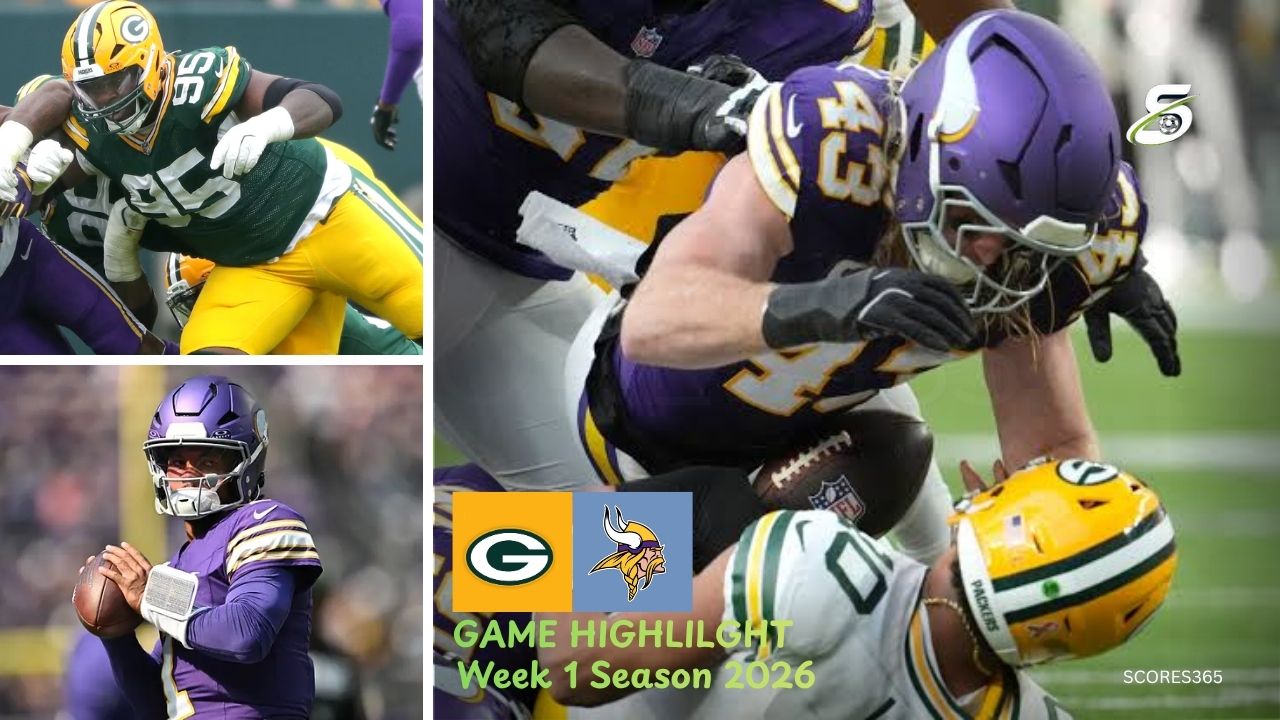
The Minnesota Vikings completed a stunning comeback against the Green Bay Packers, winning 39–22 in their 2026 NFL season opener at U.S. Bank Stadium. Green Bay controlled much of the first three quarters and led 22–10, but Minnesota produced 29 unanswered points to turn the game around in the closing stages.
The game featured outstanding performances from several key players. Packers quarterback Jordan Love threw for 387 yards and two touchdowns, both to Christian Watson, while Watson finished with 147 receiving yards. For Minnesota, backup quarterback Carson Wentz delivered three touchdown passes after Kyler Murray exited with a concussion, and Justin Jefferson recorded two touchdown receptions.
Final Score: Packers vs Vikings
| Team | Q1 | Q2 | Q3 | Q4 | Final |
|---|---|---|---|---|---|
| Green Bay Packers | 9 | 10 | 3 | 0 | 22 |
| Minnesota Vikings | 3 | 7 | 7 | 22 | 39 |
Green Bay appeared to be in control after taking a 19–10 halftime lead and extending that advantage to 22–10 in the third quarter. The Packers’ offense had moved the ball effectively, but Minnesota’s defense created key turnovers and the Vikings’ offense suddenly found another gear late in the game.
The fourth quarter completely changed the contest. Minnesota scored 22 points in the final period, including touchdowns from Aaron Jones Sr., Jordan Mason and Justin Jefferson. The Vikings also converted a two-point attempt through Jefferson, completing a remarkable comeback and moving to 1–0 while Green Bay dropped to 0–1.
Match Details
| Detail | Information |
|---|---|
| Match | Green Bay Packers vs Minnesota Vikings |
| Date | September 13, 2026 |
| Venue | U.S. Bank Stadium |
| Location | Minneapolis, Minnesota |
| Final Score | Vikings 39, Packers 22 |
| Packers Record | 0–1 |
| Vikings Record | 1–0 |
| Result | Minnesota Vikings won |
The Packers entered the game looking to start the season strongly, and their offense delivered early. Jordan Love connected with Christian Watson for an 81-yard touchdown in the first quarter before finding Watson again for a two-yard score in the second quarter. Green Bay also added field goals to establish a comfortable halftime advantage.
Minnesota’s biggest challenge came when Kyler Murray left the game during the first quarter after suffering a concussion on a scramble. Carson Wentz replaced him and eventually became the central figure in the comeback, throwing three touchdown passes and leading four consecutive touchdown drives during the decisive stretch.
Green Bay Packers Match Player Stats
| Player | Passing | Rushing | Receiving |
|---|---|---|---|
| Jordan Love | 21/42, 387 YDS, 2 TD, 1 INT | 1-0 | — |
| MarShawn Lloyd | — | 13-37 | — |
| Chris Brooks | — | 7-29 | — |
| Christian Watson | — | — | 6-147, 2 TD |
| Matthew Golden | — | — | 6-95 |
| Tucker Kraft | — | — | 3-65 |
Jordan Love was one of the game’s most productive passers despite the loss. He completed 21 of 42 attempts for 387 yards and two touchdowns, with both scoring passes going to Christian Watson. Love’s production helped Green Bay generate 419 total yards, but the Packers struggled to turn that offensive output into a win after Minnesota’s late defensive pressure.
Christian Watson was the standout receiver for Green Bay. He caught six passes for 147 yards and two touchdowns, including an explosive 81-yard touchdown in the opening quarter. Matthew Golden also contributed six catches for 95 yards, while Tucker Kraft added three receptions for 65 yards. Despite those numbers, Green Bay could not score during the fourth quarter.
Minnesota Vikings Match Player Stats
| Player | Passing | Rushing | Receiving |
|---|---|---|---|
| Carson Wentz | 12/19, 133 YDS, 3 TD | — | — |
| Kyler Murray | 3/5, 18 YDS, 0 TD, 1 INT | 2-9 | — |
| Jordan Mason | — | 15-59, 1 TD | — |
| Aaron Jones Sr. | — | 12-40, 1 TD | — |
| Justin Jefferson | — | — | 8-92, 2 TD |
| T.J. Hockenson | — | — | 4-36, 1 TD |
| Josh Oliver | — | — | 2-22 |
Carson Wentz produced a memorable relief performance. After entering for the injured Murray, he completed 12 of 19 passes for 133 yards and three touchdowns without an interception. His efficiency became especially important in the fourth quarter, when Minnesota repeatedly converted scoring opportunities and erased a 12-point deficit.
Justin Jefferson was Wentz’s most important receiving target. Jefferson finished with eight receptions for 92 yards and two touchdowns, including the decisive nine-yard touchdown in the fourth quarter. T.J. Hockenson also found the end zone on a 16-yard reception, while Jordan Mason and Aaron Jones Sr. provided important rushing touchdowns during Minnesota’s comeback.
Jordan Love and Christian Watson Lead Green Bay Early
Green Bay’s early offensive success was built around the connection between Jordan Love and Christian Watson. Watson’s 81-yard touchdown gave the Packers an early lead, and the pair connected again in the second quarter for another score. Love finished with a huge yardage total, while Watson averaged 24.5 yards per reception. Their explosive plays kept Minnesota under pressure for much of the first half.
However, Green Bay’s production became less effective as the game progressed. The Packers finished with 419 total yards, compared with only 239 for Minnesota, yet they lost by 17 points. Green Bay also committed two turnovers and was penalized 12 times for 98 yards, compared with Minnesota’s three penalties for only 15 yards. Those mistakes became increasingly costly as the Vikings mounted their comeback.
Carson Wentz and Justin Jefferson Complete the Comeback
Carson Wentz changed the direction of the game after Kyler Murray’s early exit. Minnesota trailed 22–10 late in the third quarter, but Wentz guided the offense on a series of scoring drives. His touchdown pass to Hockenson helped bring the Vikings closer before Aaron Jones Sr. scored early in the fourth quarter.
Jefferson then delivered the biggest receiving plays of the comeback. He caught Wentz’s pass for a successful two-point conversion after Jones’ touchdown and later added another touchdown reception to make the Vikings’ advantage decisive. Minnesota scored 29 straight points to close the game, turning a 22–10 deficit into a 39–22 victory.
Full Game Scoring Highlights
| Quarter | Team | Scoring Play | Score |
|---|---|---|---|
| Q1 | Packers | Christian Watson 81-yard TD reception | GB 6–0 |
| Q1 | Vikings | 59-yard field goal | GB 6–3 |
| Q1 | Packers | 38-yard field goal | GB 9–3 |
| Q2 | Vikings | 43-yard field goal | GB 9–6 |
| Q2 | Vikings | Justin Jefferson 39-yard TD reception | MIN 13–9 |
| Q2 | Packers | Christian Watson 2-yard TD reception | GB 19–10 |
| Q3 | Vikings | 16-yard TD reception by T.J. Hockenson | GB 22–17 |
| Q3 | Packers | 26-yard field goal | GB 22–10 |
| Q4 | Vikings | Aaron Jones Sr. 3-yard TD run + 2-point conversion | MIN 25–22 |
| Q4 | Vikings | Jordan Mason 1-yard TD run | MIN 31–22 |
| Q4 | Vikings | Justin Jefferson 9-yard TD reception | MIN 38–22 |
The scoring pattern shows just how dramatically the game changed. Green Bay scored 22 points through the first three quarters but was shut out in the fourth. Minnesota, meanwhile, exploded for 22 fourth-quarter points after scoring only 17 during the first three quarters.
The Vikings’ final scoring sequence was particularly impressive. Aaron Jones Sr. opened the fourth-quarter surge with a touchdown, followed by Jordan Mason’s rushing score and Jefferson’s second touchdown reception. The Vikings then added the extra point to complete the 39-point comeback victory.
Team Stats Comparison
| Team Stat | Packers | Vikings |
|---|---|---|
| Total Yards | 419 | 239 |
| Plays | 67 | 61 |
| Yards per Play | 6.3 | 3.9 |
| Rushing Attempts | 21 | 34 |
| Possession | 27:02 | 32:58 |
| Turnovers | 2 | 1 |
| Penalties | 12 | 3 |
| Penalty Yards | 98 | 15 |
| Lost Fumbles | 1 | 0 |
The statistics make Minnesota’s comeback even more notable because Green Bay actually produced significantly more yardage. The Packers gained 419 total yards and averaged 6.3 yards per play, while Minnesota recorded 239 yards at 3.9 yards per play. The difference came from efficiency, turnovers, penalties and the Vikings’ ability to capitalize on key opportunities.
Green Bay’s 12 penalties for 98 yards were especially damaging compared with Minnesota’s three penalties for only 15 yards. The Packers also committed two turnovers, while the Vikings committed one. Minnesota’s defense made those opportunities count, helping the team overcome a large statistical disadvantage in total offense.
Kyler Murray Injury and Game Turning Point
Kyler Murray’s concussion was one of the biggest early developments in the game. He completed three of five passes for 18 yards before leaving during the first quarter after taking a hard hit while scrambling. The Vikings officially ruled him out, forcing Wentz into action earlier than expected.
What initially appeared to be a major setback ultimately became the foundation of Minnesota’s comeback. Wentz handled the pressure, avoided an interception and threw three touchdown passes. His performance allowed the Vikings to maintain offensive balance while their defense created the turnovers needed to swing momentum away from Green Bay.
Final Takeaway
The Green Bay Packers vs Minnesota Vikings match player stats tell the story of a game that looked completely different in the first half than it did at the finish. Jordan Love and Christian Watson produced explosive numbers for Green Bay, but the Packers could not protect their 22–10 advantage. Minnesota’s defense and Wentz-led offense combined to dominate the closing stages.
For Minnesota, the 39–22 victory provides an impressive opening statement, especially after losing its starting quarterback early. For Green Bay, the loss highlights the importance of limiting penalties, turnovers and late-game collapses. The Vikings scored 29 unanswered points to finish the game, making this one of the most dramatic Week 1 comebacks of the 2026 NFL season.
More Update SCORES 365