

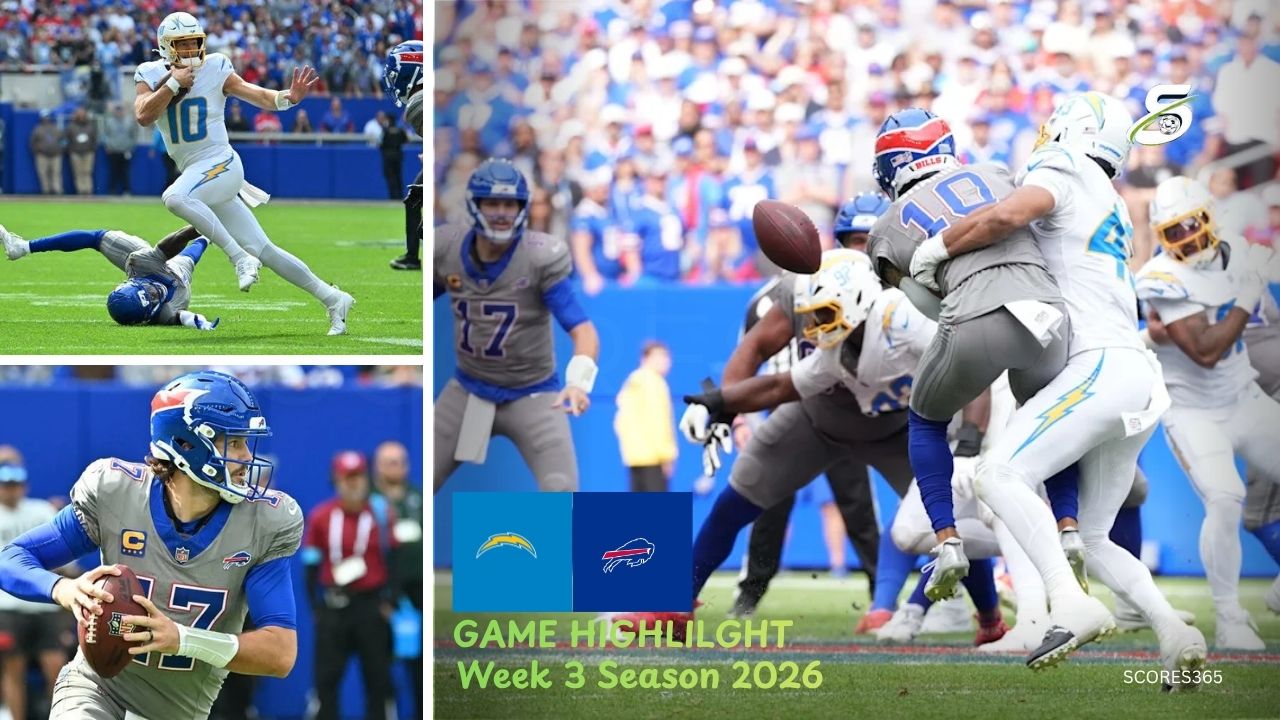
The Buffalo Bills defeated the Los Angeles Chargers 24-16 on September 27, 2026, at Highmark Stadium. Buffalo overcame an early 10-point deficit and produced a strong second-half comeback to remain unbeaten at 3-0. The Chargers started quickly but struggled to turn several opportunities into touchdowns. Buffalo’s defense forced five turnovers, although Los Angeles also had its share of productive drives. The result left the Chargers at 0-3 while the Bills continued their strong opening stretch of the regular season.
Los Angeles controlled the opening quarter and entered the second quarter with a 10-0 advantage. Buffalo responded with a field goal and a Josh Allen rushing touchdown before halftime, making the score 10-10. The Chargers regained the lead with a third-quarter field goal, but Buffalo finished strongly. Allen scored his second rushing touchdown late in the fourth quarter, while James Cook added another touchdown shortly afterward. Cameron Dicker added a late field goal, but the Chargers could not complete the comeback.
Final Score and Quarter Breakdown

The final score was Buffalo Bills 24, Los Angeles Chargers 16. Los Angeles scored 10 points in the first quarter and added three points in each of the final two quarters. Buffalo scored 10 points in the second quarter before producing its biggest offensive response in the fourth quarter. The Bills scored 14 fourth-quarter points to turn a 13-10 deficit into a winning 24-16 margin. This scoring pattern highlighted Buffalo’s ability to finish the game despite several offensive mistakes.
| Quarter | Los Angeles Chargers | Buffalo Bills |
|---|---|---|
| 1st | 10 | 0 |
| 2nd | 0 | 10 |
| 3rd | 3 | 0 |
| 4th | 3 | 14 |
| Final | 16 | 24 |
The Chargers opened the scoring through a one-yard touchdown connection between Justin Herbert and Keaton Mitchell. Cameron Dicker then added a 31-yard field goal to make it 10-0. Buffalo answered through Tyler Bass and Josh Allen, tying the contest before halftime. Dicker restored Los Angeles’ lead in the third quarter, but Allen’s second rushing touchdown and Cook’s three-yard touchdown run changed the game. Dicker’s final field goal brought Los Angeles within eight points, but Buffalo controlled the closing moments.
Buffalo Bills Team Statistics
Buffalo finished with 350 total yards and averaged 5.6 yards per play. The Bills ran 63 offensive plays, including 33 rushing attempts, and controlled the ball for 28:38. Their rushing attack was especially important because James Cook produced 154 yards on 24 carries. Buffalo also converted key possessions late in the game. However, the Bills committed five turnovers, including two interceptions and three lost fumbles, making their victory more difficult than the final score suggests.
| Team Statistic | Bills |
|---|---|
| Total Yards | 350 |
| Passing Yards | 204 |
| Rushing Yards | 176 |
| Offensive Plays | 63 |
| Yards per Play | 5.6 |
| First Downs | 22 |
| Possession | 28:38 |
| Turnovers | 5 |
| Penalties | 10 |
| Penalty Yards | 88 |
Buffalo’s offensive numbers show that the team relied heavily on its rushing production. The Bills gained 176 yards on the ground, compared with 204 passing yards. James Cook supplied the largest share of that rushing output, while Allen added 22 yards and two touchdowns. Buffalo also recorded 22 first downs and converted six of 12 third-down opportunities. The five turnovers remained the major statistical weakness, but the defense repeatedly prevented Los Angeles from turning those mistakes into touchdowns.
Los Angeles Chargers Team Statistics
The Chargers recorded 348 total yards, only two fewer than Buffalo, showing that the overall yardage margin was extremely close. Los Angeles produced 131 rushing yards and 217? Wait official data lists 226 passing and 131 rushing, giving 357 total in some sources; the Chargers’ official team statistics list 348 total net yards. For consistency with the official Chargers box score, the key team figure is 348 total net yards. Los Angeles ran 64 plays and held possession for 31:22, but its opportunities produced only 16 points.
| Team Statistic | Chargers |
|---|---|
| Total Net Yards | 348 |
| Passing Yards | 226 |
| Rushing Yards | 131 |
| Offensive Plays | 64 |
| Yards per Play | 5.4 |
| Possession | 31:22 |
| Turnovers | 1 |
| Penalties | 7 |
| Penalty Yards | 50 |
Los Angeles moved the ball effectively at times, particularly through Justin Herbert’s passing game and the running contributions from Omarion Hampton and Keaton Mitchell. However, the Chargers struggled to finish drives with touchdowns after their fast start. Their only touchdown came during the opening quarter, while Dicker supplied three field goals. The Chargers also failed on a fourth-down opportunity late in the game, allowing Buffalo to regain possession and establish control during the decisive final period.
Read Kansas City Chiefs vs Miami Dolphins Match Player Stats Complete NFL Breakdown
Justin Herbert Player Stats
Justin Herbert completed 20 of 34 passes for 226 yards, with one touchdown and one interception. His passing average was 6.6 yards per attempt, and he also contributed 17 rushing yards on four attempts. Herbert helped Los Angeles establish its early advantage, connecting with Keaton Mitchell for the game’s opening touchdown. He continued moving the ball through the air, but Buffalo’s defense tightened in key situations and prevented the Chargers quarterback from producing another touchdown during the final three quarters.
Herbert’s strongest passing targets included Tre’ Harris, Ladd McConkey and Quentin Johnston. Harris led Los Angeles with six receptions for 76 yards, while McConkey recorded four catches for 66 yards. Johnston added three receptions for 40 yards. Herbert’s 29-yard completion to McConkey helped create a late scoring opportunity, but the Chargers could manage only a field goal from that drive. His interception at the Buffalo goal line also became an important moment in the contest.
Josh Allen Player Stats
Josh Allen completed 16 of 26 passes for 204 yards and did not throw a touchdown pass. He did, however, rush for two touchdowns on eight carries and finished with 22 rushing yards. Allen also threw two interceptions and was involved in Buffalo’s turnover problems. Despite those mistakes, his rushing touchdowns proved decisive. His second one-yard touchdown run with 7:35 remaining in the fourth quarter gave Buffalo its first lead of the game at 17-13.
Allen’s performance demonstrated how Buffalo could still generate scoring plays when its passing attack was inconsistent. He connected with DJ Moore six times for 67 yards and found Ty Johnson four times for 50 yards. A key 37-yard completion to Keon Coleman helped set up Buffalo’s first touchdown before halftime. Allen then used his legs in the second half, scoring twice from one yard. His late rushing production was central to Buffalo’s fourth-quarter turnaround and ultimately helped secure the Bills’ third win.
James Cook Rushing Performance
James Cook delivered the biggest individual rushing performance of the game. He carried the ball 24 times for 154 yards, averaging 6.4 yards per carry, and scored one touchdown. Cook repeatedly created explosive gains and helped Buffalo control the fourth quarter. His 154 rushing yards represented a major portion of Buffalo’s 176 rushing yards. After Buffalo regained the lead, Cook added important runs on the final touchdown drive, including a three-yard touchdown that extended the Bills’ advantage to 24-13.
Cook’s afternoon began poorly because he fumbled on Buffalo’s opening offensive play, giving Los Angeles an immediate scoring opportunity. He later recovered from that mistake with consistent production throughout the contest. His rushing work became particularly valuable in the fourth quarter, when Buffalo needed to protect its lead and keep the Chargers offense off the field. Cook’s late touchdown capped a 45-yard Buffalo drive and provided the margin the Bills needed to withstand Los Angeles’ final scoring attempt.
Chargers Receiving Leaders
Tre’ Harris was the leading Chargers receiver, finishing with six receptions for 76 yards. Ladd McConkey added four receptions for 66 yards, while Quentin Johnston recorded three catches for 40 yards. Harris provided a reliable option throughout the game, including a 29-yard reception during the fourth quarter. McConkey also produced an important 29-yard catch during Los Angeles’ late drive. Despite those contributions, Buffalo’s defense prevented the Chargers from turning their receiving production into another touchdown after the first quarter.
| Chargers Player | Receptions | Receiving Yards | TD |
|---|---|---|---|
| Tre’ Harris | 6 | 76 | 0 |
| Ladd McConkey | 4 | 66 | 0 |
| Quentin Johnston | 3 | 40 | 0 |
Omarion Hampton also contributed on the ground with 15 carries for 56 yards, while Keaton Mitchell added 52 yards on eight attempts. Mitchell also caught the one-yard touchdown pass from Herbert that opened the scoring. The Chargers therefore received useful production from several offensive players, but their scoring efficiency remained limited. The team reached scoring range multiple times yet finished with only one offensive touchdown and three field goals, leaving Buffalo room to complete its fourth-quarter comeback.
Buffalo Receiving Leaders
DJ Moore led Buffalo’s receiving group with six receptions for 67 yards. Ty Johnson followed with four catches for 50 yards, while Dalton Kincaid contributed two receptions for 38 yards. Moore’s production included a 16-yard catch during the fourth-quarter touchdown drive, helping Buffalo move into position for Cook’s three-yard scoring run. Kincaid’s 38 yards came on only two receptions, giving him an impressive 19-yard average per catch. The Bills spread their passing production across multiple targets.
| Bills Player | Receptions | Receiving Yards | TD |
|---|---|---|---|
| DJ Moore | 6 | 67 | 0 |
| Ty Johnson | 4 | 50 | 0 |
| Dalton Kincaid | 2 | 38 | 0 |
| Keon Coleman | 1 | 37 | 0 |
Keon Coleman produced one of Buffalo’s most important receptions, a 37-yard catch during the second-quarter drive that eventually ended with Allen’s one-yard rushing touchdown. Ty Johnson also contributed as both a runner and receiver. Although Buffalo finished without a passing touchdown, its receiving group still produced several important gains. The combination of short completions, explosive catches and Cook’s rushing ability allowed Buffalo to maintain enough offensive balance to recover from its turnover problems.
Key Defensive Moments
Buffalo’s defense played a major role in the comeback. C.J. Gardner-Johnson intercepted Herbert near the Buffalo goal line and returned the ball 41 yards, stopping a dangerous Chargers scoring opportunity. Greg Rousseau also recorded two sacks and reached six sacks through Buffalo’s first three games. The Bills repeatedly limited Los Angeles to field goals after defensive mistakes and forced a crucial fourth-down incompletion late in the fourth quarter, helping protect the team’s lead.
Los Angeles also produced important defensive plays early. Genesis Smith intercepted Josh Allen twice in the first half, giving the Chargers opportunities to extend their early advantage. However, Buffalo’s defense responded as the game progressed, particularly after halftime. The Bills ultimately forced five turnovers as a team, although not all resulted in points. Their ability to recover after offensive mistakes became one of the defining statistical themes of the game and helped Buffalo remain unbeaten.
Game-Changing Fourth Quarter
The fourth quarter decided the contest after Los Angeles entered the period holding a 13-10 lead. Josh Allen produced the go-ahead touchdown on a one-yard run with 7:35 remaining, completing a 13-play, 83-yard Buffalo drive. The Bills then stopped the Chargers on fourth down and quickly returned to offense. James Cook followed with a three-yard touchdown run, giving Buffalo a 24-13 lead with just over three minutes remaining.
The Chargers did not quit and moved the ball into Buffalo territory during the final minutes. Justin Herbert connected with Tre’ Harris, Keaton Vidal and Ladd McConkey during the drive, but Buffalo’s defense ultimately prevented a touchdown. Cameron Dicker converted a 33-yard field goal with 1:59 remaining, reducing the deficit to eight points. Los Angeles then attempted an onside kick, but Buffalo recovered it and ran out the clock to secure the 24-16 victory.
Los Angeles Chargers vs Buffalo Bills Match Player Stats Summary
The main statistical story was the contrast between production and execution. Los Angeles recorded 348 official net yards and held possession for more than 31 minutes, while Buffalo produced 350 yards and 22 first downs. Yet the Bills converted their late opportunities into touchdowns, while the Chargers settled for field goals. James Cook’s 154 rushing yards and Josh Allen’s two rushing touchdowns were especially important. Buffalo’s five turnovers were costly, but its defense repeatedly prevented Los Angeles from fully capitalizing.
| Player | Team | Key Performance |
|---|---|---|
| Josh Allen | Bills | 204 pass yards, 2 rush TD |
| James Cook | Bills | 154 rush yards, 1 TD |
| DJ Moore | Bills | 6 receptions, 67 yards |
| Justin Herbert | Chargers | 226 pass yards, 1 TD, 1 INT |
| Tre’ Harris | Chargers | 6 receptions, 76 yards |
| Omarion Hampton | Chargers | 56 rush yards |
The individual statistics also show why Buffalo could recover from its mistakes. Cook consistently generated rushing yards, Allen provided two crucial rushing touchdowns, and the defense delivered turnovers and key stops. Herbert produced 226 passing yards and helped Los Angeles gain 348 official net yards, but the Chargers could not sustain enough touchdown drives. The final numbers therefore reflect a game where Buffalo’s late execution outweighed its turnover problems and Los Angeles’ strong opening performance.
Final Analysis
The Los Angeles Chargers vs Buffalo Bills matchup became a comeback victory for Buffalo after Los Angeles established a 10-0 first-quarter lead. The Bills tied the game before halftime, briefly fell behind again in the third quarter, and then scored 14 fourth-quarter points. Josh Allen’s rushing touchdowns and James Cook’s 154-yard performance supplied the offensive spark, while Buffalo’s defense made several decisive stops. The 24-16 result moved Buffalo to 3-0 and left Los Angeles searching for its first win.
For Los Angeles, the game showed that the Chargers could move the football but needed better red-zone and late-game execution. Herbert passed for 226 yards, Harris led the receiving corps with 76 yards, and Hampton rushed for 56 yards. Buffalo’s five turnovers gave Los Angeles several opportunities, but only one became a touchdown. Buffalo, meanwhile, overcame its own mistakes through strong rushing production and timely defensive plays. Those factors ultimately decided the Week 3 meeting at Highmark Stadium.
Conclusion
The Buffalo Bills earned a 24-16 victory over the Los Angeles Chargers on September 27, 2026. Buffalo finished with 350 total yards and received a huge rushing performance from James Cook, while Josh Allen scored twice on the ground. The Chargers produced 348 official net yards and led for significant stretches, but their inability to convert opportunities into touchdowns limited their scoring. Buffalo’s fourth-quarter response and defensive stops proved decisive in securing the comeback victory.
The match also provided several notable individual performances. Cook finished with 154 rushing yards and a touchdown, Allen added two rushing scores, and DJ Moore led Buffalo’s receivers with 67 yards. Herbert threw for 226 yards and one touchdown, while Tre’ Harris posted 76 receiving yards for Los Angeles. Buffalo improved to 3-0, while the Chargers fell to 0-3. The statistics show a competitive game ultimately decided by fourth-quarter execution and Buffalo’s ability to recover from turnovers.
VISIT MORE SCORES365