

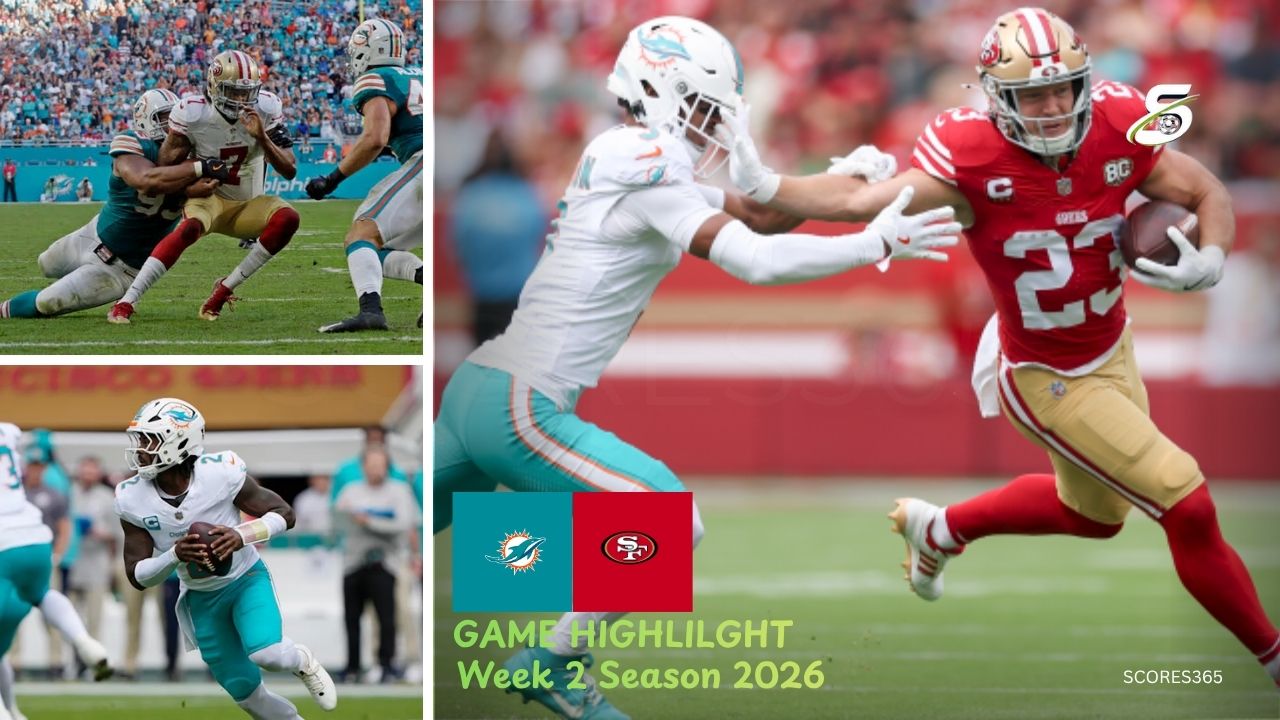
The Miami Dolphins vs San Francisco 49ers Match Player Stats from Week 2 of the 2026 NFL season tell the story of a game that changed sharply after halftime. The San Francisco 49ers defeated the Miami Dolphins 35-13 on September 20, 2026, at Levi’s Stadium in Santa Clara, California. San Francisco entered the game after its season-opening victory in Melbourne and continued its strong start with another win. Miami showed signs of progress during the opening half, but the 49ers turned their offensive efficiency into a decisive second-half advantage.
Brock Purdy directed San Francisco’s offense with 20 completions on 22 attempts for 287 passing yards and two touchdown passes without an interception. He also added a rushing touchdown and 30 rushing yards. Christian McCaffrey scored twice on the ground, while George Kittle caught a touchdown and finished with 80 receiving yards. Miami quarterback Malik Willis completed 14 of 23 passes for 197 yards and one touchdown. His late 77-yard touchdown pass to Ryan Miller provided Miami’s only touchdown of the afternoon, while De’Von Achane finished with 74 rushing yards.
Match Details
The 49ers controlled the scoreboard for most of the contest after taking a 7-0 lead in the first quarter. Miami answered with two field goals in the second period, but San Francisco added another touchdown before halftime and carried a 14-6 advantage into the locker room. The third quarter became the decisive period as the 49ers scored three more touchdowns and stretched the margin to 35-6. Miami finally reached the end zone late in the fourth quarter, but the deficit was already too large to overcome.
The final score also reflected the difference in offensive production. San Francisco finished with 382 total yards on 49 plays, while Miami produced 284 yards on 56 plays. The 49ers averaged 7.8 yards per play compared with Miami’s 5.1. Neither team committed a turnover, and both were charged with seven penalties. The 49ers’ ability to create explosive gains and finish drives with touchdowns separated the teams even though Miami had the ball for slightly more than half of the game.
| Match Detail | Information |
|---|---|
| Teams | Miami Dolphins vs San Francisco 49ers |
| Final Score | Dolphins 13, 49ers 35 |
| NFL Week | Week 2 |
| Date | September 20, 2026 |
| Stadium | Levi’s Stadium |
| Location | Santa Clara, California |
| Miami Record | 0-2 |
| San Francisco Record | 2-0 |
Quarter-by-Quarter Breakdown
| Quarter | Miami Dolphins | San Francisco 49ers |
|---|---|---|
| 1st | 0 | 7 |
| 2nd | 6 | 7 |
| 3rd | 0 | 21 |
| 4th | 7 | 0 |
| Final | 13 | 35 |
San Francisco opened the scoring with Christian McCaffrey’s one-yard touchdown run late in the first quarter. Miami responded with a 28-yard Riley Patterson field goal early in the second quarter, but Brock Purdy then extended the 49ers’ lead with a two-yard rushing touchdown. Patterson added another field goal just before halftime, leaving Miami within eight points at 14-6. The Dolphins had moved the ball during the opening half but could not turn several promising red-zone opportunities into touchdowns.
The third quarter produced the biggest swing of the game. Purdy connected with George Kittle for a 12-yard touchdown, then found Kyle Juszczyk for another score. McCaffrey added his second rushing touchdown, giving San Francisco a 35-6 lead entering the fourth quarter. Miami managed only a 77-yard touchdown pass from Willis to Ryan Miller with 2:41 remaining. The 49ers then closed the game without allowing another score.
Miami Dolphins Passing Performance
| Player | Comp/Att | Pass Yards | TD | INT |
|---|---|---|---|---|
| Malik Willis | 14/23 | 197 | 1 | 0 |
Malik Willis completed 14 of 23 attempts for 197 yards, one touchdown and no interceptions. His most productive play came in the fourth quarter when he connected with Ryan Miller for a 77-yard touchdown. That completion produced Miami’s only touchdown of the game and demonstrated the Dolphins’ ability to create a major play through the air even after San Francisco had built a large lead.
Willis also helped Miami move the football during the first half. The Dolphins produced 165 yards before halftime and held the ball for nearly nine more minutes than San Francisco during that period. The main problem was finishing drives. Miami reached the 49ers’ 10-yard line and 5-yard line on separate first-half possessions but settled for field goals rather than touchdowns. That difference became important once San Francisco accelerated after halftime.
San Francisco 49ers Passing Performance
| Player | Comp/Att | Pass Yards | TD | INT |
|---|---|---|---|---|
| Brock Purdy | 20/22 | 287 | 2 | 0 |
Brock Purdy completed 20 of 22 passes for 287 yards, two passing touchdowns and no interceptions. His completion rate was 90.9 percent, and he finished with a 149.1 passer rating according to the game reporting. Purdy also contributed 30 rushing yards and a rushing touchdown, giving him three total touchdowns in the victory. His accuracy helped San Francisco maintain drives and repeatedly attack the Dolphins downfield.
San Francisco’s passing game was particularly effective on deeper throws. NFL tracking information reported that Purdy completed all 10 of his attempts traveling at least 10 air yards, producing 211 yards and a touchdown on those throws. He was replaced by Mac Jones during the fourth quarter after the 49ers had established a 35-6 advantage, allowing San Francisco to finish the game while protecting its substantial lead.
Rushing and Receiving Leaders
| Team | Player | Rushing | Receiving |
|---|---|---|---|
| Miami | De’Von Achane | 20 carries, 74 yards | 3 receptions, 19 yards |
| Miami | Jaylen Wright | 2 carries, 11 yards | — |
| San Francisco | Christian McCaffrey | 10 carries, 23 yards, 2 TD | 4 receptions, 43 yards |
| San Francisco | Brock Purdy | 3 carries, 30 yards, 1 TD | — |
| San Francisco | George Kittle | — | 4 receptions, 80 yards, 1 TD |
De’Von Achane led Miami’s rushing attack with 20 carries for 74 yards, averaging 3.7 yards per attempt. He also added three receptions for 19 yards. His production helped Miami establish a running presence, but the Dolphins struggled to maintain the same offensive efficiency after halftime. San Francisco limited Miami to short possessions during a stretch of the third quarter, preventing the Dolphins from turning possession time into points.
Christian McCaffrey finished with 23 rushing yards on 10 carries but scored twice, including the opening touchdown and another one-yard touchdown in the third quarter. George Kittle supplied the biggest receiving total for San Francisco with four catches for 80 yards and a touchdown. Mike Evans added three receptions for 54 yards, while McCaffrey contributed 43 receiving yards. The distribution gave Purdy multiple reliable options throughout the afternoon.
Team Statistics and Offensive Efficiency
| Team Statistic | Dolphins | 49ers |
|---|---|---|
| Total Yards | 284 | 382 |
| Yards per Play | 5.1 | 7.8 |
| Plays | 56 | 49 |
| Rushes | 29 | 27 |
| Time of Possession | 30:13 | 29:47 |
| Turnovers | 0 | 0 |
| Penalties | 7 | 7 |
| Penalty Yards | 50 | 78 |
The overall numbers show that Miami was not completely overwhelmed in terms of possession or number of offensive plays. The Dolphins ran 56 plays compared with 49 for San Francisco and held the ball for 30:13. However, the 49ers gained 382 yards despite running seven fewer plays. Their 7.8 yards per play average was substantially higher than Miami’s 5.1, showing how San Francisco repeatedly generated more yardage from individual possessions.
The most important difference was scoring efficiency. Miami reached scoring range several times during the opening half but produced only two field goals. San Francisco, by contrast, converted its early opportunities into touchdowns. The 49ers scored touchdowns on each of their first five drives, building a 35-6 advantage through three quarters. That sequence transformed a competitive first half into a decisive result.
Key Highlights and Turning Points
One major turning point came from San Francisco’s ability to finish drives in the red zone. Miami moved the ball effectively at times, but its early possessions ended with field goals. The 49ers repeatedly crossed the goal line, starting with McCaffrey’s first-quarter touchdown and continuing with Purdy’s rushing score before halftime. The difference was not simply the number of drives but how efficiently those drives were converted into seven-point possessions.
The third quarter provided the decisive stretch. Kittle’s touchdown reception started the scoring burst, followed by Juszczyk’s six-yard touchdown reception and McCaffrey’s second rushing score. San Francisco scored 21 points in the quarter while Miami was held scoreless. The 49ers entered the fourth quarter with a 35-6 lead, leaving Miami with little opportunity to change the outcome. Willis and Miller eventually connected for a 77-yard touchdown, but it came with only 2:41 remaining.
Defensive and Game-Management Notes
Miami’s defense managed to avoid giving up turnovers, but San Francisco’s offense consistently created enough yardage to keep pressure on the Dolphins. The 49ers’ 382 total yards came without a turnover, while their offense sustained drives through efficient passing and timely rushing plays. Miami’s defense also had moments of resistance, but it could not maintain that level after halftime as San Francisco repeatedly reached the end zone.
The Dolphins likewise finished without a turnover, and both teams recorded seven penalties. Miami had two fumbles but did not lose either one. San Francisco did not record a fumble in the game. From a game-management perspective, the 49ers’ early touchdown production meant they did not need to take unnecessary risks late. Once the lead reached 35-6, Purdy left the game and the 49ers concentrated on running out the clock and protecting the advantage.
Brock Purdy, Christian McCaffrey and George Kittle Highlights
Brock Purdy’s performance was central to San Francisco’s offensive production. His 20 completions on 22 attempts produced 287 yards and two passing touchdowns without an interception. He added a rushing touchdown and 30 yards on the ground. The combination gave him three total touchdowns and helped San Francisco maintain its offensive rhythm through the first three quarters.
Christian McCaffrey’s contribution was especially significant in the scoring column. His two rushing touchdowns included his 100th career touchdown, adding a milestone to the 49ers’ home-opening victory. George Kittle also recorded an important statistical return, catching four passes for 80 yards and a touchdown. His 12-yard touchdown reception came during the third-quarter scoring run that pushed San Francisco further away from Miami.
Week 2 Significance
The victory moved San Francisco to 2-0 after the opening two games of the 2026 season. The 49ers had opened their campaign with a victory over the Rams in Melbourne and then returned home to defeat Miami. The Week 2 performance also continued an efficient offensive start, with the team scoring touchdowns on its first five drives against the Dolphins. San Francisco’s 35 points provided another strong scoring total while the defense kept Miami out of the end zone until the final minutes.
Miami fell to 0-2 after the loss, but the game contained some measurable offensive positives. The Dolphins improved their third-down conversion rate compared with Week 1 and produced 165 first-half yards. Willis completed nearly 61 percent of his passes and avoided interceptions, while Achane produced 74 rushing yards. The biggest issue was the contrast between the first and second halves, particularly the inability to convert early red-zone opportunities into touchdowns and the lack of sustained offense during the third quarter.
Conclusion
The Miami Dolphins vs San Francisco 49ers Match Player Stats show how San Francisco combined passing efficiency, rushing touchdowns and explosive plays to turn a six-point halftime advantage into a 22-point victory. The 49ers finished with 382 total yards, scored five touchdowns on their first five drives and produced 21 points in the third quarter. Purdy completed 20 of 22 passes for 287 yards, while McCaffrey scored twice and Kittle added a receiving touchdown. Those performances helped San Francisco establish a 35-6 lead before Miami scored late.
Miami’s 13 points included two field goals from Riley Patterson and a 77-yard fourth-quarter touchdown from Willis to Miller. Achane’s 74 rushing yards and Willis’ 197 passing yards provided positive individual numbers, but the Dolphins could not sustain their first-half movement after the break. San Francisco’s ability to turn drives into touchdowns was the defining statistical difference. The 35-13 final gave the 49ers a 2-0 record and left Miami at 0-2 heading into Week 3.
Explore More SCORES365