
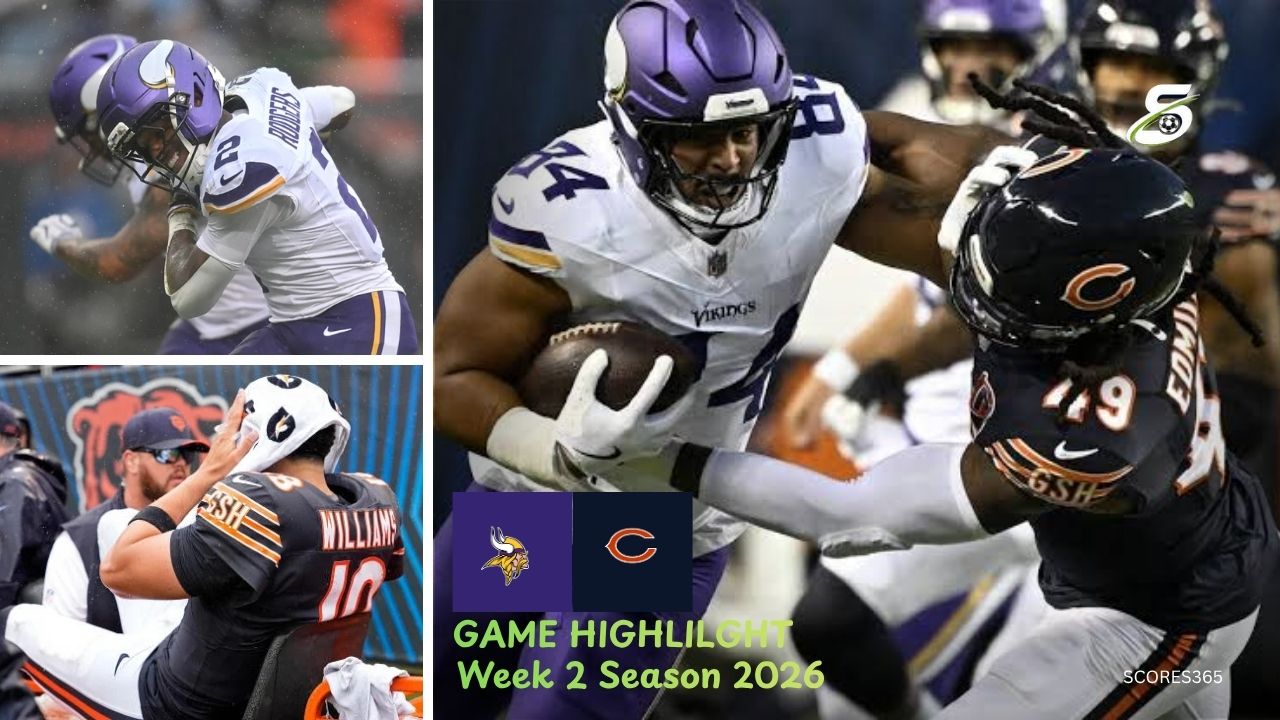
The Minnesota Vikings defeated the Chicago Bears 9-3 on September 20, 2026, at Soldier Field in Chicago. What had looked like a potentially high-scoring NFC North matchup turned into a defensive battle played through difficult rainy conditions. Minnesota scored only field goals but did enough defensively to leave Chicago with a road victory and improve to 2-0 on the 2026 NFL season. The Bears dropped to 1-1 after being unable to find the end zone.
The game featured important performances from Carson Wentz, Aaron Jones Sr., Justin Jefferson, Will Reichard, Caleb Williams, and D’Andre Swift. Wentz finished with 143 passing yards, while Jones produced 105 rushing yards on 23 carries. Jefferson led Minnesota with 55 receiving yards. For Chicago, Williams threw for 138 yards before leaving with a right hamstring injury, while Swift contributed 99 total yards from scrimmage.
Final Score
| Team | Q1 | Q2 | Q3 | Q4 | Final |
|---|---|---|---|---|---|
| Minnesota Vikings | 3 | 3 | 0 | 3 | 9 |
| Chicago Bears | 3 | 0 | 0 | 0 | 3 |
Minnesota Vikings vs Chicago Bears
The final score reflected how difficult it was for both offenses to generate touchdowns. Minnesota scored three points in the first quarter, added another field goal in the second, and then went scoreless in the third before Reichard connected on a 39-yard kick late in the fourth quarter. Chicago answered Minnesota’s opening field goal with a 50-yard Cairo Santos field goal, but that was the only scoring play the Bears managed all afternoon.
Minnesota finished with 246 total yards, compared with 297 for Chicago, but the Vikings avoided turnovers while the Bears committed two. The Vikings also converted their late opportunities more effectively, particularly on their final scoring drive. That combination of ball security, field position and defensive execution allowed Minnesota to win despite being outgained.
Carson Wentz Passing Performance
Carson Wentz completed 11 of 20 passes for 143 yards, with no touchdowns and no interceptions. His passing numbers were modest, but the veteran quarterback delivered several important throws during Minnesota’s late fourth-quarter possession. Wentz connected with Jordan Addison for a 15-yard third-down conversion and later found T.J. Hockenson for 19 yards, helping the Vikings keep the clock moving.
This was Wentz’s 100th career start, and he became the starting quarterback for a Vikings team that opened the season 2-0. His performance was not built around a high volume of passing attempts or touchdown production. Instead, Minnesota leaned heavily on its running game and defense while Wentz made enough timely throws to keep drives alive and help the team control the closing minutes.
Aaron Jones Sr. Leads Vikings Rushing Attack
Aaron Jones Sr. was Minnesota’s leading rusher, carrying the ball 23 times for 105 yards. His 20-yard longest run helped give the Vikings a consistent rushing option in conditions that made passing more difficult. Jones averaged approximately 4.6 yards per carry and accounted for a significant portion of Minnesota’s 119 rushing yards.
Jones’ performance was particularly important because the Vikings did not score a touchdown. By repeatedly gaining positive yardage on the ground, Minnesota was able to sustain possessions and put itself in position for field-goal attempts. The running game also helped take pressure away from Wentz and allowed Minnesota to play a more conservative style as the game progressed.
Justin Jefferson Receiving Stats
Justin Jefferson finished as Minnesota’s leading receiver with 3 receptions for 55 yards, including a long catch of 30 yards. His early connection with Wentz immediately demonstrated the possibility of explosive plays, as the Vikings quarterback found Jefferson for a 30-yard completion during the opening drive.
Jefferson’s overall reception total was limited, but his 55 yards gave Minnesota an important downfield threat in a game where offensive production was scarce. T.J. Hockenson added three receptions for 29 yards, while Josh Oliver recorded one catch for 24 yards. Jordan Addison also contributed two receptions for 21 yards, including his important third-down catch on Minnesota’s final scoring drive.
Caleb Williams and Bears Passing Stats
Caleb Williams completed 15 of 26 passes for 138 yards, with no touchdowns and one interception. He also rushed five times for 42 yards, making him one of Chicago’s most productive offensive players despite the Vikings’ defensive pressure. Williams’ passing production was considerably lower than what the Bears had produced in their high-scoring Week 1 performance.
Williams’ afternoon ended early after he suffered a right hamstring injury while scrambling toward the end zone in the fourth quarter. Tyson Bagent subsequently took over and attempted to lead Chicago on a late comeback drive. Bagent moved the Bears into Minnesota territory, but Dallas Turner sacked him on the final play to officially close out the Vikings’ 9-3 victory.
D’Andre Swift Leads Bears Skill Players
D’Andre Swift was one of Chicago’s most productive offensive players, rushing 16 times for 45 yards and catching five passes for 54 yards. His 99 total yards from scrimmage made him an important part of the Bears’ offense, particularly as Minnesota limited Chicago’s passing game and prevented the Bears from reaching the end zone.
Swift’s receiving production was especially useful because Chicago struggled to create consistent explosive plays through the air. Rome Odunze added three receptions for 43 yards, while Kalif Raymond caught five passes for 40 yards. Kyle Monangai contributed 47 rushing yards on 10 carries, giving Chicago another useful option in the ground game.
Minnesota Vikings vs Chicago Bears Team Stats
The team statistics show an unusual game because Chicago actually finished with more total yardage. The Bears recorded 297 total yards on 70 offensive plays, while Minnesota generated 246 yards on 51 plays. Chicago also held the ball for 32:41 compared with Minnesota’s 27:19, showing that the Vikings did not dominate the game through possession or overall offensive volume.
The major difference came in turnovers and scoring efficiency. Minnesota committed zero turnovers, while Chicago committed two. The Bears also went 0-for-3 in the red zone, while Minnesota went 0-for-1. Those missed opportunities were decisive because the Bears reached positions where touchdowns could have changed the game but failed to finish those possessions.
| Team Stat | Vikings | Bears |
|---|---|---|
| Final Score | 9 | 3 |
| Total Yards | 246 | 297 |
| Plays | 51 | 70 |
| Yards Per Play | 4.8 | 4.2 |
| Rushing Attempts | 28 | 31 |
| Time of Possession | 27:19 | 32:41 |
| Turnovers | 0 | 2 |
| Penalties | 3-25 | 8-58 |
| Red Zone | 0-1 | 0-3 |
Vikings Defense Makes the Difference
Minnesota’s defense was the biggest reason the Vikings were able to win without scoring a touchdown. The unit recorded four sacks, with Dallas Turner producing two, while Blake Cashman and Andrew Van Ginkel each added a sack. Byron Murphy Jr. also intercepted Williams, giving Minnesota one of its two defensive takeaways.
The defensive performance became even more important late in the fourth quarter. After Williams exited, Bagent moved Chicago toward Minnesota territory and appeared to give the Bears a final opportunity to tie the game. However, the Vikings defense held firm, and Turner delivered the final sack as the clock expired. Minnesota therefore preserved the six-point lead without allowing Chicago to attempt another scoring play.
Will Reichard’s Field Goals Decide the Game
Minnesota kicker Will Reichard converted all three of his field-goal attempts, connecting from 35, 49 and 39 yards. His 39-yard field goal with 1:09 remaining in the fourth quarter extended Minnesota’s advantage from 6-3 to 9-3 and proved to be the final scoring play of the afternoon.
Chicago’s only points came from Cairo Santos, who made a 50-yard field goal in the first quarter. With no touchdowns scored by either team, the kicking game became central to the final result. Reichard’s three successful attempts gave Minnesota all nine of its points and provided the margin the Vikings needed to escape Soldier Field with the win.
Quarter-by-Quarter Scoring Summary
The Vikings opened the scoring with Reichard’s 35-yard field goal in the first quarter. Chicago responded with Santos’ 50-yard field goal, leaving the game tied 3-3 after the first period. Minnesota then regained the lead in the second quarter when Reichard converted from 49 yards, giving the Vikings a 6-3 advantage at halftime.
Neither team scored in the third quarter, and Chicago remained within one possession entering the final period. Minnesota eventually extended its lead with Reichard’s 39-yard field goal with 1:09 remaining. The Bears’ final possession ended with Turner’s sack of Bagent, leaving the final score at 9-3.
| Quarter | Vikings | Bears |
|---|---|---|
| 1st | 3 | 3 |
| 2nd | 3 | 0 |
| 3rd | 0 | 0 |
| 4th | 3 | 0 |
| Final | 9 | 3 |
Complete Player Stats Breakdown
The Vikings’ offensive leaders were Wentz through the air, Jones on the ground and Jefferson as a receiver. Wentz’s 143 passing yards led the game, Jones’ 105 rushing yards were the highest rushing total, and Jefferson’s 55 receiving yards topped Minnesota’s receiving group. Hockenson, Addison and Oliver provided additional contributions during key possessions.
For Chicago, Williams finished with 192 total yards when his 138 passing yards and 42 rushing yards are combined, although his day ended before the final whistle. Bagent added 54 passing yards, Swift contributed 99 scrimmage yards, and Odunze and Raymond also made several catches. Despite those individual contributions, Chicago’s offense could not convert its opportunities into touchdowns.
Key Minnesota Player Stats
| Player | Category | Stat |
|---|---|---|
| Carson Wentz | Passing | 11/20, 143 yards |
| Aaron Jones Sr. | Rushing | 23 carries, 105 yards |
| Justin Jefferson | Receiving | 3 receptions, 55 yards |
| T.J. Hockenson | Receiving | 3 receptions, 29 yards |
| Jordan Addison | Receiving | 2 receptions, 21 yards |
| Will Reichard | Kicking | 3/3 FG |
Key Chicago Player Stats
| Player | Category | Stat |
|---|---|---|
| Caleb Williams | Passing | 15/26, 138 yards, 1 INT |
| Tyson Bagent | Passing | 5/9, 54 yards |
| D’Andre Swift | Rushing | 16 carries, 45 yards |
| Kyle Monangai | Rushing | 10 carries, 47 yards |
| D’Andre Swift | Receiving | 5 receptions, 54 yards |
| Rome Odunze | Receiving | 3 receptions, 43 yards |
| Kalif Raymond | Receiving | 5 receptions, 40 yards |
Final Takeaway From Vikings vs Bears
The Minnesota Vikings vs Chicago Bears Match Player Stats tell the story of a game dominated by defense, field goals and missed offensive opportunities. Minnesota did not record a touchdown and was outgained by Chicago, but the Vikings protected the football, generated two turnovers and received a 105-yard rushing performance from Aaron Jones. Will Reichard’s three field goals supplied every point Minnesota needed.
Chicago had enough yardage and possession to remain competitive, but its inability to finish drives ultimately determined the result. The Bears went scoreless after the first quarter, committed two turnovers and failed on all three red-zone opportunities. Williams’ late hamstring injury added another major storyline, while Minnesota’s defense closed the game with a decisive sack from Dallas Turner. The 9-3 result moved Minnesota to 2-0 and Chicago to 1-1
Explore More SCORES365