

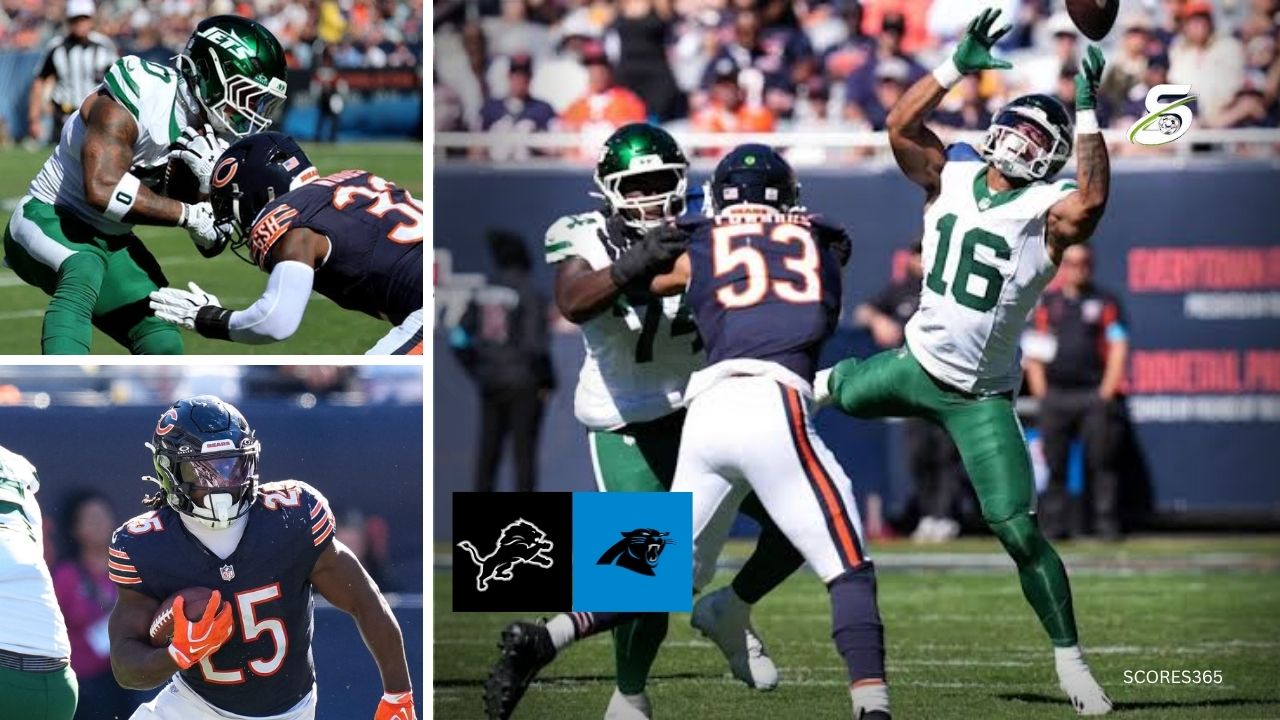
The Chicago Bears defeated the New York Jets 23-12 on October 4, 2026, at Soldier Field in Chicago during Week 4 of the NFL regular season. Chicago controlled the game from the opening quarter, using a powerful rushing attack, efficient passing and extended possessions to keep the Jets offense off the field. Kyle Monangai delivered 146 rushing yards and two touchdowns on 30 carries, while quarterback Tyson Bagent completed 25 of 34 passes for 268 yards. The Bears finished with 492 total yards and 34 first downs, producing one of their most statistically dominant performances of the early season.
The New York Jets struggled to generate consistent offense throughout the afternoon. Geno Smith completed 8 of 15 passes for 119 yards and one touchdown, while Braelon Allen led the Jets rushing attack with 59 yards on 14 carries. Isaiah Williams provided New York’s biggest offensive play with a 58-yard touchdown reception in the fourth quarter, but the Jets could not build on it. Chicago controlled possession for 42:45 compared with only 17:15 for New York and limited the Jets to 157 total yards. The result moved Chicago to 3-1 while New York fell to 1-3.
Final Score and Match Details
| Match Detail | New York Jets | Chicago Bears |
|---|---|---|
| Final Score | 12 | 23 |
| Date | October 4, 2026 | October 4, 2026 |
| Week | Week 4 | Week 4 |
| Venue | Soldier Field | Soldier Field |
| Record After Game | 1-3 | 3-1 |
| Total Yards | 157 | 492 |
| First Downs | 7 | 34 |
| Time of Possession | 17:15 | 42:45 |
Chicago entered the game looking to continue its strong start to the 2026 season, while New York needed a response after dropping its previous two games. The Bears established control through their rushing attack and long offensive possessions. After a scoreless opening stretch that included a fourth-down stop near the goal line, Chicago eventually reached the end zone through Monangai late in the first quarter. New York answered with a field goal, but Chicago added two more field goals before halftime and entered the break with a 13-3 advantage.
Chicago’s statistical advantage was substantial. The Bears ran 89 offensive plays compared with just 32 by the Jets and never punted. Their 34 first downs represented a major difference in sustaining drives, while their 42:45 time of possession repeatedly prevented New York from establishing offensive rhythm. The Jets also converted none of their seven third-down attempts. Chicago, meanwhile, converted seven of 15 third downs and consistently kept its offense on the field.
Quarter-by-Quarter Breakdown
The Bears scored the only touchdown of the first quarter when Monangai finished a drive with a one-yard rushing score. New York responded with a 36-yard field goal from Jason Sanders early in the second quarter, but Chicago continued to move the ball. Cairo Santos connected from 30 yards twice during the second quarter, giving the Bears a 13-3 halftime lead. The Jets had opportunities to stay closer, but their offense could not consistently move beyond midfield or create touchdown opportunities in the red zone.
| Quarter | Jets | Bears |
|---|---|---|
| Q1 | 0 | 7 |
| Q2 | 3 | 6 |
| Q3 | 3 | 7 |
| Q4 | 6 | 3 |
| Final | 12 | 23 |
New York pulled within seven points when Sanders made another field goal during the third quarter, but Chicago responded with a 72-yard drive that ended with Monangai’s second touchdown. That score restored a 20-6 advantage. The Jets finally produced their only touchdown with a 58-yard Smith-to-Isaiah Williams connection early in the fourth quarter. However, Sanders missed the extra point, leaving New York down 20-12. Chicago added another field goal and then controlled the closing minutes to secure the victory.
Tyson Bagent Passing Performance
Tyson Bagent delivered an efficient performance in his first start since 2023. He completed 25 of 34 attempts for 268 yards and threw one interception. His completion percentage was approximately 73.5%, allowing Chicago to maintain a steady passing threat while relying heavily on the running game. Bagent did not need to throw a touchdown because the Bears consistently generated points through their rushing attack and field goals. His 268 passing yards were also a career high, according to the Bears’ statistical recap.
| Player | Comp/Att | Passing Yards | TD | INT |
|---|---|---|---|---|
| Tyson Bagent | 25/34 | 268 | 0 | 1 |
Bagent started the game by completing his first five passes and helped Chicago establish control with quick completions to Rome Odunze and Luther Burden III. The Bears opened the game with a 14-play, 93-yard drive, although the possession ended without points after New York stopped D’Andre Swift near the goal line. Chicago continued using Bagent in a balanced offense, with 54 rushing attempts and 34 passing attempts. That distribution allowed the Bears to control the clock while limiting the number of possessions available to New York.
Geno Smith Passing Performance
Geno Smith completed 8 of 15 passes for 119 yards and one touchdown. His most productive completion came in the fourth quarter when he connected with Isaiah Williams for a 58-yard touchdown. That play gave New York some momentum and reduced the deficit to 20-12 after the missed extra point. Smith also avoided an interception, but the Jets offense did not generate enough passing volume or first downs to seriously challenge Chicago’s lead during most of the game.
| Player | Comp/Att | Passing Yards | TD | INT |
|---|---|---|---|---|
| Geno Smith | 8/15 | 119 | 1 | 0 |
Smith was pressured by the overall game situation because the Jets repeatedly faced long stretches without possession. New York ran only 32 offensive plays, compared with 89 for Chicago. The Jets also finished 0-for-7 on third down, meaning their offense repeatedly failed to extend drives. Smith’s 119 passing yards were therefore not enough to compensate for the team’s limited opportunities. The long touchdown to Williams was the major passing highlight, but it came too late to change the outcome.
Explore Los Angeles Rams vs Philadelphia Eagles Match Player Stats Final Score and Key Performances
Bears Rushing and Receiving Stats
Kyle Monangai was the central figure in Chicago’s offensive production. He carried 30 times for 146 yards, averaging 4.9 yards per attempt, and scored two touchdowns. His workload was a career high, and his two rushing touchdowns represented his first multiple-touchdown game. D’Andre Swift added 58 yards on 15 carries, while Roschon Johnson contributed 16 yards on four attempts. Chicago finished with 232 rushing yards, giving the Bears a strong foundation for their long drives.
| Bears Player | Rushing | Receiving |
|---|---|---|
| Kyle Monangai | 30-146, 2 TD | 1-4 |
| D’Andre Swift | 15-58 | 2-16 |
| Roschon Johnson | 4-16 | 1-7 |
| Rome Odunze | — | 6-94 |
| Luther Burden III | 1-11 | 4-63 |
| Colston Loveland | — | 6-57 |
Rome Odunze led the Bears in receiving with six catches for 94 yards, including a long reception of 37 yards. Luther Burden III added four receptions for 63 yards, while Colston Loveland caught six passes for 57 yards. The receiving production complemented the running game rather than replacing it. Chicago’s offense consistently moved the chains, and its ability to use both short completions and the rushing attack helped produce 34 first downs.
Jets Rushing and Receiving Stats
New York’s rushing attack was led by Braelon Allen, who carried 14 times for 59 yards. The Jets lacked the sustained rushing production needed to keep their offense on the field against Chicago’s defense. Their limited rushing output also placed greater pressure on Smith, but the quarterback finished with only 15 passing attempts. The Jets’ overall offensive output remained low because Chicago prevented New York from producing long drives and held the team to only seven first downs.
| Jets Player | Rushing | Receiving |
|---|---|---|
| Braelon Allen | 14-59 | — |
| Isaiah Williams | — | 2-73, 1 TD |
| Garrett Wilson | — | 3-27 |
| Jelani Woods | — | 1-11 |
Isaiah Williams provided the Jets’ biggest offensive highlight. His two receptions totaled 73 yards, including the 58-yard touchdown that gave New York a late chance to reduce Chicago’s lead. Garrett Wilson caught three passes for 27 yards, but the Jets could not get enough production from their primary offensive weapons. Williams’ explosive touchdown was important statistically, yet Chicago immediately regained control by extending its possession and forcing the Jets to spend most of the remaining game defending rather than attacking.
Team Statistics and Offensive Efficiency
The team statistics show just how thoroughly Chicago controlled the game. The Bears generated 492 total yards, compared with 157 for New York, a difference of 335 yards. Chicago also produced 34 first downs against seven for the Jets and ran 89 offensive plays. New York ran only 32. The Bears averaged 5.5 yards per play, while the Jets averaged 4.9, but the much larger number of plays created an enormous difference in total production.
| Team Statistic | Jets | Bears |
|---|---|---|
| Total Yards | 157 | 492 |
| Plays | 32 | 89 |
| Yards Per Play | 4.9 | 5.5 |
| Rushing Attempts | 14 | 54 |
| First Downs | 7 | 34 |
| Third Down | 0/7 | 7/15 |
| Time of Possession | 17:15 | 42:45 |
| Turnovers | 0 | 2 |
| Penalties | 12 | 4 |
Chicago’s possession advantage was equally important. The Bears held the ball for 42 minutes and 45 seconds, leaving New York with only 17 minutes and 15 seconds. Chicago also did not punt, while the Jets struggled to sustain drives. The Bears committed two turnovers, including Bagent’s interception, but New York could not turn those opportunities into enough points. Chicago’s ability to recover from those mistakes while continuing to dominate possession was a major factor in the final result.
Defensive Plays and Key Performances
The Chicago defense held the Jets to only one touchdown and seven first downs. New York finished 0-for-7 on third down, which prevented the offense from sustaining pressure on the Bears. Chicago also recorded three sacks and repeatedly forced New York into short possessions. The defense benefited from an offense that controlled the clock, but its own execution remained important because the Jets had opportunities to score after Chicago turnovers. Those chances did not produce enough points to threaten the Bears’ lead.
New York’s defense did produce one notable statistical achievement. Safety Minkah Fitzpatrick intercepted Bagent in the second quarter, ending the Jets’ lengthy interception drought. According to Reuters, the pick ended a 21-game stretch without a Jets interception and marked the team’s first interception since January 5, 2025. However, three other potential interceptions were nullified by penalties, limiting the overall impact of New York’s takeaway opportunities.
Turning Points of the Game
One early turning point came after Chicago drove 93 yards on its opening possession but failed to score when the Jets stopped Swift on fourth-and-goal from the 1-yard line. Instead of allowing that failure to change the game, Chicago returned to the ground attack and eventually scored on its next possession. Monangai’s one-yard touchdown late in the first quarter established the Bears’ physical approach and gave Chicago a lead it would not surrender.
The biggest offensive turning point came in the third quarter when Monangai finished a nine-play, 72-yard drive with a five-yard touchdown run. That score pushed Chicago’s advantage to 20-6 after New York had pulled within seven. The Jets responded with Smith’s 58-yard touchdown pass to Williams, but the missed extra point kept the deficit at eight. Chicago then controlled the final stretch and closed the game without allowing New York to mount another meaningful scoring drive.
Final Analysis
The New York Jets vs Chicago Bears Match Player Stats demonstrate a game dominated by Chicago’s control of possession and offensive volume. Monangai’s 146 rushing yards and two touchdowns provided the foundation, while Bagent’s 268 passing yards kept the Jets defense from concentrating solely on the run. Odunze’s 94 receiving yards added another important element. Chicago’s 492 total yards and 34 first downs were the clearest indicators of how effectively the offense sustained drives throughout the afternoon.
For New York, the statistical highlights were limited to Smith’s 119 passing yards, Allen’s 59 rushing yards, Williams’ 73 receiving yards and Fitzpatrick’s interception. The Jets’ 157 total yards and seven first downs tell the larger story. Their 0-for-7 third-down performance and only 17:15 of possession made it difficult to keep pace. Chicago’s 23-12 victory was therefore supported by a major advantage in offensive snaps, rushing production, first downs and clock control.
Conclusion
The Chicago Bears produced a convincing 23-12 victory over the New York Jets by controlling nearly every major team statistic. Chicago finished with 492 yards, 34 first downs, 89 offensive plays and 42:45 of possession. Kyle Monangai carried the offense with 146 rushing yards and two touchdowns, while Tyson Bagent provided 268 passing yards in his first start since 2023. The Bears’ ability to combine their rushing attack with efficient passing allowed them to control the game without relying on explosive passing touchdowns.
The Jets struggled to create offensive rhythm and finished with only 157 total yards and seven first downs. Geno Smith’s 58-yard touchdown connection with Isaiah Williams provided a late spark, while Minkah Fitzpatrick’s interception ended New York’s long drought without a pick. Those moments were not enough to overcome Chicago’s sustained control. The Bears improved to 3-1 with the win, while the Jets dropped to 1-3 after their third consecutive defeat.
Explore More SCORES365